Harvard receives first LBC Core certifications for 3 major sustainable renovations
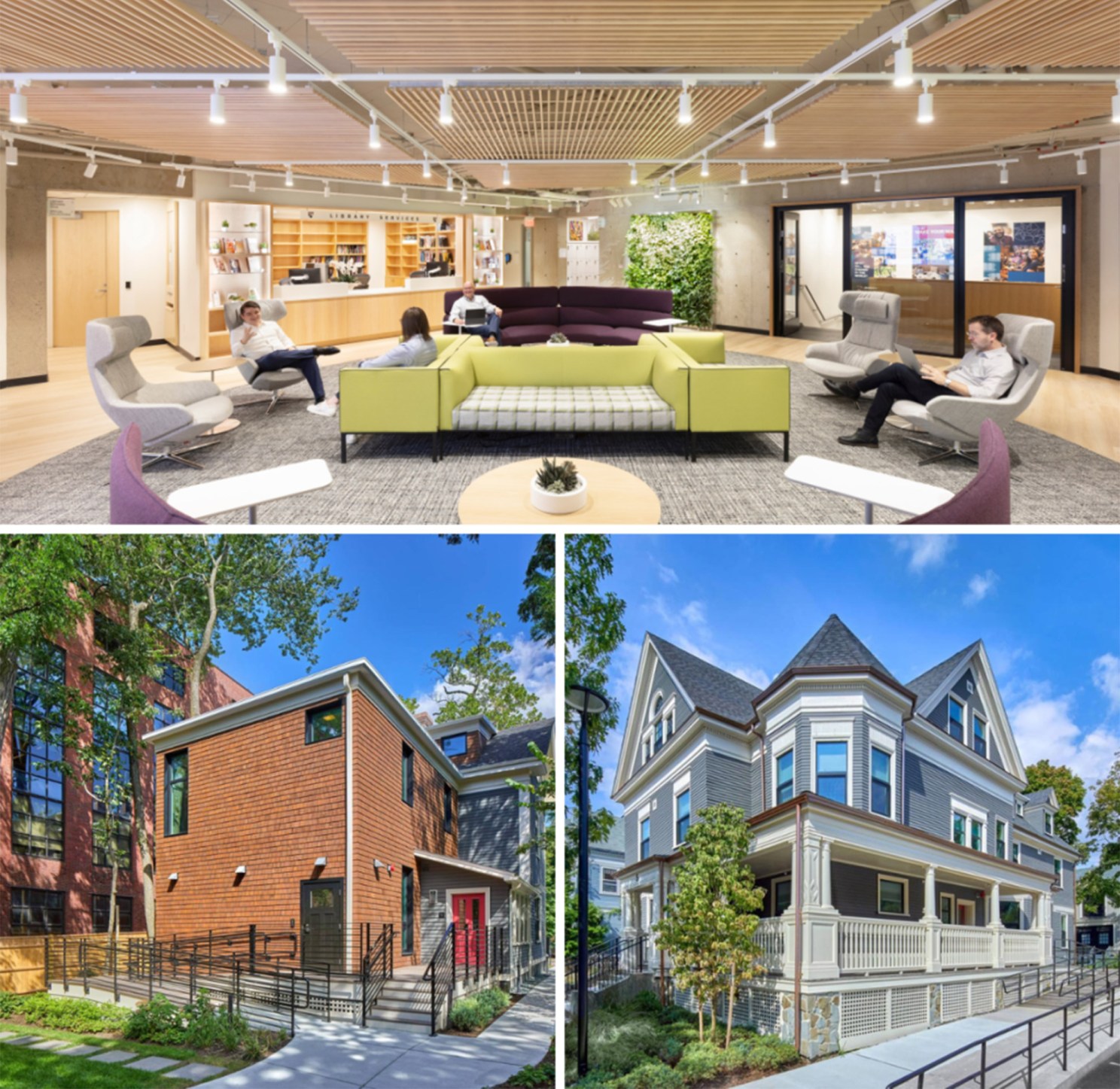
Living Building Challenge Core Green Building Certification projects: Second floor of the Gutman Library at the Harvard Graduate School of Education (top), 13 Kirkland St. (bottom left), and 5 Sacramento St. (bottom right).
Photos (top) by Bearwalk Cinema, (bottom left and right) by David Kurtis Photography
There are more than 380 buildings on Harvard’s Cambridge campus, many over 100 years old. Ensuring these historic buildings preserve their architectural character, while meeting the ever-changing needs of the campus, and the University’s aggressive sustainability goals has long been a challenge. With the recent approval of its first three projects under Living Future’s rigorous Living Building Challenge Core Green Building Certification, Harvard not only received recognition for its restoration efforts, but marked the success of three pilot renovations that emphasized holistic sustainability — paving the way to scale this work to future campus renovations.
Harvard received LBC Core certifications for two historic gut renovations of Harvard University Housing & Real Estate residential buildings at 13 Kirkland Street and 5 Sacramento Street, and an interior renovation that transformed the second floor at the Harvard Graduate School of Education’s Gutman Library.
“Harvard is pursuing LBC Core because faculty and staff advisers agreed it’s holistic, demonstrating that leadership on climate, health and resiliency can be achieved together,” said Heather Henriksen, Harvard’s chief sustainability officer. “Paired with HHBA’s removal of toxic chemical classes from everyday products, it ensures spaces aren’t just efficient, but genuinely healthier for everyone, as healthier supply chains benefit all.”
With the goal of creating more housing for Harvard affiliates on campus, the gut renovations of 13 Kirkland Place and 5 Sacramento Street, built in 1856 and 1881, paired energy and health improvements with careful historic preservation. Beyond LBC Core certifications, the two properties are the first multi-family projects globally to achieve Passive House Institute US (PHIUS) Core Revive 2021 certification. Project teams preserved historic exteriors and reused materials to reduce embodied carbon, earning 2025 Awards for Excellence in Historic Preservation and Sustainable Living from Cambridge’s Historical Commission.
“We’re committed to meeting the highest available third-party standards and creating holistically sustainable spaces whenever possible, given competing priorities,” said Justin Stratman, HUHRE managing director. “These projects show we can respect Harvard’s historic fabric while creating homes that are healthier, far more efficient, and ready for a fossil fuel-free future.”
Both residential buildings reduced energy use well beyond LBC Core’s requirement of 50 through high-efficiency energy recovery and heat pumps for heating, cooling and hot water. Low-flow fixtures, water-efficient appliances, and irrigation-free landscape reduced potable water use more than 50 percent. The projects met HHBA standards for all interior product categories and enhanced indoor air quality.
The outdoor landscape design is climate-resilient and ecologically rich while encouraging walking, cycling, and connections to nature, art, and community. Soil amendments, on-site rainwater infiltration, and stormwater management work alongside tree preservation, pollinator gardens, and biodiverse, drought-tolerant plantings, supporting resilience and habitat.
While newer than the Victorian-era buildings at Kirkland and Sacramento streets, the architecturally significant Gutman Library needed to transform the 19,000-square-foot second floor to integrate health, sustainability, and community. The renovated space unites student services, library functions, and collaborative workspaces, and marks the first-ever higher education project to achieve LBC Core for an interior renovation. Biophilic design strategies include a plant wall, daylight access, natural wood finishes, plus improved wayfinding and accessibility.
“The renovation is a terrific moment in overall campus development and another major step in transforming Gutman to better meet our community’s evolving needs,” said Jason Carlson, HGSE Chief of Operations. “We’re excited that we successfully created a student-centric hub that enhances the student experience, promotes community connections, and reflects our health and sustainability commitments.”
The Gutman project operates with low temperature hot water and significant operational and embodied carbon reductions. Advanced controls, demand control ventilation, and sensored LED lighting all lower energy use. Mechanical upgrades increase fresh air and filtration for better indoor air quality, while efficient, low-flow fixtures cut water use significantly.
Gutman achieved HHBA standards for all categories. Reusing ceilings, floors, furniture, and partitions — and careful selection of low-carbon ceilings, carpets, and gypsum products — reduced embodied carbon 56 percent compared to a conventional project.
The three LBC Core certifications symbolize Harvard’s commitment to its holistic Sustainable Building Standards, and lessons from these pilots are informing seven additional projects targeting LBC Core. Together, these certifications mark a significant step forward in Harvard’s decarbonization and health efforts.

 Featured series