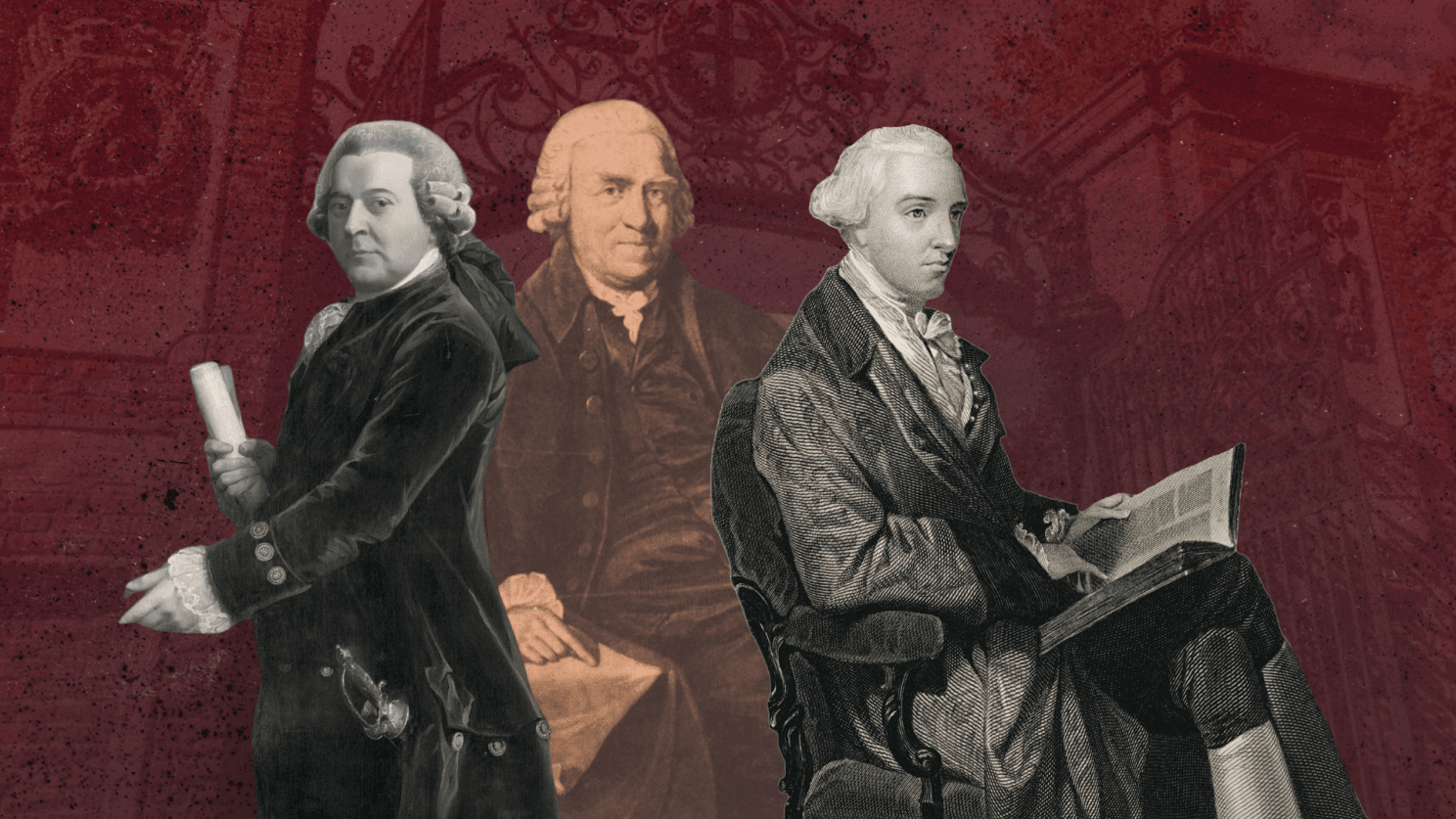
John Adams, Samuel Adams, and John Hancock were all Harvard alumni.
Illustration by Liz Zonarich
4 min read
Pushing back on British taxation helped the three Harvard alumni solidify their place in history.
Two and a half centuries ago, three Harvard graduates — Samuel Adams, John Adams, and John Hancock — played critical roles in fighting British overreach and founding America.
Samuel Adams was the first to graduate from Harvard College in 1740, adding a master’s degree three years later. At his Commencement, each graduate had to ask and answer a question, and Adams affirmatively answered, “Is it lawful to resist the supreme magistrate, if the commonwealth cannot otherwise be preserved?” foreshadowing his future work in the fight for independence.
Hancock and John Adams graduated from Harvard College a year apart, in 1754 and 1755 respectively. After graduation Hancock went on to become a very successful and respected merchant and Adams completed a master’s degree at Harvard before training as a lawyer.
All three men graduated into colonies that were questioning British authority and challenging growing taxations. Each man brought skills to help create a new solution: Hancock brought financial acumen, John Adams brought legal expertise, and Samuel Adams brought an understanding of the populace.
The Stamp Act
In 1765, without consulting colonial legislatures, the British Parliament passed the Stamp Act, which required colonists to pay a new tax on most printed materials. It produced an uproar.
John Adams, in a letter to his town’s legislature, wrote a succinct summary of how this violated colonial rights, which served as a model for other towns to oppose the act. Hancock, using his influence as a merchant, joined resistance to the act by participating in a boycott of British goods, while Samuel Adams, always popular with the citizens of Boston, fostered protest movements and public demonstrations.
After the Act was repealed, John Adams was elected as a selectman in Braintree, Massachusetts, John Hancock was elected to Massachusetts’ House of Representative, and Samuel Adams was re-elected to the same House and selected as its clerk.
The Townshend Acts
In 1767, Britain passed the Townshend Acts, establishing duties on various goods and creating a British-owned customs agency in the colonies.
When these new customs agents demanded to search Hancock’s boat for smuggled goods, he refused, which his admirers would later call the first act of physical resistance to British authority in the colonies. In the Massachusetts House, Samuel Adams created petitions and organized economic boycotts, calling for other towns and colonies to do the same. Within a year, towns in Massachusetts, Rhode Island, and Connecticut had joined.
Because of the resistance and an increase in mob violence, the British government sent more military to the colonies, which only created more tension. In 1770, when British soldiers patrolling Boston were struck with snowballs and stones, they opened fire on the crowd. Five civilians were killed and the event became known as the Boston Massacre. Representing the soldiers allowed John Adams to convey his knowledge of the law as well as his evenhandedness. Soon after the trial, when a vacancy opened up in the Massachusetts legislature, John Adams was the town’s choice to fill the vacancy.
The Tea Act
By 1773, with the passage of the Tea Act, the revolutionary writing was on the wall.
The once moderate Hancock led a Boston town meeting that resolved that anyone who supported the Tea Act was an “Enemy to America.” Samuel Adams held several town meetings, including the infamous December 16 meeting, attended by upwards of 7,000 people, which ended with a group of men marching down to Boston Harbor and dumping 342 chests of tea into the water. Samuel Adams immediately worked to publicize and defend this protest, arguing that the Tea Party was not the act of a lawless mob, but was instead a principled protest and the only remaining option that the people had to defend their constitutional rights. John Adams also applauded the destruction of the tea, calling it the “grandest event” in the history of the colonial protest movement.
Not long after the Boston Tea Party, at the Second Continental Congress, all three men proudly signed the Declaration of Independence and started the process of creating a nation that better represented the values they had fought so hard to defend.
In the years following the American Revolution, all three men would return to Harvard campus to receive honorary degrees for their work in creating the United States of America.
Current trends ‘not sustainable,’ says Fed chair, whose conversation with Harvard undergrads also touched on inflation, impact of war, independent decision-making

 Featured series