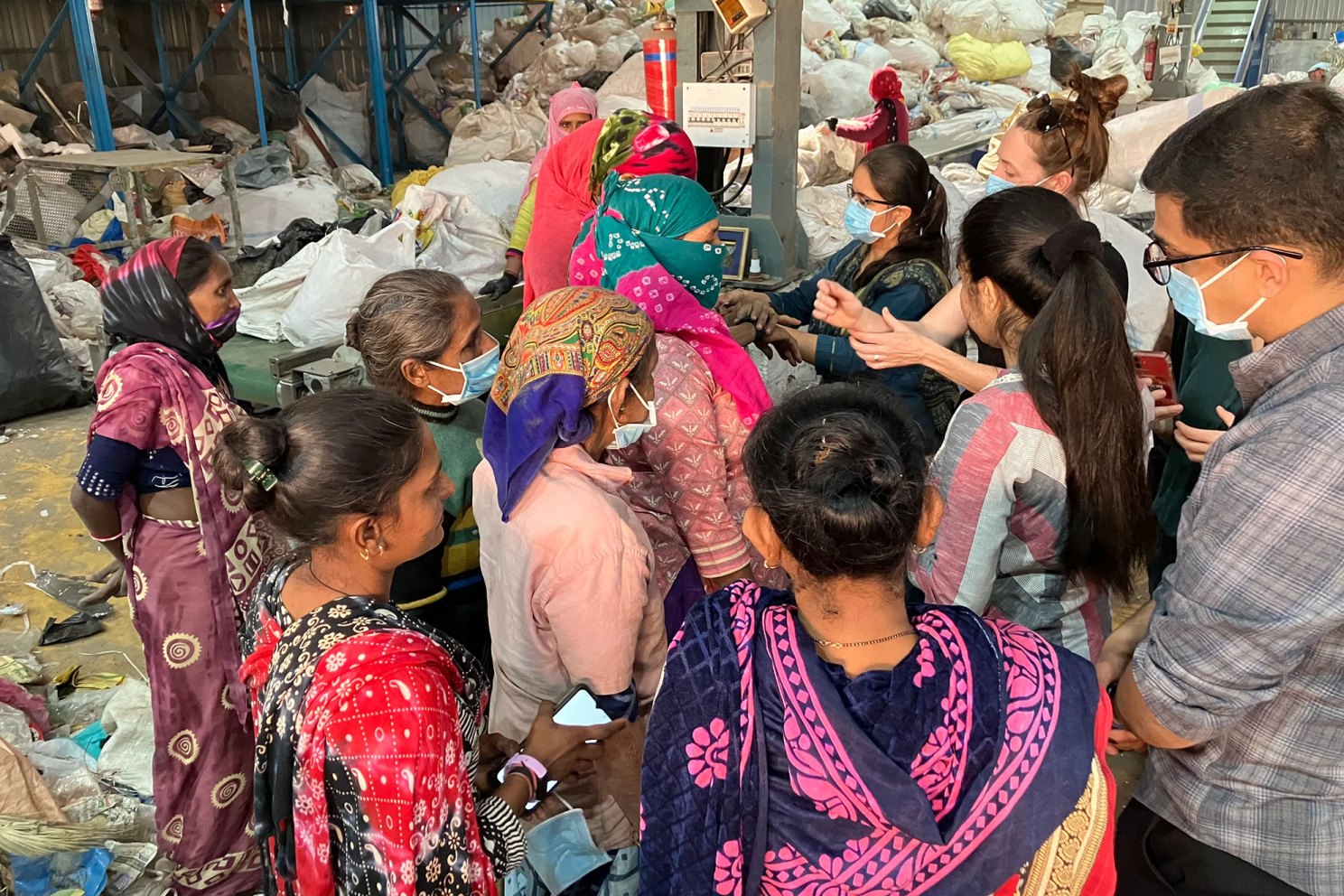
Across much of global health research, communities are frequently studied without being meaningfully involved. Instead, people are surveyed, measured, and written about from a distance. However, Satchit Balsari, associate Professor in Emergency at Harvard Medical School and Harvard T.H. Chan School of Public Health, and a Faculty Steering Committee member at the Harvard Global Health Institute, has built a career challenging that default.
Over the past two decades, his lab has followed disasters and humanitarian crises across the globe, including natural disasters, like earthquakes, floods, and hurricanes in South Asia, the U.S., and Central and South America, as well as populations displaced by wars and refugee crises in Bangladesh and the Middle East. Throughout, he has been drawn to the application of new and emerging technologies to advance health and human rights in populations in distress.
That trajectory has led him to a distinctive way of solving problems in global health — one that looks a lot like design thinking in practice. Instead of starting with a dataset or a shiny new tool, Balsari starts with the people most affected, asks what they see as the greatest gaps, and then “reverse engineers” the research and technology to serve those needs.
From data to decisions in disasters
A central pillar of Balsari’s recent work is CrisisReady, which he works alongside two long-time collaborators, Harvard Professor Caroline Buckee and Vice President of Direct Relief Andrew Schroeder. Together, they ask a basic question: how do you take cutting-edge research and convert it into tools that are valuable to communities?
Their answer is to start not with technology, but with conversations.
“CrisisReady works in very close collaborations with communities around the world, where we ensure that we understand what the missing information gaps are, and then we find the data streams that will help answer those questions,” explained Balsari.
The team is intentional about ensuring that dashboards are not used in a vacuum but shared directly with specific individuals and response agencies who can act on them. Using this model, the group has responded to over 50 disasters around the world in the last couple of years.
One powerful example comes from the recent wildfires in California. Balsari noted that the challenge in planning any rescue efforts is when people are evacuating from wildfires, but no one knows which direction they are going. The CrisisReady team was able to work with state officials in California and help them quickly determine, based on real-time mobility data, the best locations for rescue shelters and health operations.
For Balsari, this is design thinking in action: by deeply understanding a problem, testing ideas, and iterating with multiple perspectives in mind.
Climate, heat, and the hidden costs to workers
As climate change reshapes the landscape of disasters, Balsari’s work has increasingly focused on workers in extreme heat conditions. At the Harvard Global Health Institute, Balsari’s Scholarly Working Group is building on lessons learned from research that started at the Salata Institute, studying the impact of heat on workers. One of the central concerns is that much of the global response to heat risk is too narrow.
“Often when we talk about the impact of heat on workers, we measure mortality,” he said. “But leading up to mortality are often years, if not decades, of suffering and impact on morbidity and wages. How do you help communities and policymakers think through this?”
The challenge is especially stark in the informal economy.
“Our imagination is still wrapped up in guaranteeing workers shade, cooling, hydration breaks, and sanitation facilities,” he said. “We need to be so much more expansive than that. How do our economies have to be reengineered around the changing climate?”
The working group is trying to rigorously examine the evidence of these proposed protections and learn from best practices around the world, with particular attention to informal workers who lack the protection of a formal employer.

 Featured series