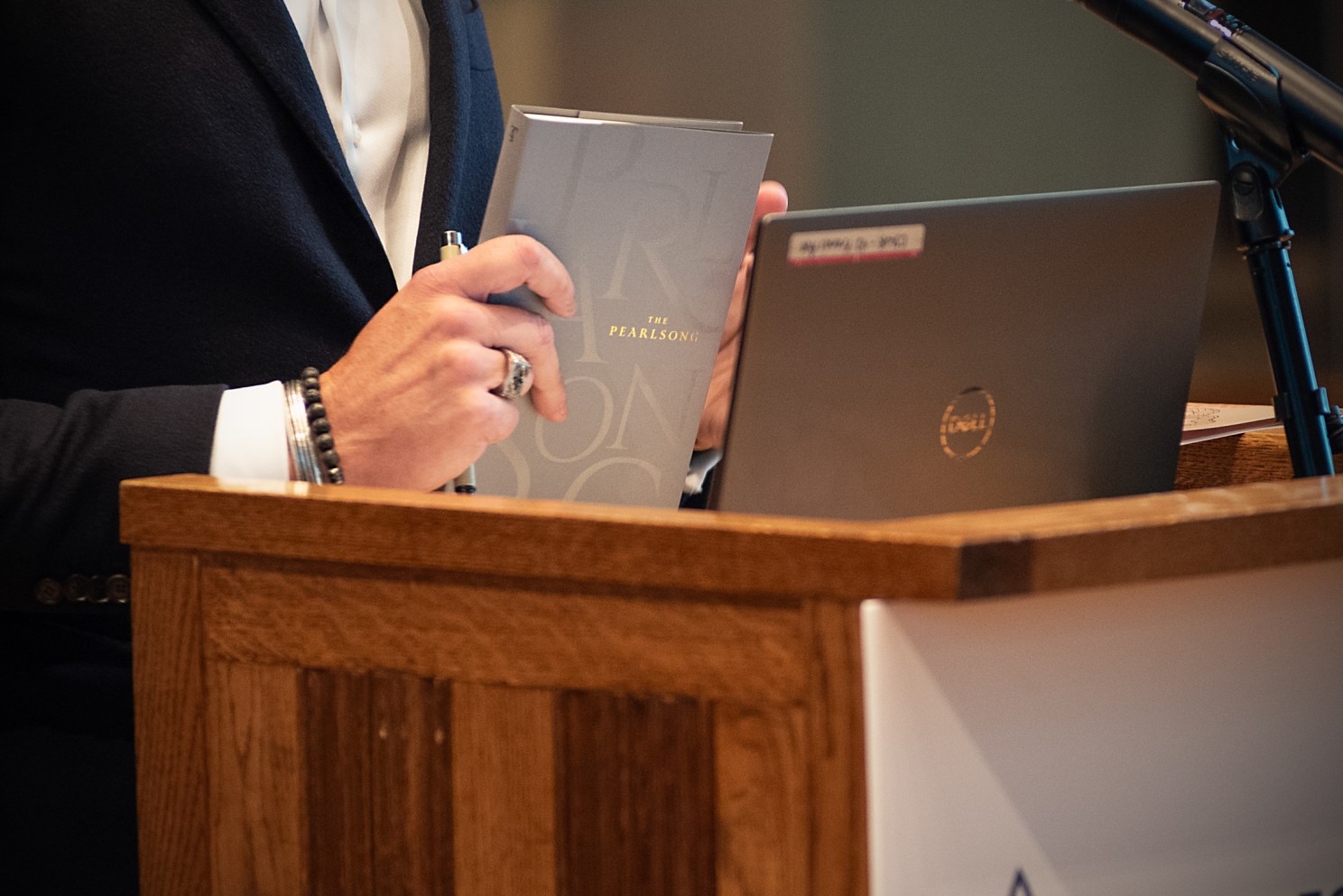
A mystical poem recounting the tale of a Parthian prince sent to Egypt by his parents to recover a sacred pearl from the clutches of a monstrous serpent is the first in a series of important visionary and mystical ancient text translations from the Center for the Study of World Religion’s (CSWR) Texts and Translations of Transcendence and Transformation (4T) initiative.
“The Pearlsong,” with its mysterious origins and fantastical story elements, is most likely an addition to the original early third-century narration about Thomas the Apostle, “The Acts of Thomas.” Also known as the “Hymn of the Pearl,” which the Apostle Thomas recites while in prison, is included in only one manuscript each of the Syriac and Greek texts. The book is the first of four planned books in the series, aiming to highlight pre-modern texts along the ancient Silk Road with scholarly translation and interpretation.
“This series has been a dream of mine for many years,” said Charles M. Stang, co-editor of the 4T series, director of the Center for the Study of World Religions, and professor of Early Christian Thought at the Harvard Divinity School. “We are offering a series that focuses on pre-modern texts, on the conviction that these ancient texts can still speak to us. But they are not always easy to approach without some interpretative aids.”
The celebratory release of “The Pearlsong” was kicked off at an event on Oct. 20 at Harvard Divinity School, featuring addresses by Stang, CSWR 4T Research Associate Adam Bremer-McCollum, “The Pearlsong” co-editor and translator, and Erin Walsh, assistant professor of New Testament and Early Christian Literature, associate faculty, Center for Middle Eastern Studies at the University of Chicago Divinity School. The evening was also punctuated by the performance of a new musical composition inspired by the poem by CSWR Visiting Scholar Jane Sheldon, an Australian American soprano, composer, and sound designer.
“The Pearlsong,” with its linguistic and textual entanglement, is just over 100 lines and recounts the prince’s magical journey, during which he faces peril and significant challenges. He falls asleep and forgets his identity and mission. A letter from his parents awakens him, gives him a spell to put the serpent to sleep so he can retrieve the pearl, and then guides him home.
“’The Pearlsong’ has its share of mysteries and enigmas that keep readers coming back,” said Bremer-McCollum. “Just as you can love a great novel or a “Star Wars” movie, this is a story that I hope, after learning about it, you will reflect on, and find themes that touch our pretty poignant times.”
The finely crafted book, published by the Center for the Study of World Religions and distributed by Harvard University Press, includes the English translation from the Syriac, with the translation and original text on facing pages. It also contains appendices and commentary on Syriac meter, the poem’s linguistic features, excerpts from the “Acts of Thomas,” and more. The volume is designed to appeal to both scholars and newcomers to ancient literature, making the text accessible for teaching and research.
“Whether one has knowledge of any of the languages referenced or not, ‘The Pearlsong’ readily adapts to the reader, inviting further inquiry,” Walsh said.
Jane Sheldon is well-known for creating highly specialized contemporary opera and art music for voice. Her composition for the release of “The Pearlsong” featured operatic voice and piano, which she at times plucked with a guitar pick, and used an electromagnetic device to hold cords.
“This task of setting ‘The Pearlsong’ pushed me to do things I don’t normally do,” she said. “In my composing, I’m trying to find sonic expression for highly specific psychological states or altered states. [The narrative] seemed to suggest an intimate presentation with me and the piano, which I use for mining sound that ornaments the story.”
Portions of the piece will be available on the CSWR website, along with a free download of the book and a link to the fine print edition.
The next volume of the 4T project, “Porphyry of Tyre on Theology and Theurgy,” is scheduled for release later this fall, followed by the third volume in the spring and the final book in the summer.
“This series is an entry, whether it’s to go into a specific language from antiquity or a specific kind of text, and learn more about the amazing literary heritage in various languages,” said Bremer-McCollum. “We are very excited about this project.”

 Featured series