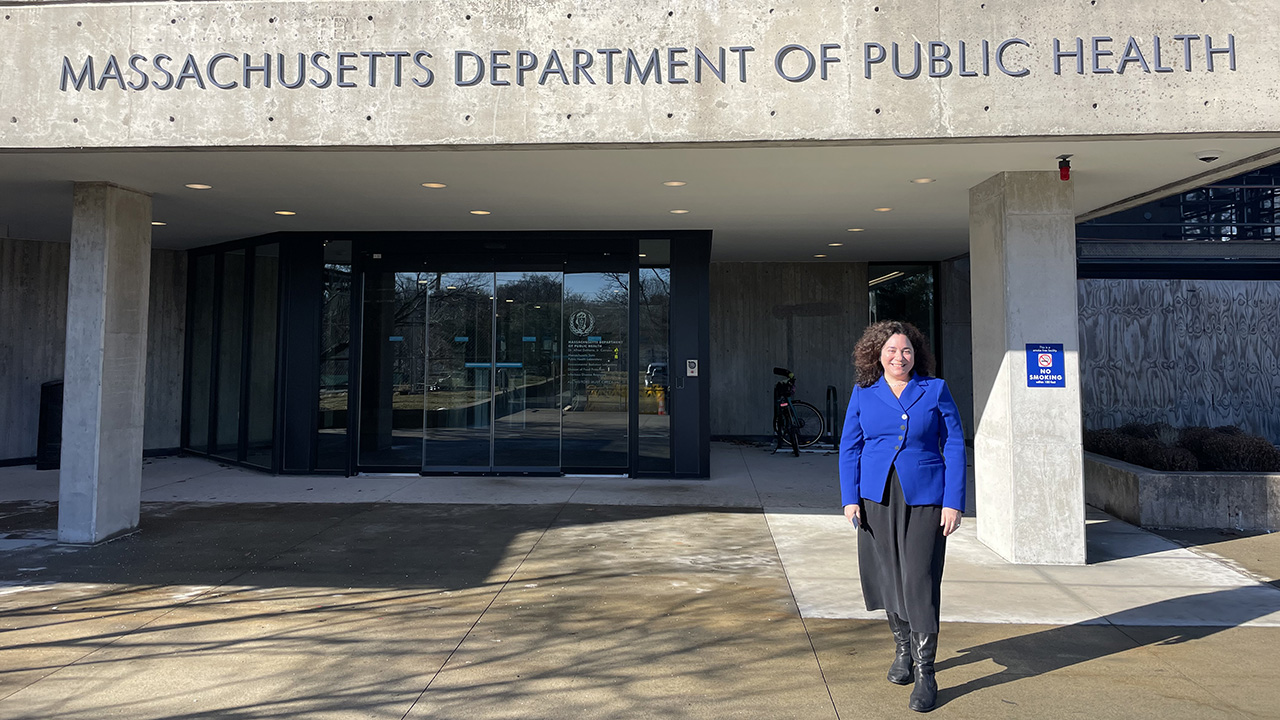
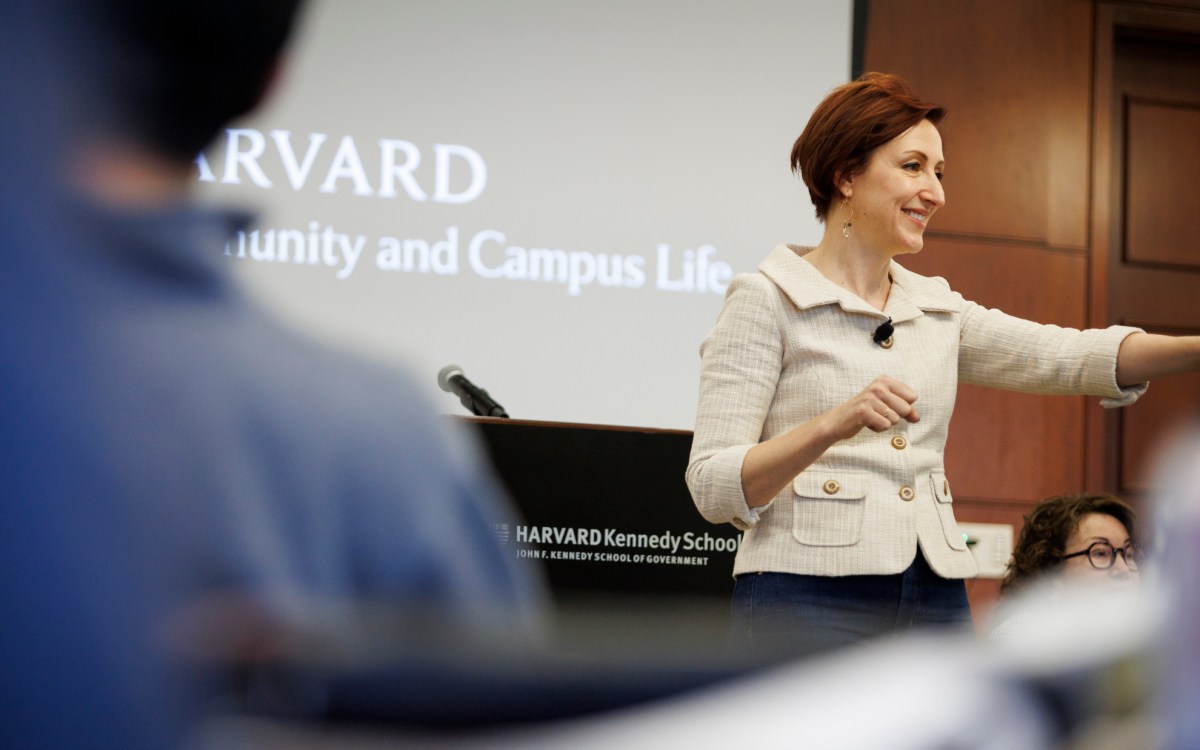
When Harvard Medical School and Mass General Hospital’s Ingrid Bassett, M.D. ’00, M.P.H. ’07, began her public service leave at the Massachusetts Department of Public Health (DPH), she set out to try something new. A long-time physician and infectious disease researcher, Bassett is a participant in Harvard Impact Labs’ Public Service Leave program — a new initiative that enables Harvard faculty to take a leave to work in a government or nonprofit organization. She went to DPH not to write papers or launch a study, but to work directly on a pressing, real-world challenge: pediatric vaccination in Massachusetts.
Bassett’s career has focused on evaluating strategies for improving engagement in HIV and TB care and prevention in South Africa, and she describes herself as a traditional researcher: “I do the study, I create the evidence, and then it’s up to someone else to take that evidence and do something with it.”
The Public Service Leave at DPH is allowing Bassett to work directly with practitioners and communities. The experience is proving transformative, both for Bassett and for the communities she is serving.
Bringing academic skills to community health Massachusetts has strong overall childhood vaccination rates, but Bassett quickly learned that statewide numbers can obscure meaningful local disparities.
“While Massachusetts has been really successful with pediatric vaccination overall,” she noted, “we definitely have pockets with low kindergarten vaccination rates.”
Her work is focused on Western Massachusetts — particularly Berkshire, Franklin, and Hampden counties — where lower vaccination rates intersect with proximity to New York state, where measles cases have been rising sharply. Communities need at least 95 percent of residents vaccinated to prevent outbreaks of measles and other diseases, and vaccination rates among kindergarteners in these counties are falling behind. Rather than assuming a single cause, Bassett is asking what local, structural, and community-specific factors might be driving the lower vaccination rates. “What might lead to a low vaccination rate in one place may be different in another,” she said.
Drawing on her global health research experience, she is applying a prevention-oriented framework that emphasizes meeting people where they are. In South Africa, her work has focused on bundling HIV prevention with other routine services. In Massachusetts, she is bringing that same thinking to pediatric vaccination.
“Prevention is especially amenable to community-based delivery,” she explained.
Importantly, WIC staff already engage families on immunization issues and see their clients multiple times a year. Bassett has been listening to the people engaged with families to learn what might encourage vaccine uptake in each of their communities, conducting qualitative outreach to WIC staff, public health nurses, school nurses, and pediatric stakeholders.
“I’m not doing research in a typical academic sense,” she emphasized. “I’m taking the skills that I’ve cultivated in my research life and really trying to think about them in a very pragmatic way.”
This approach led Bassett to focus on WIC, the Special Supplemental Nutrition Program for Women, Infants and Children that provides food benefits for low-income mothers of young children. WIC has local offices all over Massachusetts: trusted, non-clinical settings where families already receive support. By creating a map of local WIC offices and schools with low vaccination rates, she discovered substantial overlap between them.
“It turns out there’s a huge amount of overlap,” Bassett said. “The WIC offices are really right there.”
She is also exploring a collaboration with the Massachusetts Public Health Nurse Association, a key stakeholder group with members representing every community across the state, assessing whether public health nurses could help deliver vaccination education or services in WIC settings. She convened a multi-sector stakeholder meeting bringing together pediatricians, school nurses, staff from the state’s Medicaid program, and immunization partners to identify coordination gaps and opportunities where DPH support could make a difference.
As Bassett describes it, much of this work involves navigating — and intentionally leveraging — the many strengths of a large, complex organization. “The Department of Public Health is big, and part of my work has been identifying synergies across different parts of the department,” she said.

 Featured series