Featured series

Nation & World
Warning: This debate ‘could be really combustible’
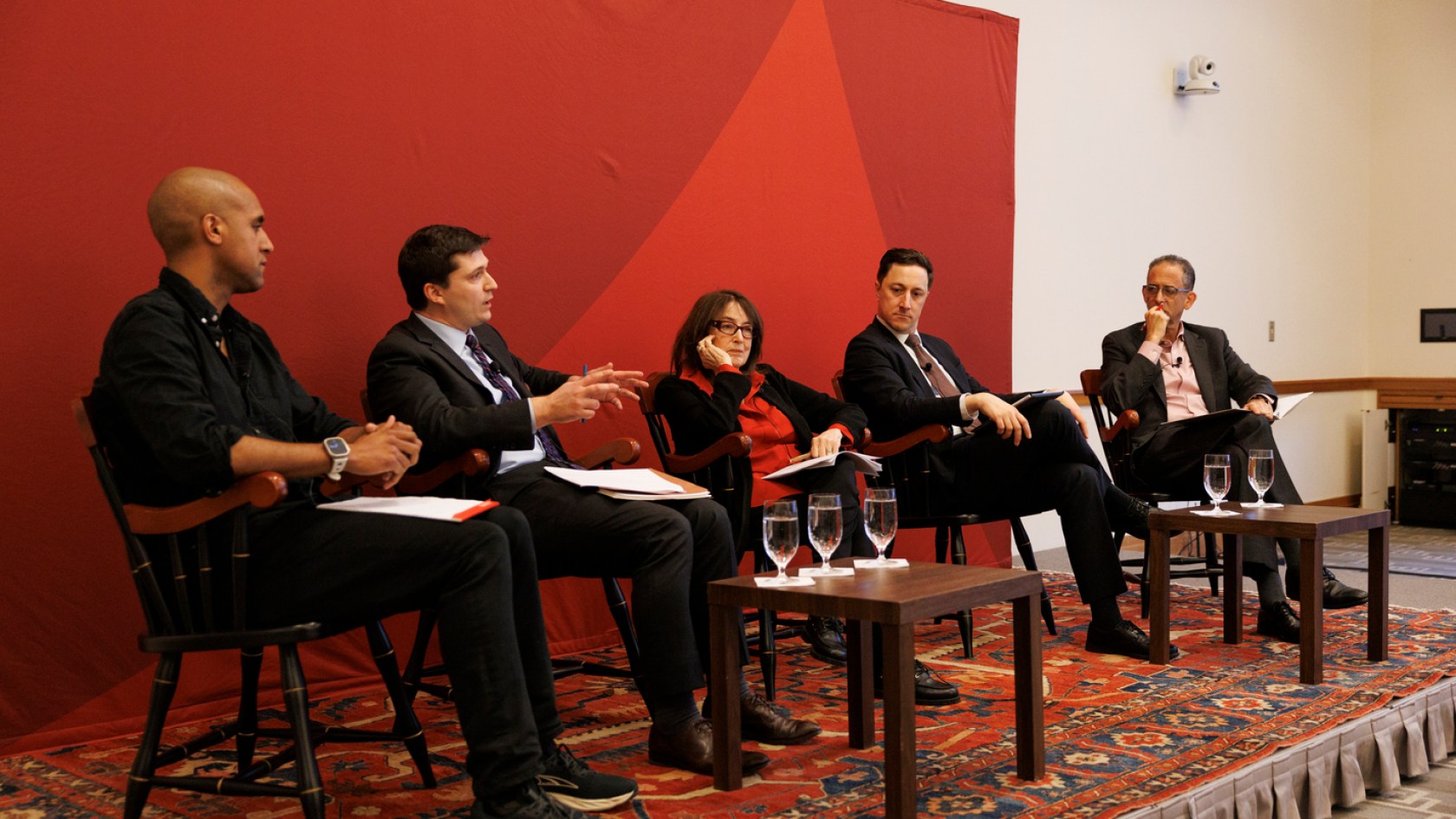
Nikolas Bowie (from left), Garrett West, Nancy Gertner, Derek Muller, and John C.P. Goldberg.
Niles Singer/Harvard Staff Photographer
Conservative and progressive law scholars get together to trade views on SCOTUS legitimacy — and prove a chatbot wrong
Having the Federalist Society and the American Constitution Society host an event together would be asking for disaster.
At least that was ChatGPT’s sentiment when Kristi Jobson, the assistant dean for admissions at Harvard Law School, asked the chatbot how to arrange campus groups for a student event. It even advised seating the traditionally conservative and progressive law societies on opposite sides of the room — otherwise the result “could be really combustible.”
American Constitution Society event chair Abbott LaPrade laughed about AI’s prediction as he introduced panelists for the recent event titled “Is the Roberts Court Legitimate?”
The talk was part of the “From Dissent to Dialogue” series, one of eight student-led projects funded by the President’s Building Bridges Fund across six graduate Schools and the College. It brought together law scholars from differing ideological perspectives to debate the provocative question about the nation’s highest court.
It was, in Law School Dean John C.P. Goldberg’s words, “exactly what was envisioned” for the fund — “getting people together who disagree to learn from each other, to see where they really agree and where they really disagree.”
In opening remarks as moderator, Goldberg introduced a distinction made by renowned former Law School Professor Richard Fallon, who died last year: the difference between legal legitimacy — the legal validity of the Court’s decision-making — and its moral legitimacy. Are the Court’s decisions just?
Given polls that show the Supreme Court’s lowest favorability rating from the public in at least 50 years, he asked whether the Court was experiencing a crisis of legitimacy.
Derek Muller, a Federalist Society invitee and professor of law at Notre Dame, said that in the sense that the court is making law, issuing decisions, and rendering judgments, “It is quite obviously legitimate.” The deeper, more fraught questions, he said, are sociological. Does the public accept the Court’s decision-making?
He said all the panelists likely believe that the Court appears bound by the Constitution and precedent. “If we say the court is illegitimate, this starts to raise very significant questions for us,” he said. “Do we have a duty to obey an illegitimate authority or even to impeach these judges because we think they are illegitimately promulgating the law? What are the steps that will be required to save the court from illegitimacy?”
Nancy Gertner, senior lecturer on law at HLS and a former judge on the U.S. District Court for the District of Massachusetts, said that legitimacy is too low a bar. “We certainly expect more of a court than that they say they’re following the law, that they’re wearing robes, that they’re in front of a flag,” she said. “We expect not every division in the court to be a partisan division. We expect that longstanding precedent is not eliminated whole.” Issues with the court need to be thought about on a fundamental level: how the country selects judges, whether they’re held to the ethical standards to which others must abide.
Addressing the Court’s public approval, Garrett West, a law professor at Yale, said he doesn’t think the Supreme Court should necessarily be driven by opinion polling. The Court is not particularly well-equipped to gauge public opinion, he said, and the public often doesn’t have strong opinions on decisions the Court is making.
If opinions of the Supreme Court fell to such a point that political actors no longer treated the Court’s opinions as legitimate, that would be a problem, he said. “I don’t think we’re quite there yet, in particular because presidents of the last two administrations have generally acquiesced in the judgments of the Supreme Court.”
When it came to the Court’s legitimacy, Nikolas Bowie, Louis D. Brandeis Professor at HLS, said it helps to have a sense of what people think the Court should be doing. He draws inspiration from the Congress of Reconstruction following the American Civil War, a body interested in the broader question of how to “reconstruct the country as a multiracial democracy in the wake of a clear breakage in the constitutional order.”
He believes that the problems that plague the Supreme Court today, and that have led to its low standing with the public, is the act of horizontal review — deciding whether laws passed by Congress are constitutional.
“The government we have now is one that appears broken, in part,” he said, “because of the laws that Congress has passed over the years to protect democracy are being invalidated or undermined by the Court,” including the Voting Rights Act, campaign finance laws, laws protecting civil servants from being fired, and laws protecting the peaceful transfer of power.
Gertner criticized the Supreme Court’s overruling of past decisions, especially since 2018. She charges some of these reversals didn’t result from new evidence and facts, but for less substantial reasons: “I just thought the other guy was wrong.”
Muller disagreed with Gertner’s characterization. He pointed to research that said the Court is overturning precedents at a much lower rate than the Warren Court (1953-1969) — though he acknowledged that a debate could be had about the significance of the precedents. He also argued that decisions to overturn federal statutes such as Roe v. Wade or Regents of the University of California v. Bakke were not “fly-by-night” decisions, but rather the conclusion of long legal campaigns that created a “robust body of doctrine” that led to their reversals.
Gertner, who served on former President Joe Biden’s commission on the Supreme Court, expressed support for traditional Court reform, saying, in response to one audience question, “I can’t think of any circumstance under which Court reform can be seen as a bad thing.”
West pushed back, asking whether she thought the Trump administration would more likely defy the Supreme Court if Biden, for example, had added six new justices to the Court during his last term. Muller joked that the Supreme Court should expand to 535 members, divided into two chambers. He said that partisan reforms were doomed to failure, though he was open to the case for age limits for justices, among others.
Bowie agreed that when thinking about reform, it’s important to think of what you’re reforming the Court to do. “What matters for me,” he said, “is a democracy.”