Featured series

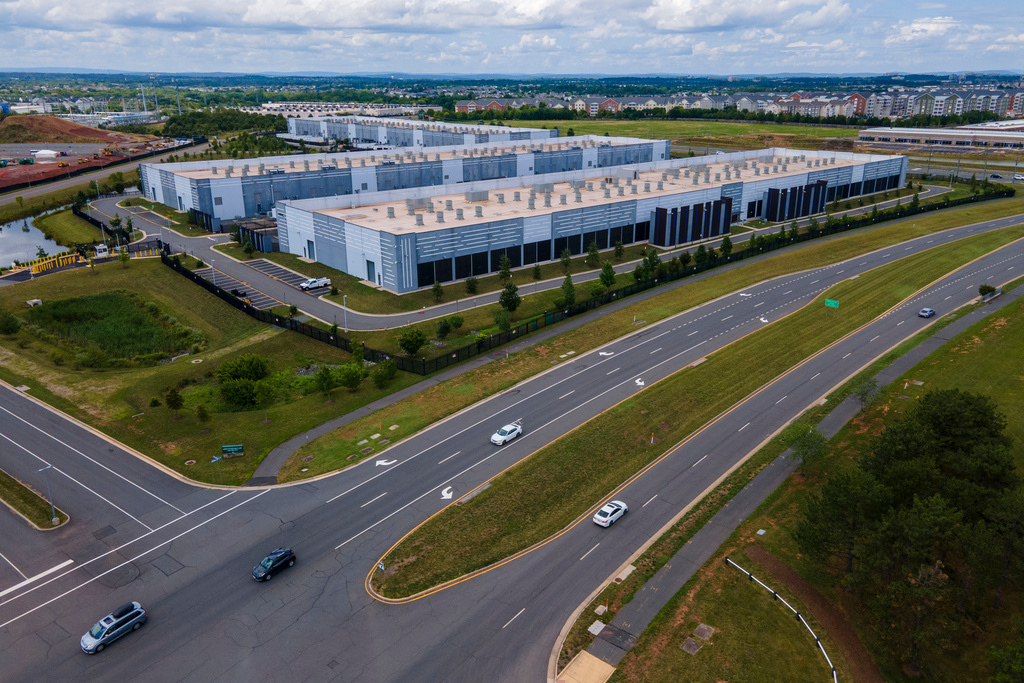
A data center in Ashburn, Virginia.
Ted Shaffrey/AP file
Work & Economy
Why are communities pushing back against data centers?
Tech, data policy expert says concerns legitimate over rising power rates, water use, environmental issues amid mushrooming growth
Data centers, which house computer systems that help train AI models, are blanketing the country, a boom fueled by surging interest in AI and state tax breaks.
More than 4,000 are already in operation, mostly in Virginia, Texas, and California, and 3,000 more are being planned or under construction.
Data center developers and tech giants argue the projects benefit communities by creating new jobs and boosting local economic development through increased property tax revenue and future business opportunities. They also note that infrastructure must grow if the nation wants to remain a global AI power.
But public opposition is mounting over the large water and electricity demands and other strains that data centers, often the size of warehouses, place on communities, according to a recent poll by the Pew Research Center.
In this interview, which has been edited for length and clarity, Ben Green, assistant professor in the University of Michigan School of Information and Public Policy and a faculty associate at the Berkman Klein Center for Internet & Society, discusses the impact of data centers on communities, the factors behind their rapid expansion, and the potential for regulation.
Residents are increasingly pushing back against plans to build data centers in or near their communities. Are their concerns legitimate or exaggerated?
The public broadly is quite negative about data centers. Overall, their concerns are very legitimate.
The public is concerned about rising electricity rates caused by data centers. They are concerned about the enormous water use that data centers require. They’re concerned about public handouts in the form of tax breaks that are going to data center developers, and they’re also aware that data centers don’t bring meaningful economic development, especially in the form of jobs.
I think the public is quite right to be concerned about data centers. My research and other research have shown that these are a bad deal for communities on the local level.
“I think the public is quite right to be concerned about data centers.”
It’s been impressive just how well communities have organized around this, how educated they have gotten about the topic, and how many of these projects they have been able to stop. It’s a sort of David and Goliath fight; local communities are pushing back against some of the wealthiest companies in the world.
Certainly not every effort is successful. Sometimes, the wealth and power of these companies win out. But many data center projects have been blocked by local resistance, and many municipalities have passed moratoria that pause data center development.
How much water and electricity do data centers require on average?
The standard definition of a hyperscale data center is that it is more than 10,000 square feet with more than 5,000 servers. But even that is way below the current standard of the data centers that are being built today.
Just a few miles from where I live in Ann Arbor there is a big project, part of OpenAI’s Stargate Project in Saline Township, Michigan, where the plan is for it to be over 2 million square feet and use 1.4 gigawatts of energy. That is equivalent to the energy use of a million households.
What is important here is not just the scale of an individual data center, but also the number of data centers that are being developed at rapid pace across the country, which is fueling a massive expansion in energy and water demand.
Estimates suggest that within a couple of years, the electricity needed for data centers is going to be around 10 to 15 percent of total nationwide electricity demand. This means that the data center boom is putting severe strain on efforts to move the country toward renewable energy sources, often by prolonging the use of fossil fuel plants that had been slated for closure.
Data center developers claim they bring jobs to local communities. What’s your take on that?
It’s a significant false promise of these data centers. Developers say this because they know that it is attractive to policymakers; they come asking the state to give them benefits in the form of tax breaks, reduced regulations, or special zoning permissions in exchange for job creation.
That also allows data center developers to play into this idea of spreading the aura of the tech economy and Silicon Valley across the country by saying, “We can bring a taste of Silicon Valley to Michigan or Ohio or Colorado.”
“It’s a significant false promise of these data centers.”
In practice, this is not what happens. The construction of data centers requires work because these are large construction projects, but that lasts a year or two; sometimes that labor is local and unionized, and sometimes that labor is trade professionals who come in from other states.
Once the data center is up and running, it requires very few people, often just 20 to 50 staff members, because it’s not an office for software developers, product managers, or marketing experts. It is a warehouse of servers.
Do tax revenues and other community benefits outweigh the downsides of data center expansion?
Unfortunately, there’s just very little economic development that plays out on the local level.
There is some tax revenue, but even that is reduced because of tax break policies. Over the last year, Virginia and Georgia have given up more than a billion dollars’ worth of revenue as a result of tax breaks. That’s money that is being handed back to the industry rather than going into public funds that could pay for infrastructure, schools, or healthcare.
Also, there are not beneficial ripple effects like you might see with other industries. Living within a stone’s throw of a data center does not mean that you are getting better or faster or cheaper access to these technologies.
Communities in both blue and red states have pushed back against data centers. Why is this an issue that unites communities regardless of their political leanings?
Data centers are becoming an important issue in local, state, and potentially federal elections because it is an important subject for voters. They can really feel how data centers affect their lives in ways that are tangible and concrete.
And it’s causing some interesting realignments and potential for bipartisan coalitions because it’s not a simple left or right issue. Liberals and people on the left are concerned for environmental reasons and distrust in AI companies, but many conservatives are upset about data centers too.
This introduces a sort of wild-card effect into future elections where being critical of data centers is a big winning issue for candidates. That played out in November in some Virginia and Georgia elections and is a hot topic for candidates campaigning right now, such as in the Michigan Senate primaries.
What policy recommendations are needed to address the expansion of data centers?
Regulation is definitely necessary. One important action is to repeal tax breaks for data center developers because they are incentivizing further data center development and are making it a further bad deal for communities.
A large number of projects are happening because states have passed tax breaks to incentivize data center development. About 35 states now have these tax breaks in place as part of their recruitment pitch.
There are many other considerations.
First, transparency needs to be a bare minimum requirement. There’s an amazing amount of obscurity in data center development right now. Contracts are secretive, and when they are made public, there are huge redactions, and policymakers are signing nondisclosure agreements. There should be early and consistent transparency about what’s being proposed and what the terms of these deals are.
There should be rate protections for consumers with clear contract provisions such that the cost of upgrading the utility infrastructure to service a hyperscale data center doesn’t get passed on to consumers like you and me, which has been happening consistently across the country.
If you live near data centers, your electricity bills are going up, often by a factor of two or more. There should also be a stronger voice for communities in determining whether to welcome data centers, and under what conditions.
One final piece is the need to think about broader planning on how much total water and electricity demand from data centers a state or a region or utility jurisdiction can handle. It’s one thing to say that a state can handle one hyperscale data center, but quite another for that state to be welcoming dozens of such facilities.
We have to make sure that we’re not sacrificing climate goals just for the sake of building more data centers or building data centers faster. We should not be allowing the desire among the tech industry for rapid data center development to push renewable energy goals to the wayside.