Featured series
Arts & Culture
Time has not been kind to VHS
Video by Niles Singer/Harvard Staff Photographer
As tech turns 50, preservationists race to save material stored on vanishing format. Methods include … baking?
Before streaming, before Blu-ray, and before DVDs, the VHS videocassette was the king of video. First launched in Japan in 1976, the format, short for Video Home System, was easy to use, compatible with any television, and affordable.
After winning the battle for dominance with the Betamax cassette, the VHS ushered in an era of amateur filmmaking, home movie collections, and video store rentals. Recognizing the value of the new format, Harvard curators quickly began amassing materials on VHS. Though no single tally of Harvard’s VHS holdings exists, a 2018 count of audiovisual material says the figure is likely in the tens of thousands.
But 50 years after its launch, the technology is all but obsolete. The cassettes’ magnetic tape degrades over time, putting curators, archivists, and conservators in a race against the clock to salvage as much as they can before it’s too late.
In a climate-controlled storage vault, Joanne Donovan recently rifled through stacked cardboard boxes and pulled out a VHS tape titled “Honoring the Wisdom of Experience,” dated Nov. 11, 1995. The tape is part of the papers of Louisa Pinkham Howe, a sociologist and psychotherapist who, among other achievements, testified in Brown v. Board of Education that racial segregation was psychologically damaging to children.
The tape has not yet been digitized.
“Digitization is very much a priority, considering how ephemeral this format is,” said Donovan, lead archivist for visual materials and recorded sound collections at the Harvard Radcliffe Institute’s Schlesinger Library. “There’s not as much information available about the history of women, and women of color in particular. There’s a risk of it being lost.”
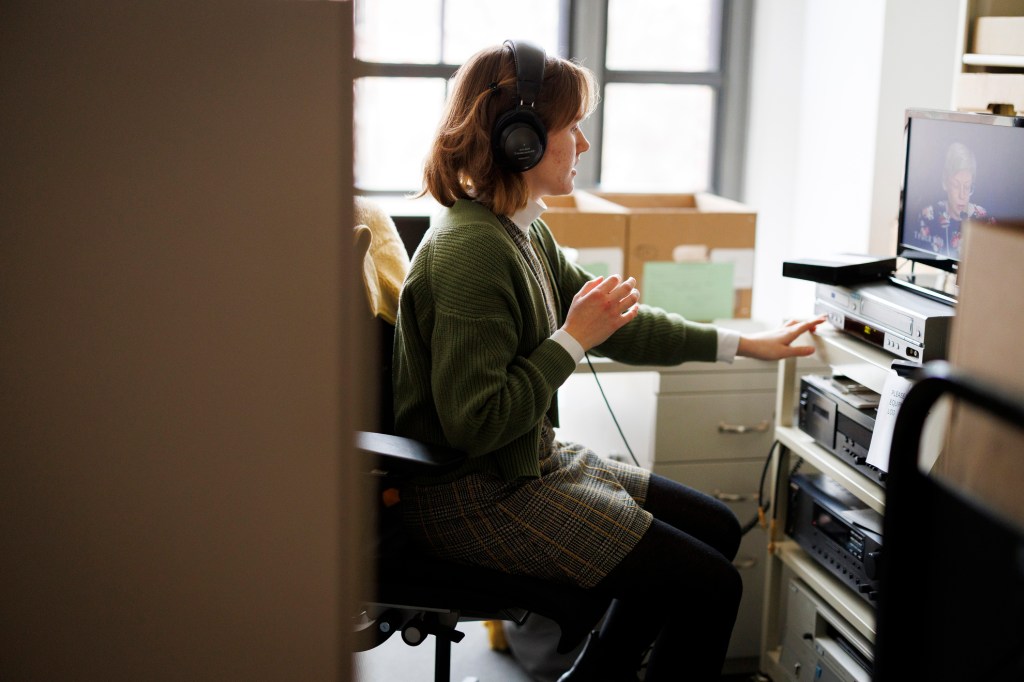
Processing assistant Michaela O’Gara-Pratt reviews VHS tapes.
Photos by Stephanie Mitchell/Harvard Staff Photographer
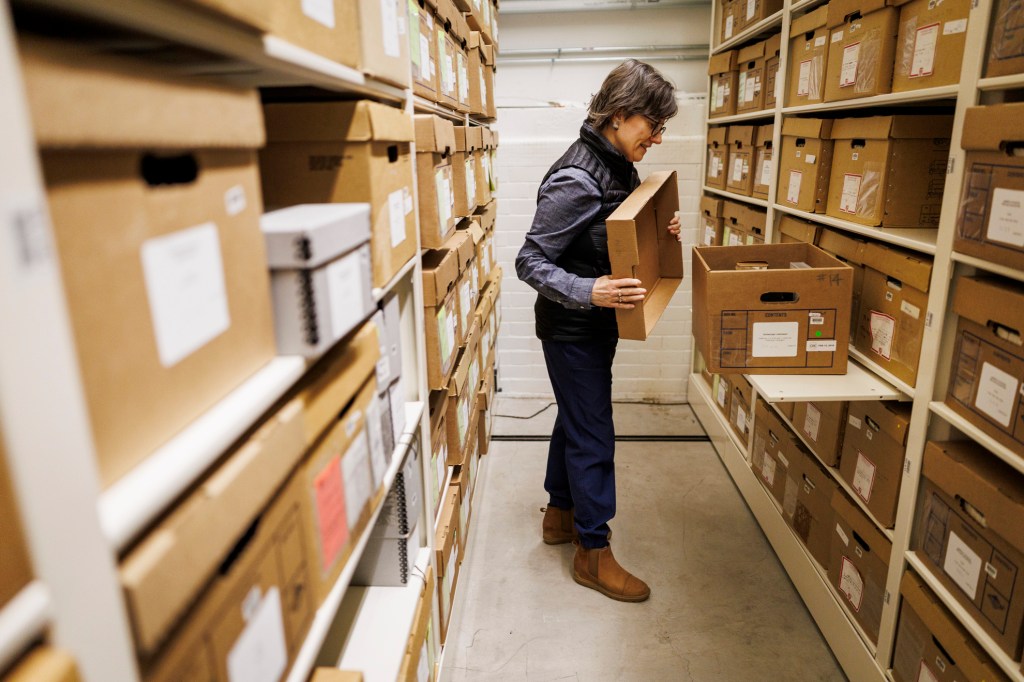
The Schlesinger, which collects materials related to the lives of American women, holds about 5,000 VHS tapes. According to Donovan, only about a quarter of the collection is available digitally.
Lately, when videos come back from being digitized, they’re often “snowy,” a sign that the tape was too degraded for a clear capture.
The VHS era — the mid-1970s through the late ’90s — saw a huge transformation in culture, Donovan explained, and much of it was documented on VHS’ Mylar tape. The Schlesinger’s VHS holdings include materials from the women’s music movement; oral histories; recordings of luminaries such as chef Julia Child, lawyer Florynce Kennedy, and poet June Jordan; and training videos from Lamaze International and the National Organization of Women.
Elsewhere at Harvard, many items in the Busch-Reisinger Museum’s VHS collection come from Joseph Beuys, a German artist and theorist known for embracing new media.
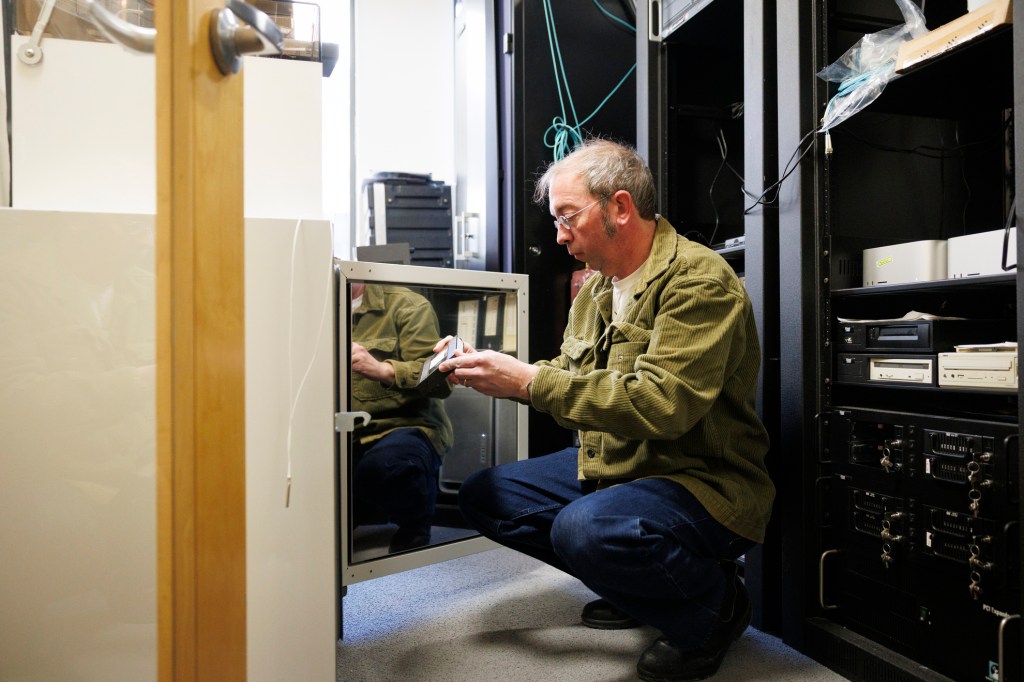
Jason Bitner, Media Technician IV, putting a VHS tape into the oven.
Photos by Niles Singer/Harvard Staff Photographer
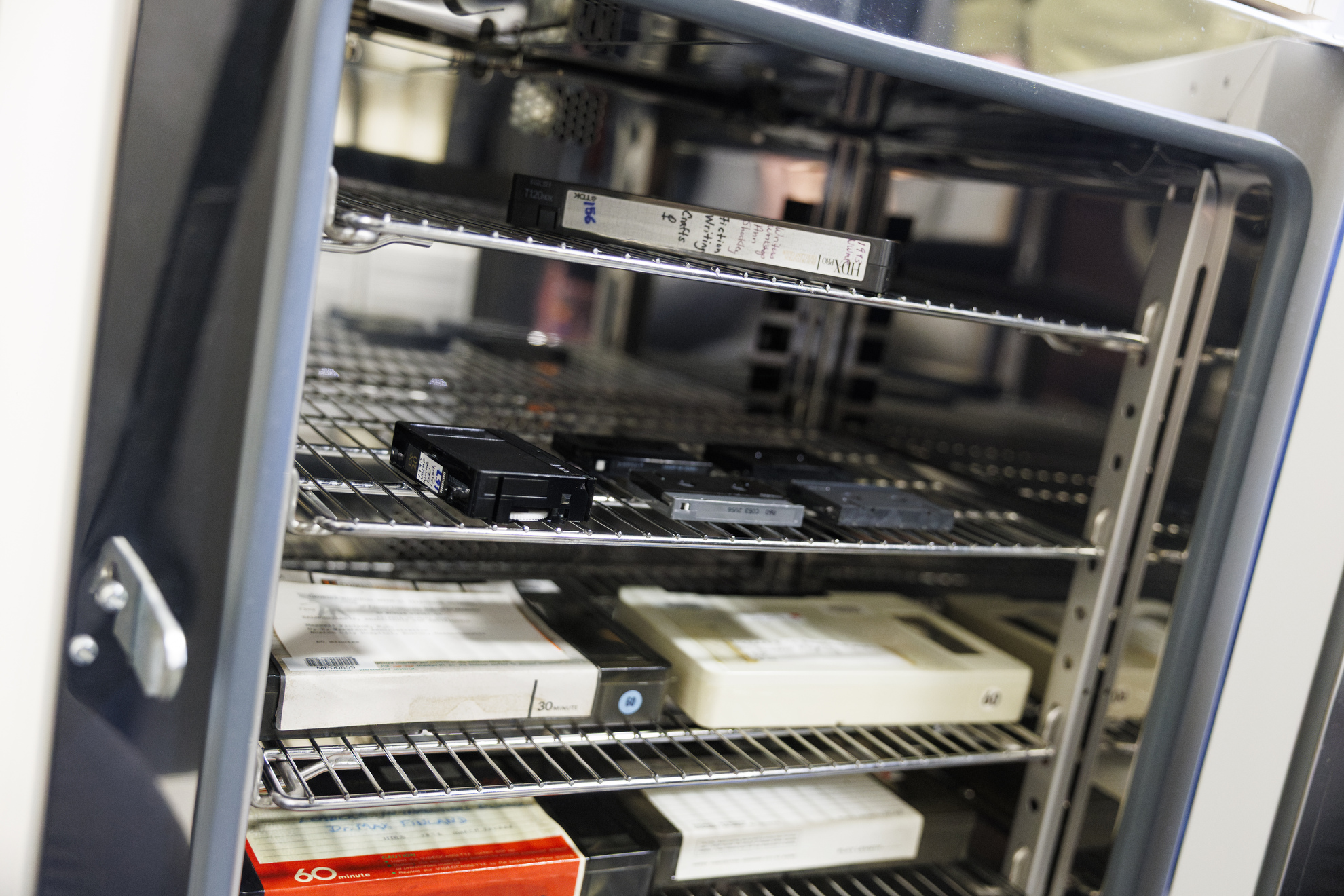
VHS tapes being heated in an oven, which helps with the preservation process.
“Beuys in particular was part of a generation of artists who saw the videocassette as a kind of democratizing medium,” said Lynette Roth, Daimler Curator of the Busch-Reisinger Museum. “It was a way to make art more accessible and less elitist compared with traditional media, like painting, for example.”
But ironically, video art often languished in museum archives.
“You can’t really use the videocassette; you’ll wear it out. So these artworks were underrepresented in our galleries,” Roth said.
To finally make good on Beuys’ egalitarian vision, Susan Costello, the conservator of objects and sculpture for the Harvard Art Museums, is overseeing a project digitizing analog media, including VHS tapes.
“You would think it’s pretty easy: You just box everything up and send them over to be digitized. But it’s actually quite a lot of work,” said Costello. “The curatorial department had to put values on all of them, because they’re works of art. We needed detailed condition reports before they left the building so we knew if anything happened to them. Some of the items needed new casing made for them to make it safe to ship them.”
“You would think it’s pretty easy: You just box everything up and send them over to be digitized. But it’s actually quite a lot of work.”
Susan Costello
In May of last year, professional art movers loaded about 70 pieces of analog media into a climate-controlled truck and brought them to Harvard Library’s Media Preservation Lab.
There, head of media preservation Kaylie Ackerman, senior time-based media conservator Melanie Meents, and their teams are racing against the clock to preserve the contents of the fragile plastic cases.
One problem: sticky shed syndrome. Instead of spooling smoothly off the reel, some poorly preserved tape adheres to the layer below it.
“If you just play the tape, you start ripping oxide off it, which erases the tape in the most heinous way possible,” Ackerman explained.
The solution is remarkably low-tech: baking. Using special laboratory ovens that are capable of holding a constant steady temperature, Ackerman bakes VHS tapes at 125 to 130 degrees Fahrenheit for up to five days.
“If you can bake the tape at a particular temperature for a particular amount of time, you can temporarily re-cure the material for long enough to get a good preservation transfer,” she said. It’s a high-stakes gamble: There might only be one chance to read the tape before it’s too degraded to try again.
“The reason we digitize it is that otherwise it would just disappear,” she continued. “These are things that support scholarship, that support research, teaching, and learning throughout the University. It’s important for Harvard to not only have the material, but preserve it, so that in 150 years a new scholar can still work with it as a primary resource.”