Featured series
Science & Tech
The ascent of us
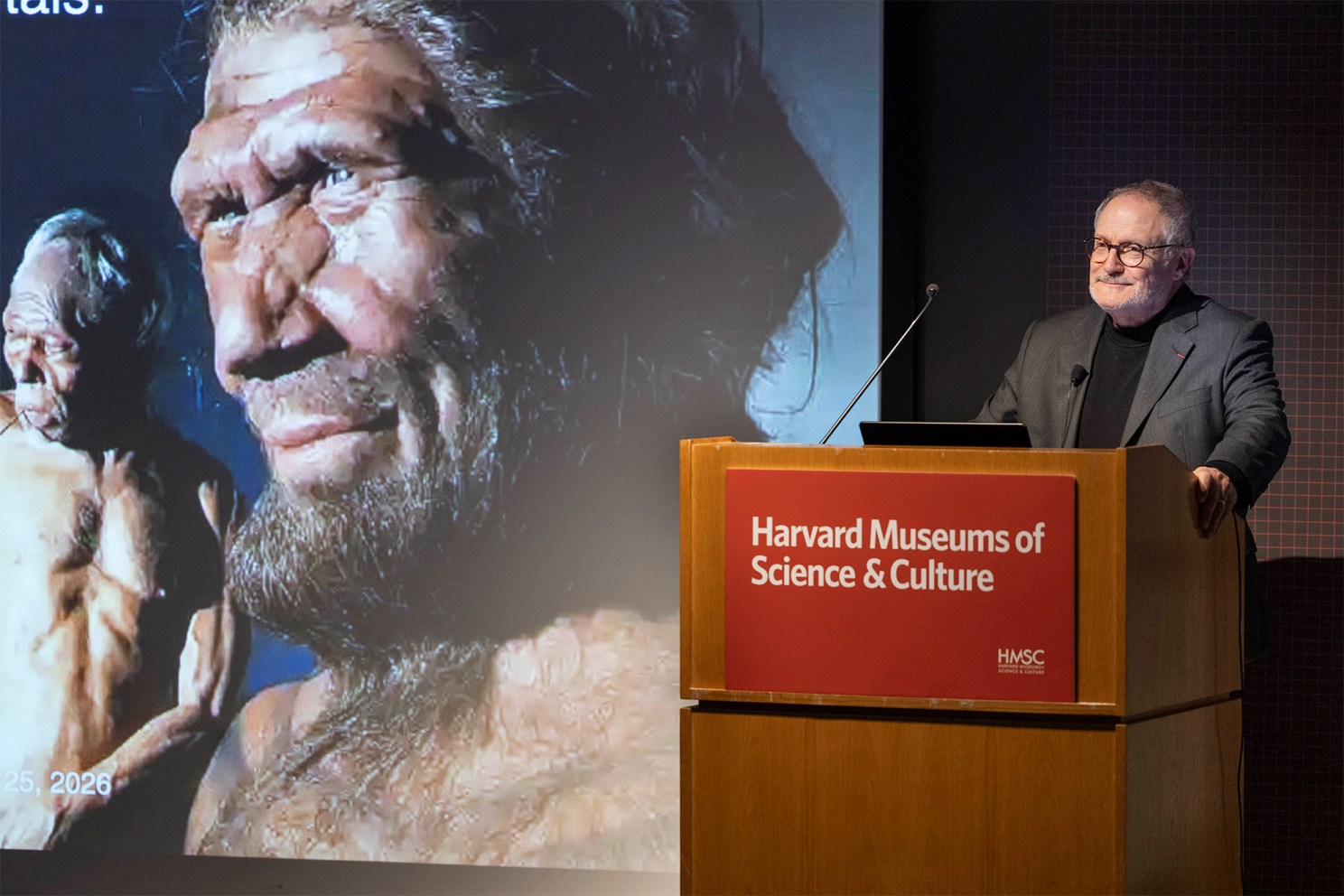
Jean-Jacques Hublin.
Photo by Kris Snibbe ©
Anthropologist traces split between Homo sapiens and Neanderthals, other human forms
The triumph of Homo sapiens over Neanderthals, a huge step in human evolution, was not the clearcut event that paleontologists have long believed.
More likely, it was the result of continued interactions — and even some interbreeding — with modern humans resulting from just one surviving group.
At a Peabody Museum event March 25, Professor Jean-Jacques Hublin drew on cutting-edge research in archaeology, paleogenetics, and paleoproteonomics to examine that transition in Eurasia, tracing the processes that during the Paleolithic period gradually transformed a world of multiple human forms into one inhabited by a single surviving lineage.
Speaking as part of the Hallam L. Movius, Jr. Lecture Series, Hublin, professor at the Collège de France (Paris) and emeritus professor at the Max Planck Society, began by referring to the work of the series namesake, a groundbreaking archaeologist who focused on the Paleolithic.
It was Movius, Hublin said, who first pointed out that the tools — or “industries” — left behind by the different groups hinted at the distribution of these populations.
“If you look at the evolution of paleolithic industries throughout the Old World, you have very different stories depending on what part of the world you are,” he said.
Neanderthals and Homo sapiens were quite distinct species, Hublin explained.
For example, although they were likely only separated 800,000 to a million years ago, the skulls and jawbones of these hominids are more markedly different from each other than those of chimpanzees and bonobos, which separated one and a half million years ago.
The two hominid species also, at least initially, lived in different areas, with Neanderthals primarily living in a moderate climate swath that stretched across Europe into Asia, and Homo sapiens living in Africa, before they migrated north in a series of moves.
They were not the only early hominids.
“More than 40,000 years ago, you had all these different hominids existing,” Hublin said. In Eurasia, for instance, two sister groups, the Neanderthals and the Denisovans, apparently coexisted.
“So we have a divide between an African world where our species evolve and a Eurasian world where the Denisovans and the Neanderthals evolve. And at some point, our species replaced all the others,” said Hublin, calling that event, “the most spectacular event in hominid evolution of the last million years and arguably the most important event of the whole human evolution.”
That event was likely the result of a long history of interactions.
“We know from ancient DNA that there were already contacts probably more than 250,000 or 300,000 years ago,” said Hublin.
The proof, he said, lies in the genome of Neanderthals who came after this period, which contain mitochondrial DNA, a part of the genome of the African people, ancestors of present-day humans. This DNA, he said, is transmitted through maternal lineages, suggesting some interbreeding between species.
This “hybridizing,” or inter-species mating, is now seen as something that happened several times rather than as a one-time occurrence.
Such genetic evidence has countered older theories that postulated that “you have modern humans coming into Europe, moving as a wave, replacing them.” he said. “Reality is more complex.”
Another way to trace these two groups is through their technology. He said hand-held cutting tools, created by chipping away at stone to form sharp edges, are distinctive to their users, and he illustrated the point with a series of slides.
Digs associated with European Neanderthals, for example, are characterized by “shapeless flakes,” according to Hublin. But in areas populated by Homo sapiens, sharpened stones were increasingly focused on a tip, possibly enabling users to put them on the end of a stick or other projectile, making a spear for hunting.
“This prevalence of points and projectiles is something that we see already in Africa before the spread of these hominids into Western Eurasia,” he said.
Some European sites, however, have turned up similarly sophisticated tools. Originally, archaeologists had theorized that Neanderthals had developed these independently, even simultaneously with Homo sapiens. However, newly found Homo sapiens teeth at these sites link the better tools to incursions by our ancestors earlier than had been previously known.
This work was enabled by a new technology developed at the University of York in the United Kingdom. The technology extracts collagen from bone fragments, from which a protein fragment known as a peptide is extracted.
Using a mass spectrometer, which “basically measures the size of this fragment,” said Hublin, researchers can identify differences that are specific to each species.
These findings show that populations of Neanderthals and Homo sapiens coexisted in Europe for thousands of years, perhaps as early as 55,000 to 53,000 years ago, probably separated by topical barriers — mountains, for example.
And while some groups intermingled, given the DNA evidence, other groups likely had more hostile interactions, as indicated by the presence of Homo sapiens bone fragments in the piles of refuse.
The result is a much more complex picture of our origins than had been believed.
“We have exchanges between the two groups at the gate of Africa. We have this integration of mitochondrial DNA microsomes that existed in the past. More recently, we had an integration of Neanderthal DNA into the genome of present-day humans outside of Africa,” he said. “So most people in this room have about 2 percent DNA of Neanderthal origin.”