Featured series

Work & Economy
Powell issues a warning on U.S. debt
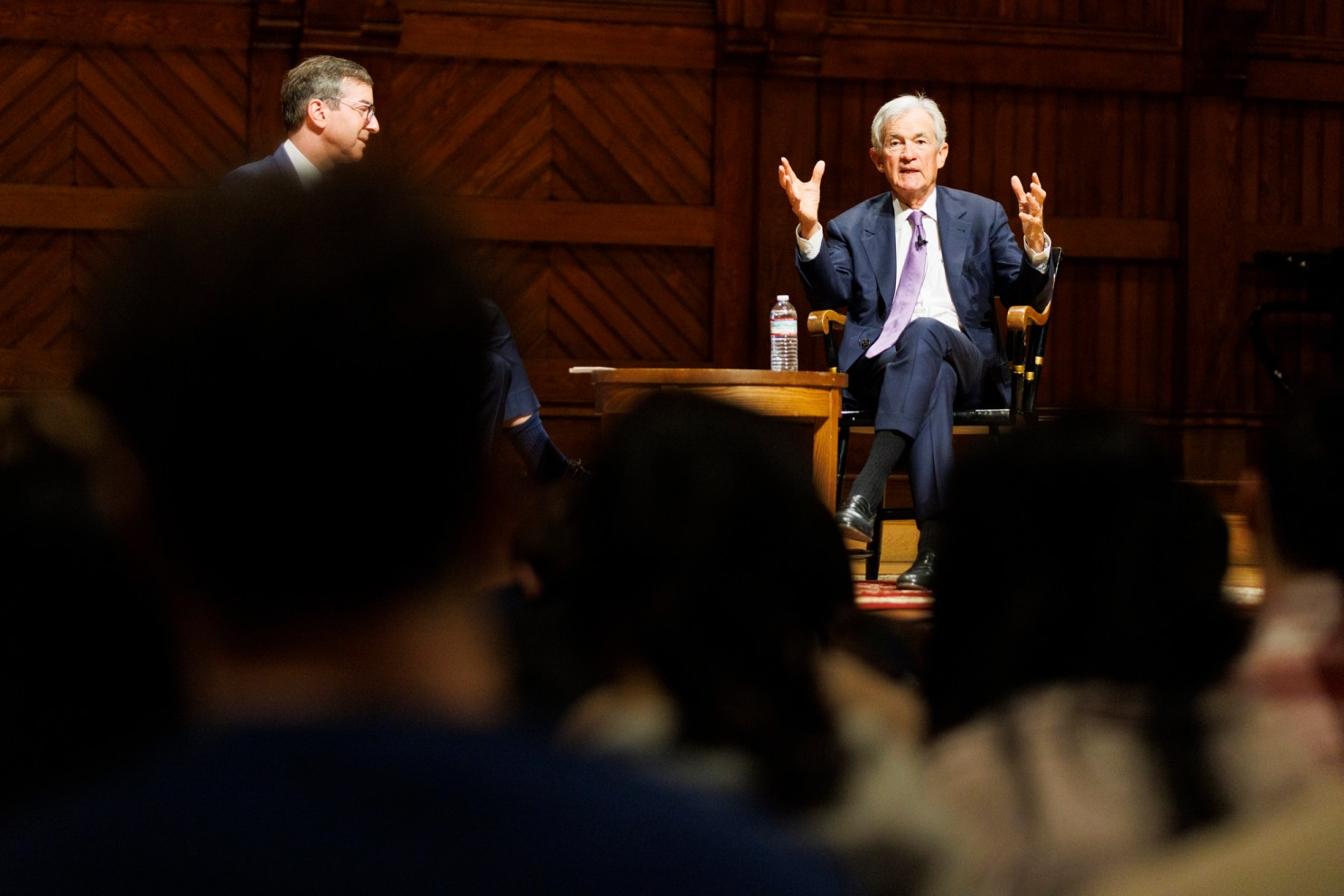
Jerome Powell (right) with David Laibson.
Veasey Conway/Harvard Staff Photographer
Current trends ‘not sustainable,’ says Fed chair, whose conversation with Harvard undergrads also touched on inflation, impact of war, independent decision-making
Federal Reserve Chairman Jerome Powell expressed confidence in the “resilience” of the U.S. financial system during a visit to Harvard on Monday and said that the Fed will take a “wait-and-see” approach to the economic impact of the Iran war.
Powell spoke at Sanders Theatre with undergraduates in “Principles of Economics,” a macroeconomics course co-taught by Jason Furman, Aetna Professor of the Practice of Economic Policy at the Kennedy School and in the Department of Economics, and David Laibson, Robert I. Goldman Professor of Economics. Laibson moderated the talk.
Powell said that the Fed remains committed to its target inflation rate of 2 percent even against headwinds created by U.S.-imposed tariffs and the conflict in Iran. The Federal Open Market Committee thought the goal was within reach in late 2024 when U.S. growth was at 2.5 percent, 12-month inflation was just above 2 percent, and the labor market was essentially at full employment. These data followed a period of serious recession worries among many economists.
“I would call that a soft landing,” Powell said.
Nominated to serve as Fed chair by President Trump in late 2017, Powell was nominated a second time by President Biden in 2021. His term officially ends in May, but he has said that he will remain as chair until his successor has been approved by the Senate.
Historically, the Fed tends not to react when oil and gas prices rise because energy supply shocks are often short-lived, so the central bank will “wait and see” how Iran-related oil prices affect the broader economy and will monitor inflation expectations “very, very carefully” before making any policy adjustments, Powell said.
He expressed deeper concerns about the nation’s balance sheet. Our $39 trillion debt is not the real problem, he said; it’s that the current path Congress is on — spending more than the U.S. is taking in — is “not sustainable.”
“The country has to get back to ensuring that the economy is growing fast enough to keep pace with spending,” he said.
“It will not end well if we don’t do something fairly soon,” Powell warned.
On emerging threats, Powell said that the Fed has taken significant measures to fortify the U.S. financial system against outsized risks and credit losses like those that fueled the 2008 global financial crisis.
“We have a hugely resilient financial system,” he said.
With the financial sector constantly evolving, what the country needs from the Fed is “vigilance,” not the elimination of all risk, Powell said. “You just need to always know that there’s another thing coming.”
The Federal Open Market Committee is monitoring private credit markets “super carefully,” he said, but at the moment sees no systemic threat to the nation’s financial stability.
Asked by a student about the Fed’s view of employment, Powell acknowledged a tough labor market for younger people. But given U.S. dynamism and growth since World War II, he urged students to be optimistic about the medium- and longer-term economic outlook and to become comfortable and proficient with AI.
Though Powell did not comment on Trump’s nominee for Fed chair, Kevin Warsh, he did make a case for the importance of Fed independence and rejected the idea of partisan motives in the central bank’s policymaking.
“We’re not trying to work against any politician or any administration, but we have to be careful to stick to what we’re doing,” he said, adding: “The Fed is not a perfect institution. What we do is very challenging, highly uncertain, but it’s a great American institution and I’m very proud to work with the people I work with.”
Many observers have warned that any effort to interfere with the Fed’s traditional independence from politics would threaten significant harm to the financial system and to the country. “It’s very hard to build great democratic institutions and much easier to bring them down,” Powell said.