Featured series
Nation & World
Is a more perfect union still possible?
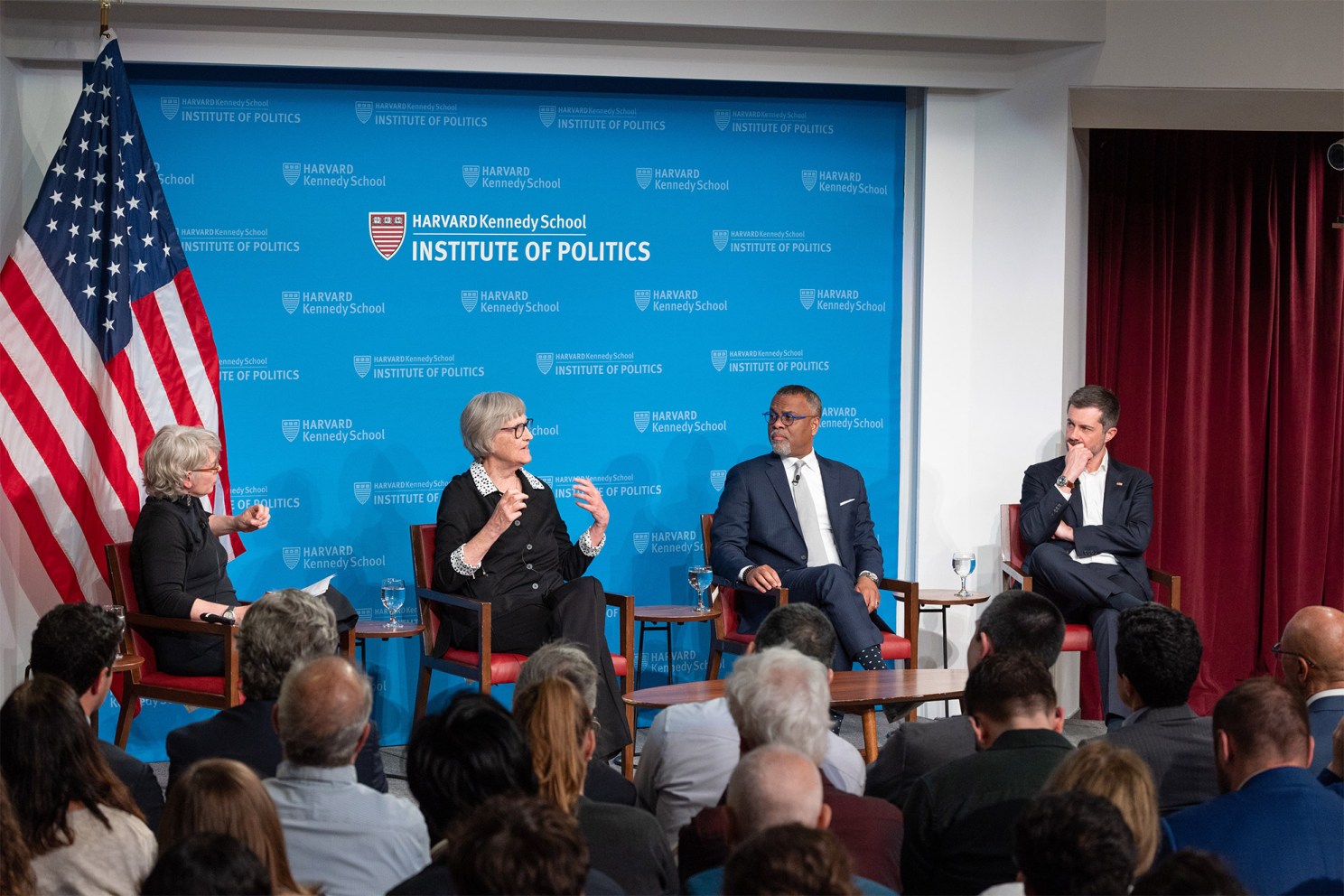
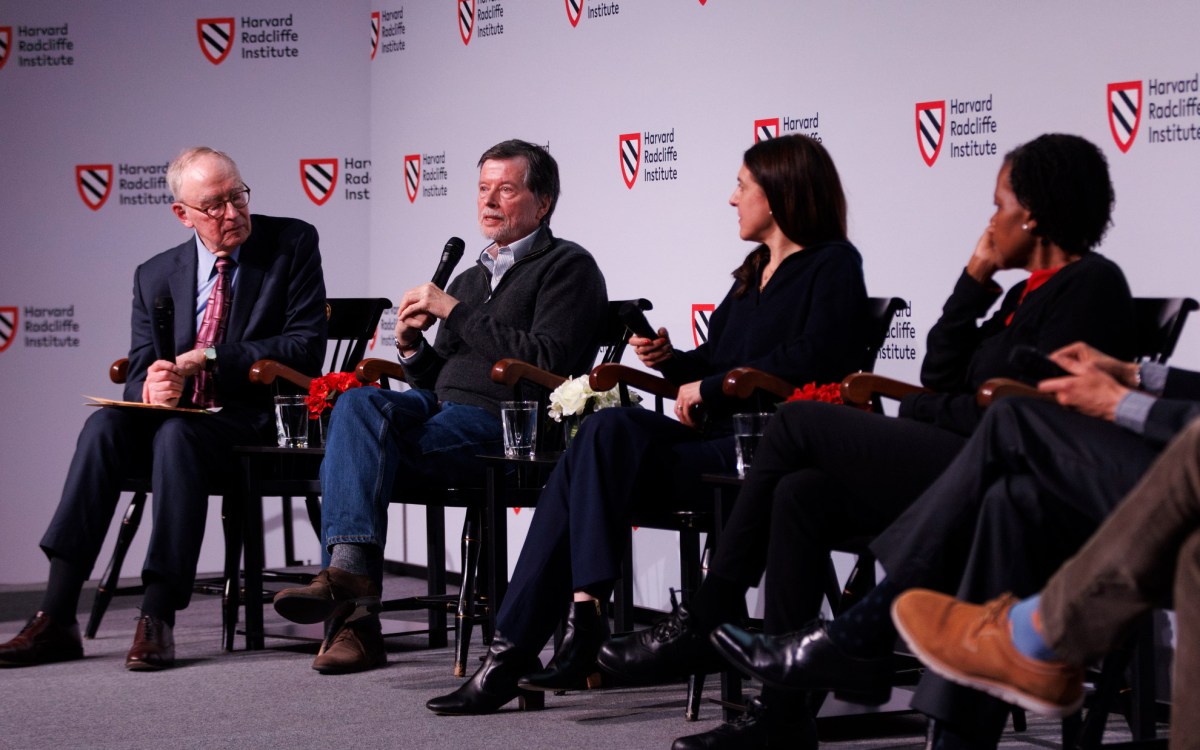
Moderator Jill Lepore with Drew Faust, Eddie S. Glaude Jr., and Pete Buttigieg.
Photos by Martha Stewart
Faust, Buttigieg, and Glaude look at past, present of nation’s divides
During a talk Monday evening at Harvard Kennedy School, a panel of American history scholars and political analysts discussed the forces of the present and the past animating the country’s divisive political climate and whether there remains a path to a more perfect union.
Drew Faust, a Civil War historian and president emerita of Harvard, and Eddie S. Glaude Jr., a scholar of African American studies and religion at Princeton, said in many respects the schism in today’s U.S., which often feels like a loosening confederation of Red and Blue states, can be traced back to the North/South divide over slavery during the Civil War.
In fact, social scientists and economists have noted the persistence of political and economic differences that remain between former Union and Confederate states.
While there is much ideological and sociological overlap, Glaude cautioned against leaning too heavily on that geographic dichotomy to fully explain the current partisan rift because it “overburden[s] the South” and “feeds the myth that the moral problem resides there, as opposed to in the heart of the nation.”
“If we’re going to get to a good place again … it’s going to be because people do something and decide that union matters and that we want to be a nation that is unified.”
Drew Faust
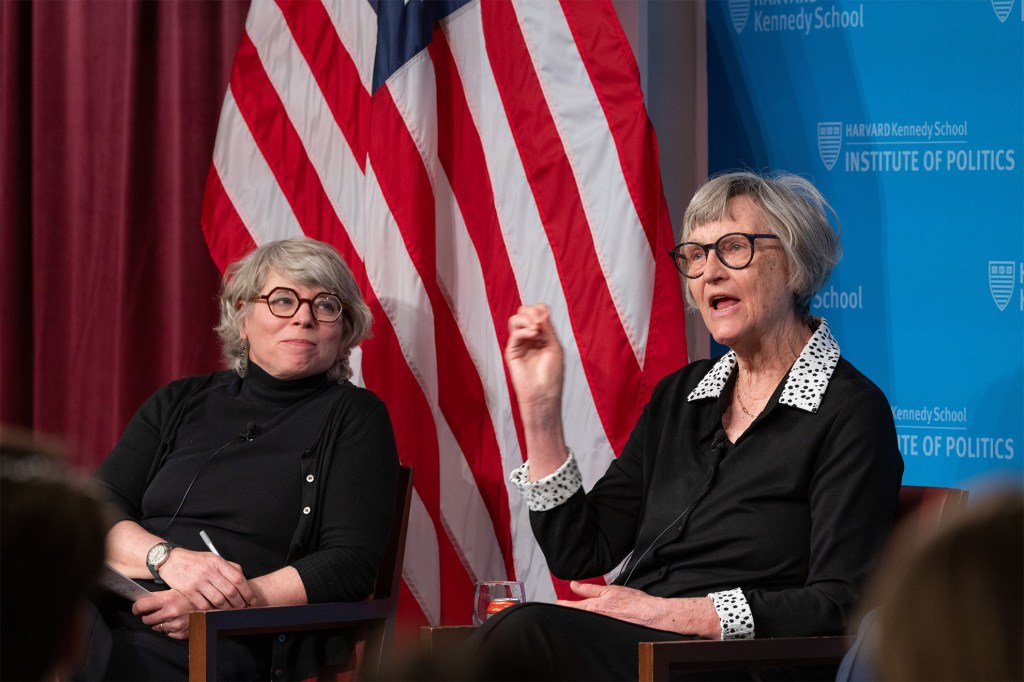
The discussion was the first in a new series recognizing the country’s 250th anniversary and the need for “straight talk” during “hard times,” said Jill Lepore, David Woods Kemper Professor of American History at Harvard and a New Yorker staff writer, who is moderating the series.
A second event, on April 13, will feature Mitt Romney, who was formerly a U.S. senator of Utah, governor of Massachusetts, and the Republican nominee for president in 2012.
The nation’s history “doesn’t have to be destiny,” said Pete Buttigieg ’04, who served as U.S. secretary of transportation during the Biden administration and mayor of South Bend, Ind., from 2012–2020. He’s currently a visiting fellow at the Institute of Politics.
“We’re actually in one of those rare moments which, for all of the pain and the pathology of being an American right now, could also be an incredibly fertile moment for different patterns, different coalitions, and perhaps a very different electoral map in the near future,” he said.
Whatever comes next, that future has to be truly different, Buttigieg said.
“If there’s one thing I’m preaching right now, it’s that our job as a country and the job of my political party is not to somehow take power, find all the bits and pieces of everything they smashed, remember how it used to look, tape it all back together and serve up the world as it looked in 2022 — because that’s not going to work,” he said.
The panel considered the range of generational, socioeconomic, and educational factors that can improve or worsen divisions and how it’s important to not only think and talk about ways to bridge those gaps, but to take action to make it happen.
“Union doesn’t just come automatically. We’ve had to struggle for union” since the earliest days of the nation’s history, said Faust.
“And so, if we’re going to get to a good place again … it’s going to be because people do something and decide that union matters and that we want to be a nation that is unified,” she said.
Institutions such as universities and the U.S. military still play key roles nurturing union by gathering people from different places, with different values, beliefs, and experiences to live and work together toward a common purpose, Faust and Buttigieg said.
The group was asked whether they thought it was still possible to salvage the term “union” given the divisiveness of our politics and social media’s power to fuel it.
Glaude said that it can be done, but it will require deep reflection about the obligations we have to each other as Americans and what it will take to renew a commitment to working together toward a greater common good.
“What we’ve witnessed over the last 50-plus years is an evisceration of any robust notion of the public good. We’ve become self-interested persons in pursuit of our own aims and ends, in competition and rivalry with each other,” he said.
“What does it mean for us to imagine ourselves differently? That’s not going to come from politicians. It’s not going to come from prophets who were anointed from on high. It is going to come from us, understanding our role.”