Featured series
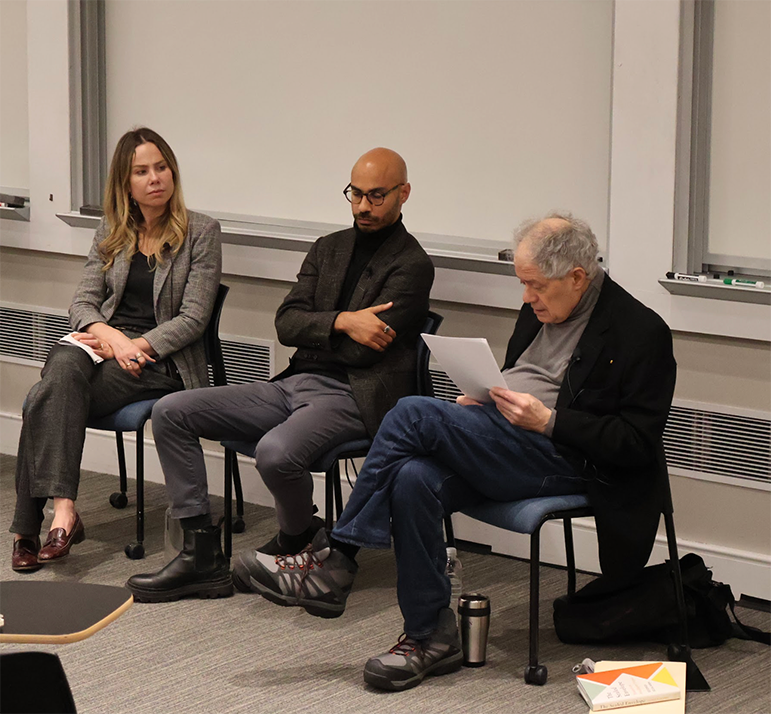
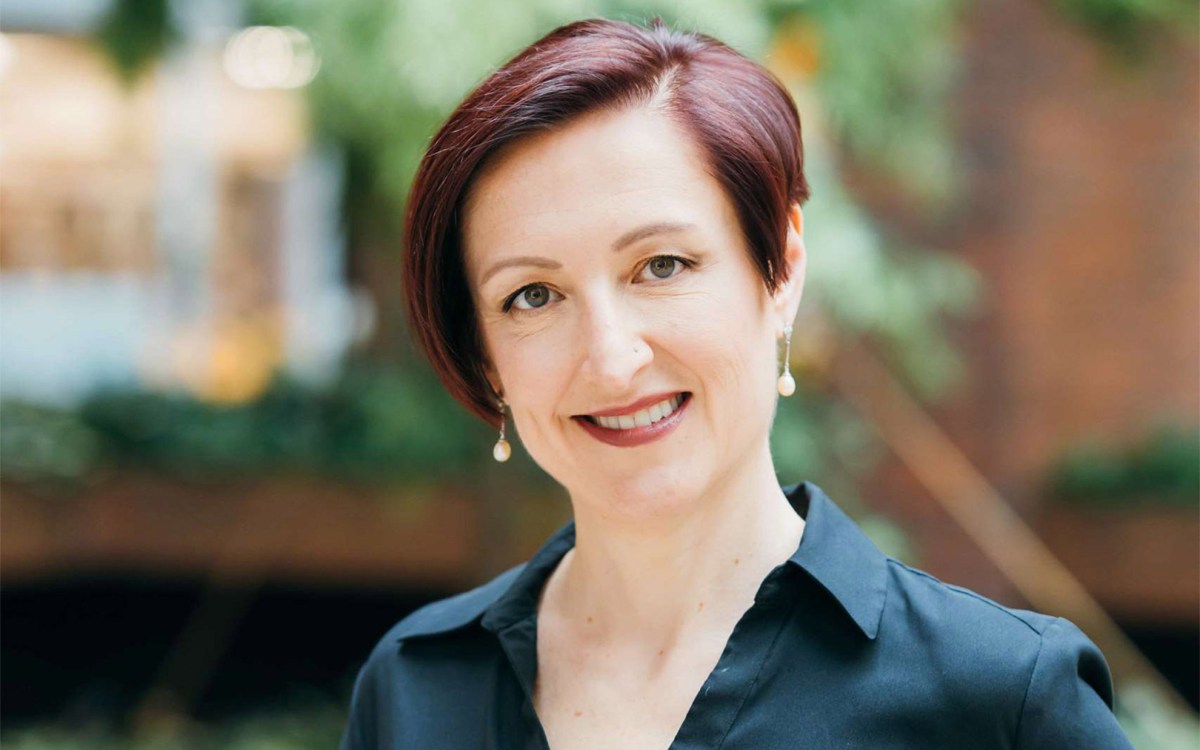
Anastasia Berg, Jesse McCarthy, and George Scialabba.
Photo by Mira Kaplan
Arts & Culture
Where have all the public intellectuals gone?
Panel discusses evolving tradition in U.S. due to social, economic shifts, and need for such thinkers in democratic cultures
If there’s one thing public intellectuals can agree on, it’s the necessity of disagreement. But thoughtful debate in a public forum is becoming increasingly rare, threatening the the future of intellectual life in America, according to George Scialabba ’69, Professor Jesse McCarthy, and Anastasia Berg ’09.
The three spoke about the evolving role of the public intellectual at an event hosted by the Public Culture Project, an initiative of the Division of Arts & Humanities, on Feb. 25.
“Partly, public intellectuals exist to give voice and articulation to as-yet unformed ideas in public, the populace. And hopefully to compare and contrast,” said Scialabba, an essayist and literary critic. “It never works ideally. Usually public intellectuals, like everyone else, are partisan — sometimes rancidly partisan. But in democratic cultures they do help people understand their encoded impulses and desires and see them or hear them represented in public life.”
Scialabba, whose most recent book is the just-published “The Sealed Envelope: Toward an Intelligent Utopia,” said that that despite the longtime stereotype of the U.S. as an anti-intellectual nation, the country has historically produced many public intellectuals across ideological traditions.
That would include, for instance, representatives of the so-called New York Intellectuals (such as Lionel Trilling, Clement Greenberg), Harlem Renaissance (W.E.B. Dubois, Alain Locke), Cold War liberals (Arthur Schlesinger Jr., Richard Hofstadter), conservatives (William F. Buckley, James Burnham), and individual writers like Hannah Arendt and Susan Sontag
But today, Scialabba said, the conditions that once supported great thinking are eroding. Urban gathering spaces and flexible part-time jobs that offered time and space to pursue intellectual pursuits are disappearing, and small magazines and newspapers can’t financially support writers the way they used to.
Additionally, many intellectuals have been absorbed into academia, where there is less room for public engagement, he said.
“For everyone, it means a narrowing horizon,” Scialabba said. “Students, especially, are affected. The panic currently raging among the young about their career prospects could not be a more effective deradicalizing agent and could not be more unfavorable to producing public intellectuals if it had been designed for that purpose.”
“For everyone, it means a narrowing horizon.”
George Scialabba
McCarthy, John L. Loeb Associate Professor of the Humanities and of the Social Sciences, defines intellectuals as people who believe deeply that ideas matter. He said that at many critical moments in American history, including the Civil War and the end of slavery, there was never a question for Black American intellectuals about whether arguments were important.
“There was no way to ever imagine that ideas didn’t matter, the stakes of political struggle have always been so stark and so immediate that the question of getting involved in this emerges spontaneously and of necessity,” McCarthy said.
Berg, a philosophy professor at the University of California, Irvine, worries that with the advancement of technology, including AI, young people are increasingly deprived of opportunities to hone linguistic and cognitive skills.
She said it was especially concerning at times like the present when ideas and arguments are more important than ever.
“I really worry that people will not be able to conduct an argument, as their entire cognitive, linguistic lives are being mediated for them,” Berg said.
She warned of the dangers of falling into patterns of habitual, unexamined thinking, citing philosopher Hannah Arendt’s idea that most evil arises from thoughtlessness or a shallow inability to think beyond clichés and stock phrases — such as the kind a large language model may produce.
In fact, the whole reason Socrates insisted on accosting Athenian citizens with existential questions was to promote “perplexity” in others, she said.
In some corners of the country, intellectuals are taking on the cause, passing their passion for inquiry to the next generation through initiatives like the Program for Public Thinking, run by the University of Chicago, and “The Point” magazine, where Berg is an editor.
“Our task has been to inculcate the habit of perplexed thinking,” said Berg. “It’s only such thinking, Arendt insisted, that can condition human beings against that most banal, the most common and most treacherous evildoing. There’s an ethical significance to being able to approach things in a perplexed manner.”
She acknowledged that engaging in intellectual discourse and disagreement with others can be uncomfortable and destabilizing. For hosts and organizers, it can be hard to provoke thought in an audience without alienating or scaring people off.
“How do we stage disagreements? This is a huge focus of what we try to convey to our students,” Berg said. “How do we disagree in public and stage a disagreement that’s antagonistic and exciting and incisive, that draws in rather than alienates our readers or the people who identify with one of those positions? How do we encounter beliefs radically different than our own without condescension or contempt?”
That can help us, she said, at a critical moment in history.
“Today I see this extra task for public intellectuals of safeguarding a public, safeguarding the capacity of people to meaningfully disagree with one another.”