Featured series
Science & Tech
Ultra-cool step toward transformative technologies
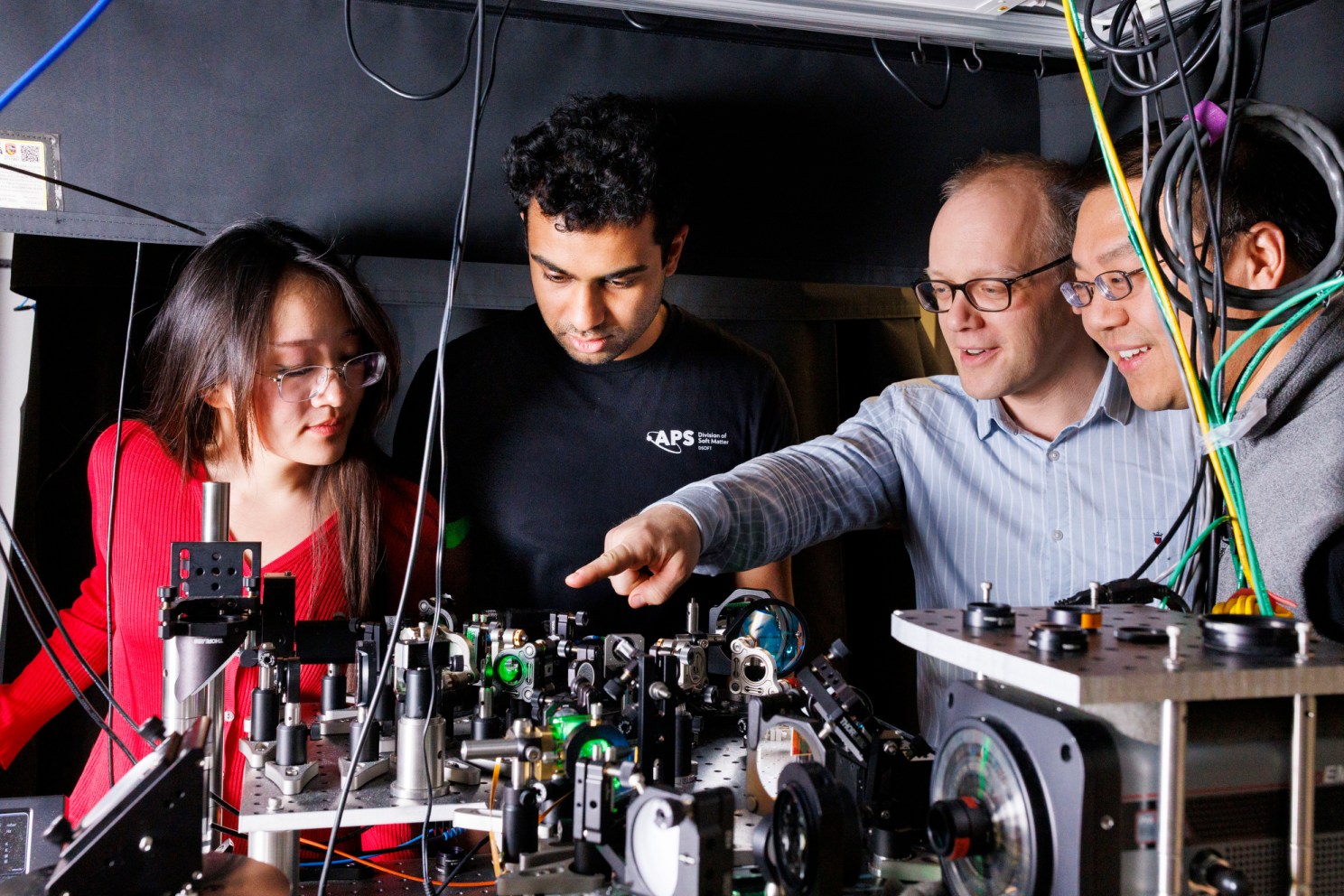
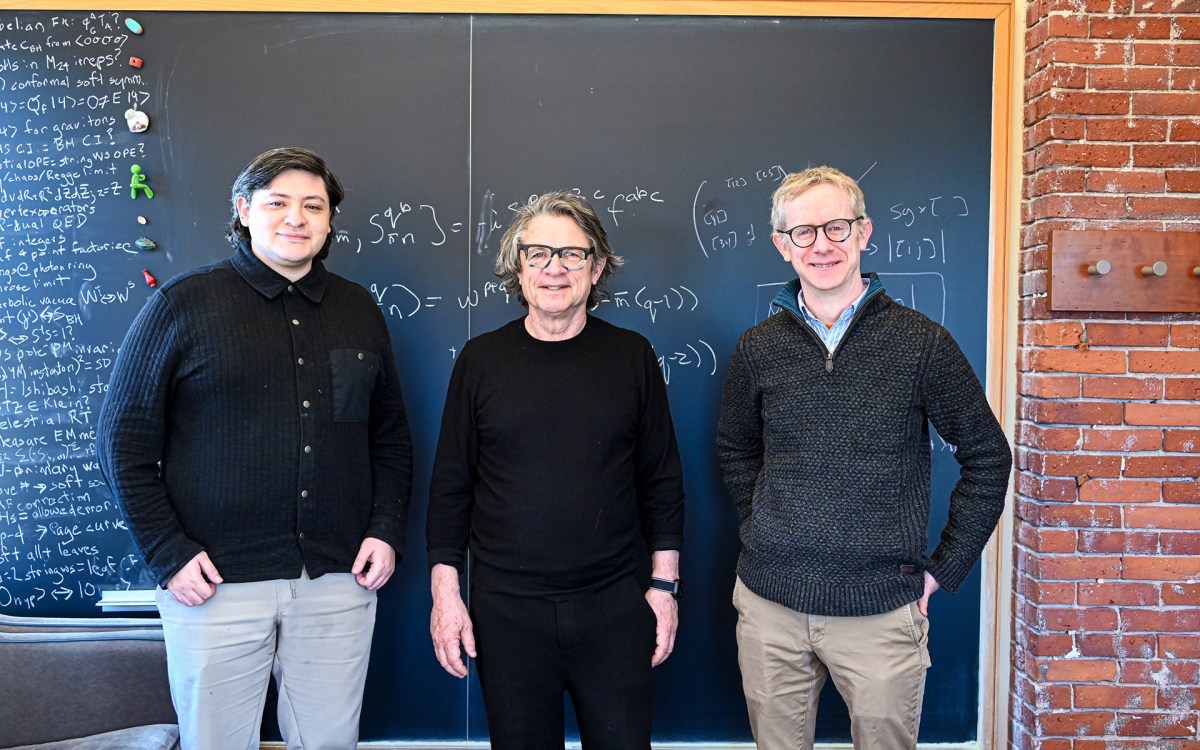
Chris Laumann (second from right) with graduate students Esther Wang and Srinivas Mandyam, and Norman Yao, a professor of physics.
Veasey Conway/Harvard Staff Photographer
University physicists gain new window into superconductivity by improving device pioneered by Harvard Nobelist Percy Bridgman
For more than a century, condensed matter physics has grappled with one of its greatest unsolved challenges: how to build superconductors that operate at room temperature and transmit electricity with no loss.
Now, in a paper recently published in Nature, a team of Harvard physicists has reported new insights into why one promising superconductor has yielded mysteriously uneven results.
The researchers used a novel method to study materials at high pressure by adding quantum sensors to a simple device pioneered by a Nobel-winning Harvard physicist in the last century, a tool that will likely prove useful to advance future work.
“We can ask questions at high pressure that we could never ask before,” said Norman Yao ’09, Ph.D. ’14, professor of physics and senior author of the new study. “And the question that we’ve been getting the most from our colleagues is: Can you measure our rock too?”
Most existing conductors cannot transmit electricity without some resistance and thus lose power (in the U.S., about 5 percent of electricity is lost in transmission but in some countries the losses amount to half of energy production). Superconductors have zero resistance — and thus no energy loss — making them potentially a revolutionary innovation.
In theory, better superconductors could make it economically feasible, for example, for wind farms in Siberia to power eastern Asia or solar panels in the Sahara Desert to supply Europe.
They also hold great potential in other applications such as magnet technologies, motors, maglev trains, high-energy particle accelerators, and magnetic resonance imaging (MRI) systems. Currently, MRI machines use liquid helium to bring the superconducting coils down to minus 452 degrees Fahrenheit.
Superconductors were first discovered in 1911, but practical applications long remained elusive because the materials require extremely cold temperatures.
One breakthrough came in 1986, when J. Georg Bednorz and K. Alex Müller discovered superconducting copper oxides, or cuprates, that worked at much higher temperatures than previously known materials (the pair won a Nobel Prize only 19 months later).
This revelation sparked a historic conference known as “The Woodstock of Physics” and the search for other “high temperature” (which here means not quite so cold) superconductors. Among the earliest proposed materials were the nickelates — layered nickel oxides that were chemical “cousins” of the cuprates.
In 2023, the first bulk nickelate superconductor was discovered. The discovery generated excitement, because the material had a critical temperature above the boiling point of liquid nitrogen (minus 320 degrees Fahrenheit, which, though deathly cold by human standards, is relatively warm for a superconductor), but also caution, because superconductivity emerged only under extremely high pressures.
This material proved to have puzzlingly uneven performance, and some scientists suggested only a small percentage of the material really was capable of superconductivity.
To better understand this mystery, a team led by Yao and Chris Laumann ’03, an associate professor of physics at Boston University, sought to study these materials at micron scale by adding some new tricks to an old technology.
In the first half of the 20th century, Harvard physicist Percy Bridgman conducted pioneering experiments of materials under high pressure by using a vice-like apparatus that squeezed samples between two cone-shaped anvils of steel or tungsten carbide (Bridgman won a Nobel Prize in 1946).
Later, other researchers switched the anvils to diamonds, one of the hardest naturally occurring materials on Earth. Besides hardness, diamonds offer another advantage: They can be turned into sensors.
By bombarding the diamonds with ions and baking them at high temperature, researchers create defects known as “nitrogen vacancy centers” that can detect magnetic and electric fields. In 2019, the Yao group became the first to add these nitrogen vacancy centers to the diamond anvil, allowing them to take new measurements of materials under pressures above 100 gigapascals — roughly those in the outer core of the Earth nearly 3,000 kilometers below the surface.
In the experiments, the diamond anvil cell — a device about the size of wine cork — and the sample are mounted on a rod and lowered into a cryostat, a refrigerator whose temperature can go down to 4 degrees Kelvin, or about minus 452 Fahrenheit.
A beam of green light is directed into the interior of the diamonds, the nitrogen vacancy centers fluoresce red, and the light bounces back up a series of mirrors into a photon detector. A complex series of operations boils down to this: Changes in the red fluorescence reveal tiny shifts in the local magnetic field around the nickelate sample, a phenomenon known as the Meissner effect and a key indicator of superconductivity.
“This nitrogen vacancy measurement is able to see superconductivity on significantly smaller-length scales and long before conventional methods that are based upon resistance,” said Srinivas Mandyam, co-lead author of the new paper and a Ph.D. student in the Kenneth C. Griffin Graduate School of Arts and Sciences studying physics. “When you’re trying to discover new compounds, this might pick it up much earlier than the usual way would.”
With this technique, researchers can map samples at millionths of a meter and correlate local superconducting behavior with temperature, pressure, stoichiometry (the ratio of elements in the material), and other forces including normal stress (compression) and shear stress.
“The tools that we’ve been developing as a group are quite special because you can really image functionality under pressure and determine where exactly the material acts as a superconductor,” said Yao.
The researchers adjust pressure like a “tuning knob.” Near the critical pressure, they saw the first evidence of superconductivity in localized regions. As they added pressure, these superconducting regions encompassed larger portions of the rock. They also discovered that superconductivity was curtailed by shear stresses.
Until now, the uneven results in nickelates had been attributed to a range of possibilities, such as inhomogeneities in chemistry and structure. The new study reveals that a single sample really should be seen as a collection of micron-scale localities that behave differently.
These insights could help engineer more efficient materials — a small step toward the ultimate goal of superconductors that work at ambient temperatures and pressures.
Laumann, a frequent collaborator with the Yao group, said the new tools would allow researchers to “sniff around this neighborhood better,” and more deeply investigate the properties of the varied types of superconductive materials discovered so far.
“It’s like if a tree falls in the woods and nobody’s there to hear it, does it make a sound?” said Laumann. “If nobody is there to tell you, it’s just not something you can see or discuss. The fact that we can now make these local measurements opens up a whole new range of questions.”