Featured series


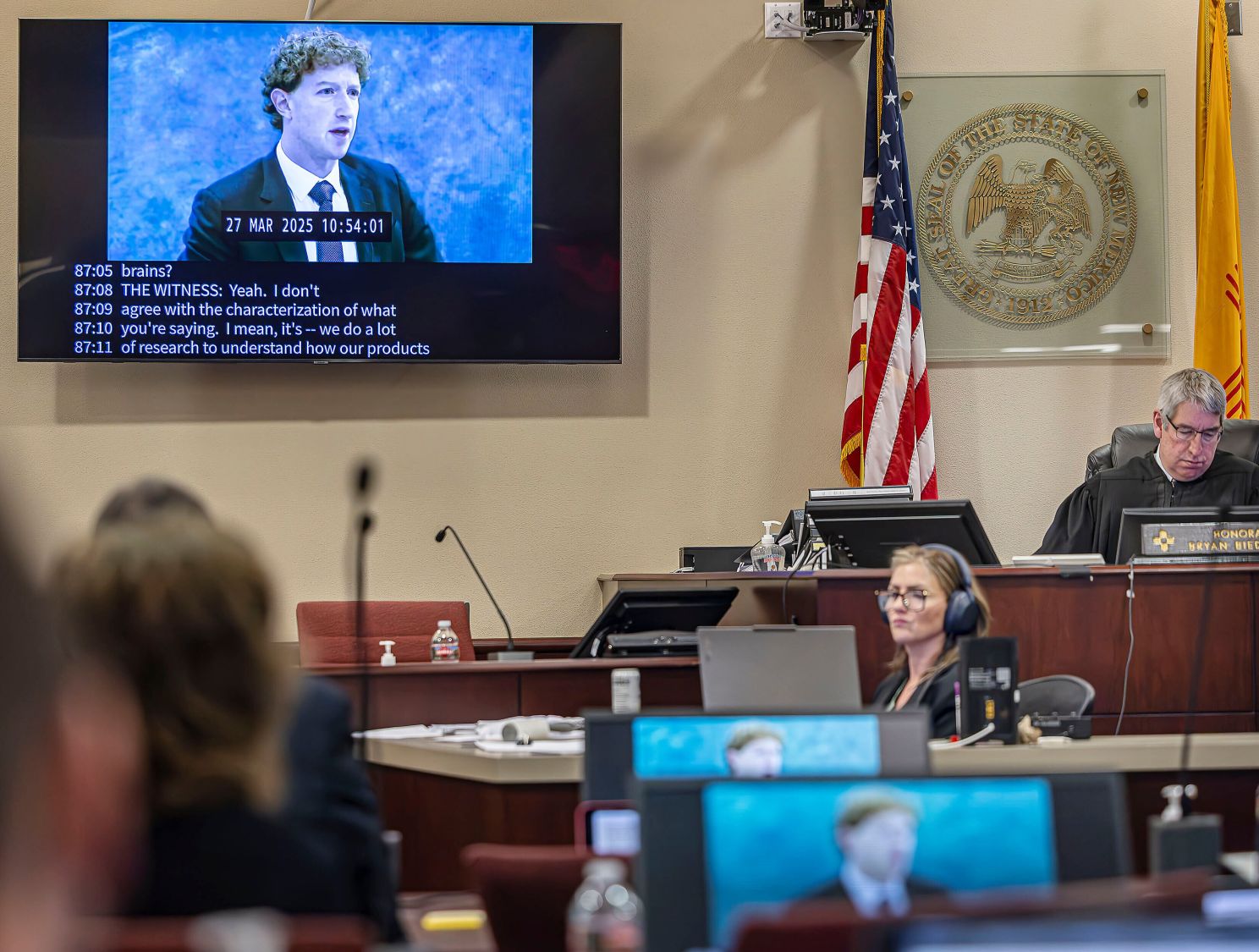
Meta Founder and CEO Mark Zuckerberg’s deposition is played for jurors in Santa Fe, N.M., earlier this month.
Photo by Jim Weber/Santa Fe New Mexican via AP, Pool
Nation & World
Social media firms lost two bellwether cases, but future remains unclear
Legal scholar on next move for tech giants, chances of ‘master settlement,’ more
Juries in federal and state courts said this week in a pair of bellwether cases that tech companies are liable for public health harms to young users on their platforms. The decisions represent a blow to the broad protections long enjoyed by firms against legal liability for user content posted on social media websites.
In Los Angeles, a 20-year-old woman sued Meta, which owns Instagram and Facebook, and YouTube, successfully argued the tech giants designed their platforms with addictive features that targeted teens and children. A jury awarded her $3 million.
A jury in New Mexico found that Meta had violated state consumer protection law by failing to safeguard minors from online sexual predators and misleading the public about its safety. The company was ordered to pay $375 million in damages.
In this edited conversation, I. Glenn Cohen, the deputy dean and James A. Attwood and Leslie Williams Professor of Law at Harvard Law School, and faculty director at the Petrie-Flom Center for Health Law Policy, Biotechnology & Bioethics, discusses the verdicts and what they mean for social media’s future.
The federal trial in Los Angeles was a very closely watched case. How significant is this?
The verdict is significant for the plaintiffs, but standing alone, [it’s] not a huge amount for Meta or YouTube to pay. Compare this to the $375 million verdict in the New Mexico attorney general’s case (on a different legal theory) to see the difference in scale.
But the key is that this is just the first of thousands of filed cases. It is one of several bellwether trials meant to play out the various legal theories, defenses, and settlements.
If Meta or YouTube had to pay the same amount of damages in each of the cases that would be a very large liability, but all evidence suggests that the plaintiffs were strategic in choosing to start with this case, which may have particularly compelling facts about damage to the plaintiff.
At the same time, even if other cases in the set are less compelling, the large amount in this case likely will serve as an “anchor” to other plaintiffs in any settlement negotiation and may make the plaintiffs hold out for a higher dollar amount in any settlement.
TikTok and Snapchat settled out of this case for undisclosed sums. For Snapchat, which is a much smaller company, I think this just increases the stakes for them if they have many more cases to come.
The plaintiff argued an untested legal theory — that social media companies intentionally design these platforms so that children and teenagers get addicted to using their products. Were you surprised by the verdict?
Not particularly. I might have guessed that the punitive damages — meant to punish the defendant beyond what is needed to compensate the plaintiff — might have been higher still.
How do you expect Meta and Google, which owns YouTube, will react?
I think they are likely to appeal the case. They may have other grounds, but they are almost certain to argue on appeal that Section 230 [of the 1996 Communications Decency Act, which shields online platforms from liability for third-party content posted on websites] should have prohibited their liability, and perhaps other arguments about how the trial was conducted — so, evidence that they think should have been excluded, for example, that was included.
I am sure they will do a deep dive as to what they believe swayed the jury and retool their arguments for the next several bellwether cases.
Should they appeal, argue that, and win, the amount suggested by the jury will never be paid.
Twice this week, juries found social media companies liable for harm involving children. Do these losses in state and federal court suggest something larger is afoot on the issue of social media liability or is it too soon to say?
I think it is a bit too soon to say, but it does lend some credence to the comparison my co-authors and I have made in a recent article to tobacco and opioid litigation. As in tobacco, different kinds of plaintiffs (here: children, AGs) are advancing different theories at the same time in a sort of pincer movement on the social media companies.
As the liability risk piles up, a master settlement that will handle all or much of the litigation becomes more attractive.
It is harder to say what effect it will have on legislative action by Congress — whether it makes legislators more interested in intervening in new regulation or makes them more content to let tort law play out in the courts.