Featured series

Nation & World
Two Americas, then and now
Photos by Niles Singer/Harvard Staff Photographer
Panel featuring filmmaker Ken Burns probes ‘disjunction’ between Declaration of Independence and the Constitution
The Declaration of Independence, with its assertion of human equality, is akin to America’s “vision statement,” said historian Vincent Brown, Charles Warren Professor of American History. He sees the Constitution, threaded with compromises on individual rights, as more like the country’s “operating manual.”
“The disjunction between the vision statement and the operating manual is part of the dilemma of the United States and its history,” he said.
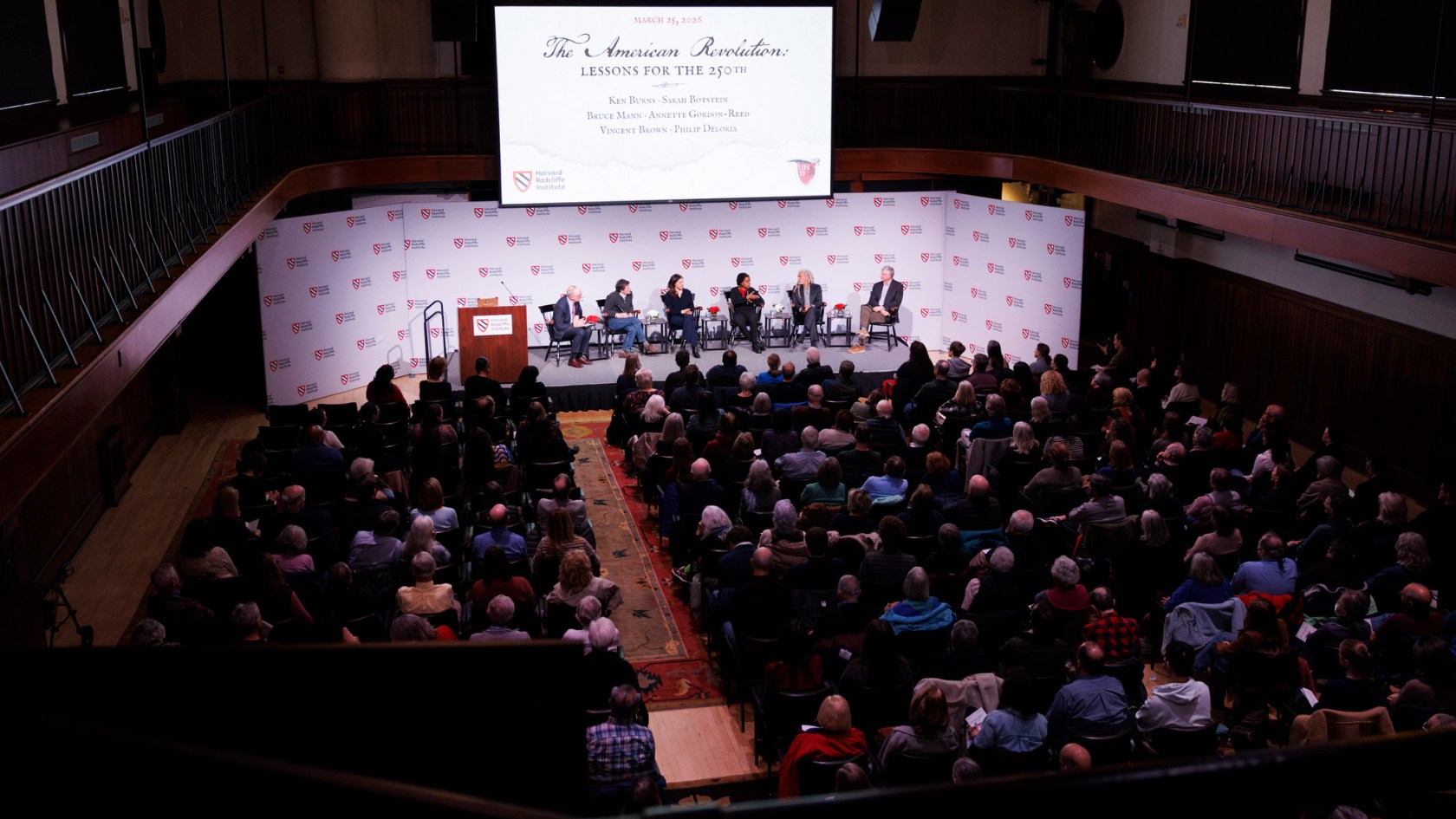
Brown was one of three faculty from Harvard’s History Department to join filmmakers Ken Burns and Sarah Botstein for a conversation that mined the nation’s founding for lasting lessons. The March 25 event, co-presented with the Radcliffe Institute for Advanced Study, was offered as part of the History Department’s “Harvard in 1776” series. It showcased Harvard experts who appear in Burns and Botstein’s new PBS documentary, “The American Revolution.”
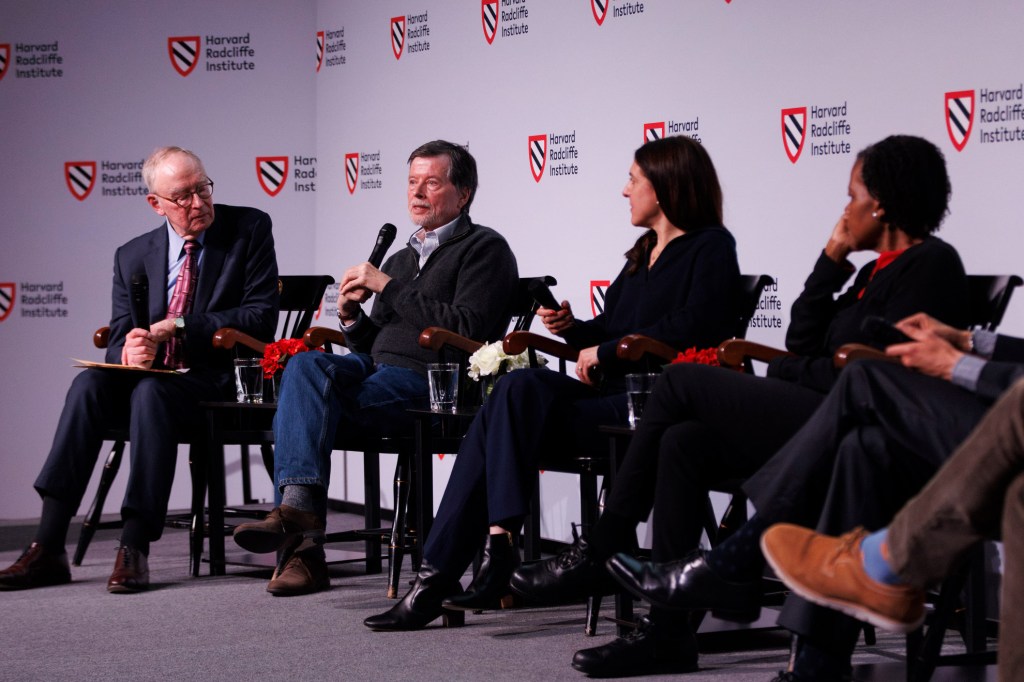
“It’s only fitting that we’re doing this with these people on stage,” said moderator Bruce H. Mann, Carl F. Schipper Jr. Professor of Law at Harvard Law School, who quipped that the 12-hour series is “largely told by the Harvard History Department,” including six of its current and former faculty (with interviews featuring the late Bernard Bailyn).
The audience at the Knafel Center was treated to clips from each of the film’s six episodes. Brown, also a professor of African and African American studies, was seen talking about how Britain’s 18th-century colonies in the Caribbean, with their vast numbers of enslaved laborers, were far more profitable and powerful than those on the Atlantic seaboard. Panelist Annette Gordon-Reed, Carl M. Loeb University Professor and professor of history, covered Thomas Jefferson, primary drafter of the Declaration, and his lifelong relationship to slavery, an institution he knew was wrong. Panelist Philip Deloria, Leverett Saltonstall Professor of History, recalled that Continental Army recruits were promised Native American land.
The documentary foregrounds community impacts — including those felt by women, enslaved Black Americans, and the poor who came to dominate Gen. George Washington’s army — in uncovering the Revolution’s complex military and political history.
“We want the film to be somewhat inspirational, a little bit patriotic, and for audiences to care about American history — to care about where we’ve been, so they can understand where we are now and how to fight for a better future,” Botstein said.
Mann asked how that telling differs from what panelists grew up with.
“One of the things you get from the documentary is that this has always been a multiracial, multicultural country,” said Gordon-Reed, author of the Pulitzer Prize-winning “The Hemingses of Monticello: An American Family” (2008). “Growing up in Texas, the vision I got was that it was a story from when the country was white.”
“For me, one of the things that’s been so lovely is that Ken and Sarah have been so committed to surfacing Native American stories,” said Deloria, whose research focuses on the history of relations between Indigenous peoples and the U.S.
The conversation kept returning to the aspirational language found in the preamble to the Declaration of Independence. It was a “time-bomb of possibility,” observed Burns, noting its immediate resonance with those on the margins of late-18th-century society.
The filmmaker credited President Abraham Lincoln, among others, with later elevating the Declaration and its ideas to the lofty status they now enjoy in the popular imagination. “It’s very interesting that the Gettysburg Address, which we argue is one of the great speeches, begins with a nod to the Declaration — not to the Constitution,” he said.
Drawing further on the disharmony between these documents, Brown articulated a “mission” standing before Americans today. “How do you take the utopian content of ‘all men are created equal, all people are created equal’ and reconcile that with all the compromises found in the Constitution and all the history that has ensued since?”
To that point, Mann closed by asking what the Revolution can teach the nation on its 250th birthday.
“This is probably the first time that I thought more about the grievances of the Declaration than the Preamble,” answered Gordon-Reed, referring to the document’s lengthy list of charges against King George III. “You start thinking, ‘What does tyranny mean? What were these people rebelling against?’ The lesson is that the experiment is ongoing. The people have to be vigilant; they have to be involved.”
Deloria underscored Gordon-Reed’s point with a story from rural Michigan, where he proposed a community reading of the Declaration last summer. “Many people said, ‘No, it’s too political,’” he recalled. “I think what that tells us is we must fight. Not only for the principles in the Declaration, but for the right to speak the Declaration itself.”