Featured series

Science & Tech
What exactly is consciousness? (And does my Venus flytrap have it too?)
In new book, author Michael Pollan explores nonhuman sentience, stream of thought, AI
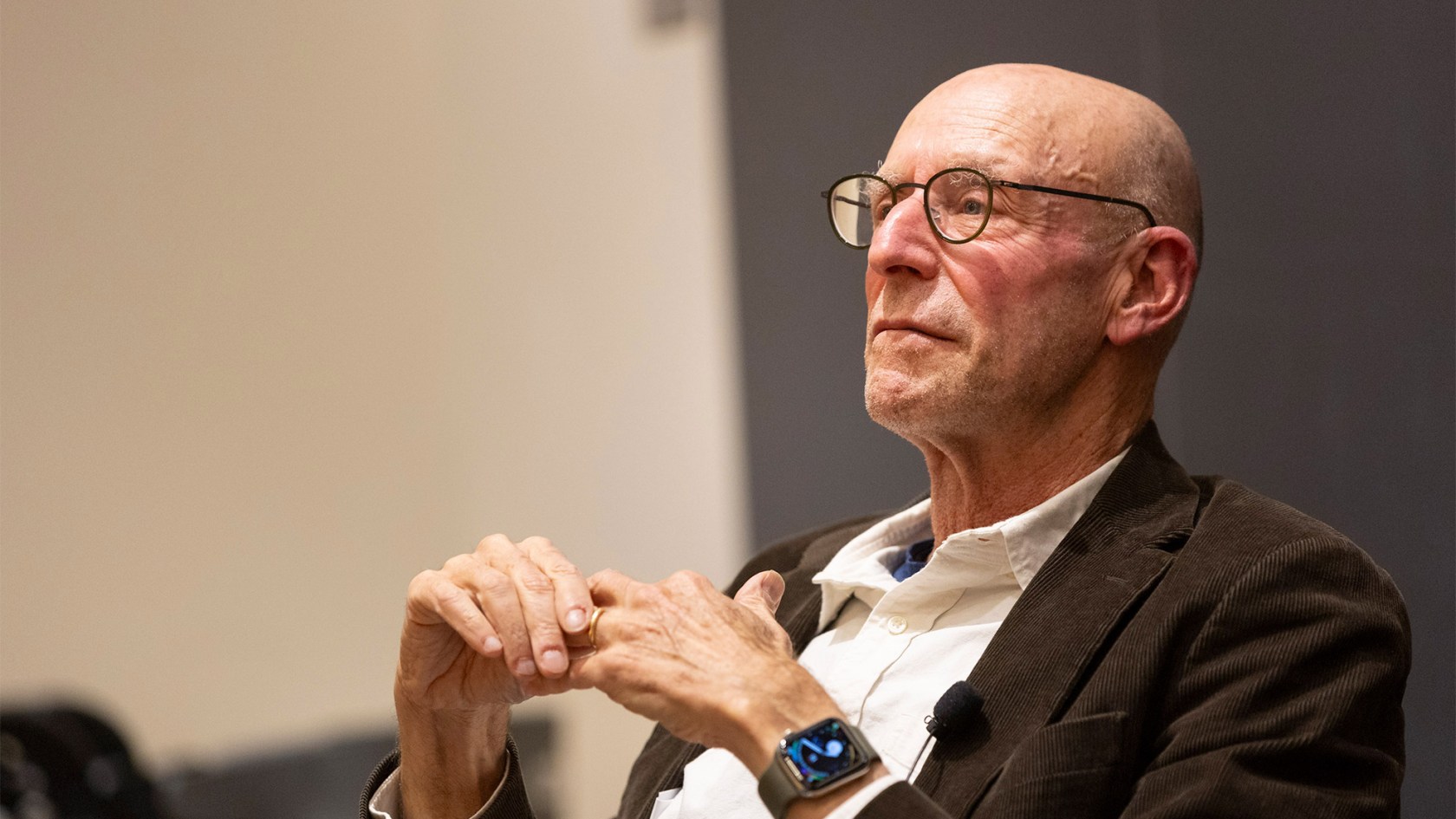
Michael Pollan.
File photo by Niles Singer/Harvard Staff Photographer
The brain is constantly managing a myriad of bodily functions, and most of them happen without our being aware of it. So why do some operations rise to the level of awareness?
That’s the question at the heart of Michael Pollan’s just released new book, “A World Appears: A Journey Into Consciousness.”
Pollan is the award-winning author of 10 books, including “This Is Your Mind on Plants” and “How to Change Your Mind,” and is the Lewis K. Chan Arts Lecturer and professor of the practice of nonfiction, emeritus. His latest book takes insights from science, literature, philosophy, spirituality, and psychedelics to turn the spotlight of consciousness on itself and explore what it is — and whether only humans have it.
Pollan will discuss the book with Louisa Thomas, a staff writer at The New Yorker and a lecturer in creative writing at Harvard University, on Thursday at the First Parish Church in Cambridge.
This interview has been edited for length and clarity.
You start by defining the “hard problem” of consciousness that the book sets out to explore. What is that hard problem?
It was set forth by a philosopher named David Chalmers back in 1994, and he basically said, “How do you get from matter to mind? How do you get from three pounds of brain tissue to subjective experience, having a voice in your head? You’re not aware of about 90 percent of what the brain does, so why do we have this space of interiority? Why isn’t everything the brain does completely automatic?”
This is a problem that neuroscientists have been working on since about the late ’80s. Before that, consciousness was not considered a respectable subject for scientists to delve into, so there was remarkably little work done.
So the book is really a look at the modern attempt to understand consciousness by both scientists and other kinds of thinkers.

There are a lot of theories about what consciousness is, and Chalmers is kind of a key figure in judging the relative success of each.
Yes, he’s very good at that. He takes any new theory of consciousness and applies himself to it until he hits a wall. He sort of serves the field as a kind of superego.
But a surprising number of scientists look to him as an arbiter of what is or isn’t a good theory. It’s an interesting phenomenon, because you don’t usually have science deferring to philosophy, but this is an area where that’s the case.
Why do you think that is?
It’s possible that we don’t have the right kind of science to solve this particular problem. All we have to understand consciousness is consciousness: The whole scientific enterprise is a manifestation of human consciousness. We can never step outside of it, and that makes it a uniquely difficult problem.
Also, for the last 400 years, science has organized itself around the idea that it should focus on objective, measurable, quantifiable reality, and leave subjectivity to the church. That was Galileo’s bargain, and it still holds.
The tools we have to understand what is finally a subjective experience are limited, and I argue it may take a revolution in science to solve the problem. It may take science learning how to incorporate phenomenology — lived experience — into its methodology before we can solve this problem.
That’s not to say we can’t learn a lot about consciousness. We’re all experts in it. Novelists and poets also know an awful lot about consciousness, so I turn to them as well as scientists.
What are we actually talking about when we talk about consciousness?
In the book I move from the simplest to the most complex manifestations of consciousness, starting with sentience. There are people who would say consciousness and sentience are the same thing, but I see an important difference.
I think sentience is a simpler, more basic form of consciousness. All it requires is an awareness of one’s environment, the ability to distinguish beneficial changes from destructive changes, and to move toward one and away from the other. Even bacteria have this: Chemotaxis is the bacteria’s ability to recognize dangerous molecules and food.
I think sentience may be a property of life that you need to deal with in a world that’s complex and ever-changing and unpredictable, and it may be that every living thing does sentience in a different way that suits their needs, the scale at which they live.
A group of researchers who call themselves plant neurobiologists (it isn’t exactly neurobiology, since no neurons are involved; I think the name is meant to troll more conventional botanists) are doing fascinating experiments that show, for example, that plants can be rendered insentient.
If you expose a Venus flytrap to xenon gas, which is a bizarre kind of anesthetic, they won’t react when a fly crosses their threshold. Another plant, Mimosa pudica, can be taught not to react, not to close its leaves, to false stimuli. It can remember the lesson for 28 days.
Also, the root of a corn plant can navigate a maze to find fertilizer. There are vines that change leaf shape depending on what plant they’re curling their way around.
I wouldn’t call that consciousness. I don’t think plants have interiority the way we do. But plants have more than instinct. They’re capable of intelligent decision-making.
You go on to talk about feeling as this next layer of consciousness. Why do feelings play such a big role in your framework for consciousness?
For a long time, scientists assumed consciousness had to be this cortical phenomenon. It had to be tied to rational thought, the kinds of things only we humans can do.
But a neurologist named Antonio Damasio, beginning with his book “Descartes’ Error,” showed that maybe feelings come first, that consciousness may be a product not of the cortex but of the upper brainstem. I think he makes a persuasive case.
Let’s say you have a feeling of hunger. That’s a basic sensation generated in your body, and your cortex is enlisted to make a reservation for dinner or imagine various counterfactuals that could get you fed. So the cortex is involved, but it comes into the picture later.
If you believe that feelings are the basis of consciousness, there are a couple of implications. One is that it helps make the case that animals, which have similar structures in their brain stems, are conscious. The other implication is questioning whether machines can become conscious. Machines are pretty good at thinking, but they’re much less good at feeling.
Feelings are grounded in biology; feelings are the way the body communicates with the brain. And feelings depend, I think, on the fact that we can suffer, perhaps on the fact that we’re mortal. You could ignore a feeling completely if there wasn’t a sense of vulnerability attached to it.
So I’m just not convinced that computation can describe everything a brain does. Our thought processes are so nuanced and subtle, it’s hard to attribute that to computation.
What did you learn about your own thought process through writing the book?
Scientists seldom look at the contents of consciousness, which is our thoughts. But I worked with a psychologist named Russel Hurlburt, who has spent the last 50 years sampling what he calls inner experience.
If you participate in his experiment, as I did, you wear a beeper, and over the course of the day, at completely random times, it sends a beep into your ear, and you have to write down exactly what you were thinking at that moment, however banal or profound. (In my case, it was always banal.)
And then he interrogates you. He says, “Were you thinking in words, in images, or in unsymbolized thought?” If you were thinking in words, were you speaking them or hearing them? He really drills down.
In my case, he came to the conclusion that I had very little inner experience. I was offended by that, because I think I have plenty of inner experience, but he couldn’t find it.
After 50 years, his biggest finding is that we don’t know that much about how we think, and that different people think in different ways.
At certain points reading the book, I got so interested in analyzing my own thinking that I stumbled over the act of reading.
Yes! One of the things I’m trying to do is defamiliarize consciousness. You know, my experience with psychedelics is partly what got me interested in consciousness, as has happened to millions of other people who have used them.
Going through life, reality seems transparent to us. We forget we’re looking through the windowpane of our consciousness. But it takes consciousness for the world to appear to us.
Psychedelics kind of smudge the windowpane so that we become aware of this miracle. I’m hoping the book will do the same, without any chemical assistance.
In the end, I shift from focusing on the problem of consciousness to focusing on the astounding fact of it. We’re given this gift of consciousness, and we’re giving it away thoughtlessly to companies that want to profit from it — by buying and selling our attention, and, with AI, our emotional attachment.
I’m hoping people will leave with a sense that this is really precious, this space of privacy and freedom that we have, and we have to defend it.