Featured series


Arts & Culture
‘The sound stopped suddenly’
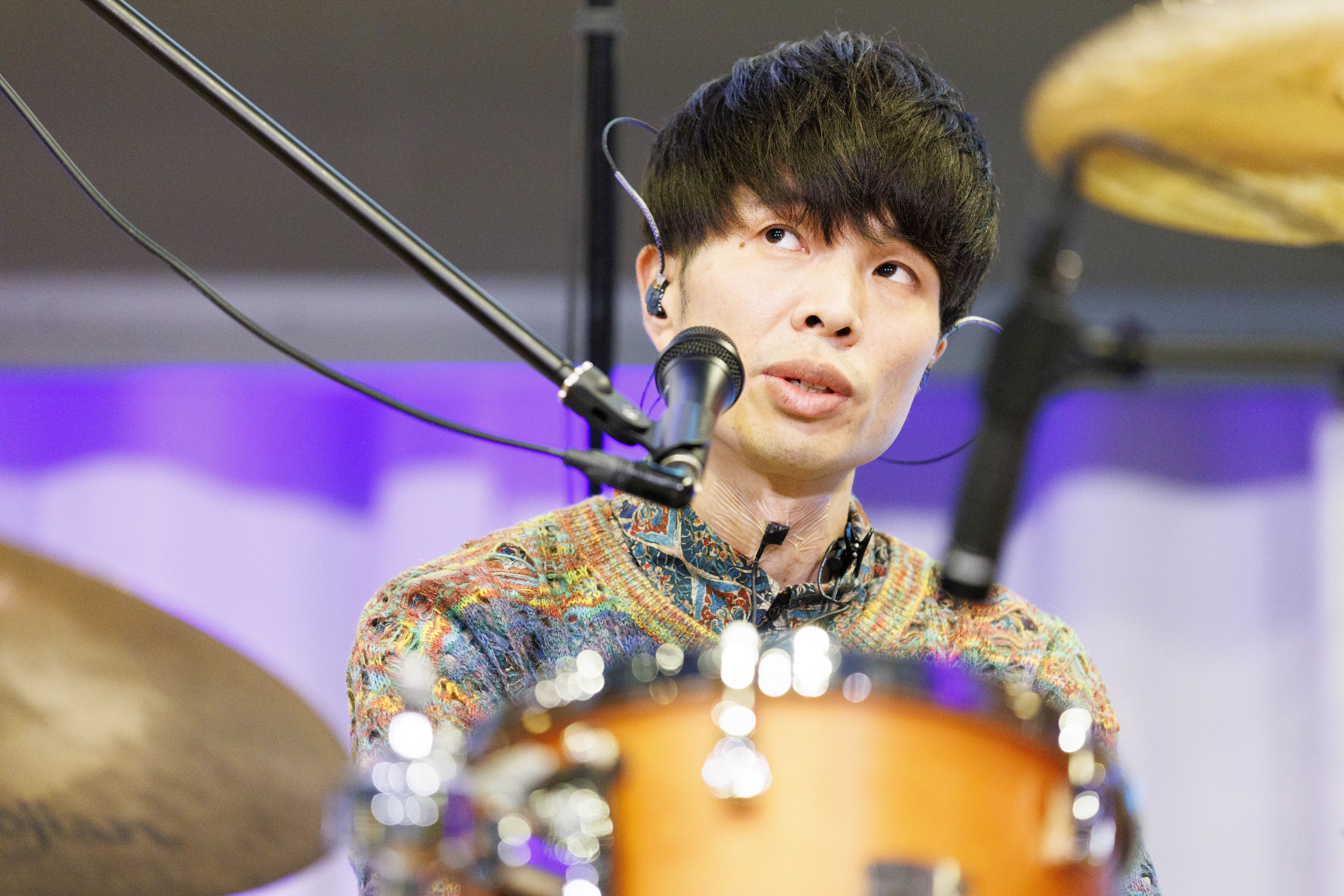
Satoshi Yamaguchi.
Veasey Conway/Harvard Staff Photographer
After rare condition robbed drummer of ability to play music, science led him back
The first symptoms appeared during a concert.
In 2009, Satoshi Yamaguchi, a drummer with the Japanese rock quartet RADWIMPS, found himself lost during a familiar bridge.
“The sound stopped suddenly,” Yamaguchi recalled in a 2023 TV news interview with NHK World-Japan. “I wanted to use my right foot to hit the drum twice, but I ended with the first try. At that instant, my brain really drew a blank. I thought, ‘What’s going on?’”
It took five years to receive the diagnosis of musician’s dystonia, which causes involuntary muscle spasms. The neurological disorder, impacting roughly 1 percent of professional musicians globally, eventually forced Yamaguchi’s exit from the band he had co-founded in 2003. But it also opened a remarkable new chapter in the percussionist’s story.
In a recent event hosted by the Reischauer Institute of Japanese Studies, Yamaguchi recalled his journey from rock stardom to scientific researcher intent on solving the mysteries of his condition. He also showed off the voice-activated drum kit that enabled his return to live performance in 2024, nearly a decade after he left RADWIMPS.
“My children had only ever seen me play the drums on the screen,” Yamaguchi recalled, sharing a photo of his family of five. “This was the first time they heard me perform live.”
Key to Yamaguchi’s trajectory was drummer-turned-scientist Shinya Fujii of Keio University’s NeuroMusicLab. The pair, who met when Yamaguchi arrived as a visiting researcher in 2021, went on to pursue a series of academic inquiries into musician’s dystonia.
Their first paper, published in 2024, charted the disorder’s impact on Yamaguchi’s musicianship. The effects may seem subtle to the untrained ear. But when symptoms appeared, the researchers confirmed, the drummer fell out of rhythm with a metronome.
For Yamaguchi, the findings came as a relief. “When I was still active in the band, I had no way to share the difference or the struggle with the people around me,” he told a packed house at Smith Campus Center. “But through science, I was finally able to reveal the true nature of that ghost.”
“When I was still active in the band, I had no way to share the difference or the struggle with the people around me. But through science, I was finally able to reveal the true nature of that ghost.”
Satoshi Yamaguchi
Inspired, Yamaguchi went on to conduct a large-scale survey of professional and amateur Japanese musicians. Results show musician’s dystonia is more prevalent among pros, with the right lower limbs most frequently afflicted.
Also uncovered was a potential link with the stress caused by in-ear metronomes, increasingly used in the music world by drummers, conductors, and other designated timekeepers. The devices dictate the rhythm of each piece, with a click track delivered directly to the eardrum.
“In recent years,” Yamaguchi explained, “large-scale live performance has evolved into a total entertainment experience that includes not only listening to performance, but also synchronizing the music with visuals, lighting, special effects, and programmed sound sources.”
In 2023, Yamaguchi moved to the Bay Area for a residency at Stanford University’s Center for Computer Research in Music and Acoustics. It was an unlikely place to discover the joys of taiko drumming, a traditional Japanese art form. He ended up performing in a 50th anniversary concert with the group San Jose Taiko.
The art form’s whole-body rhythms are taught orally — not via sheet music, Yamaguchi noted. While learning this way, he was struck by an idea. “What if I could use my voice to create the sound of the bass drum?” he recalled wondering. “My voice could become my instrument.”
Developed in collaboration with Yamaha, VXD is a bass-drum interface operated via vocal cues and throat sensor. Yamaguchi met privately last week with scientists from the Harvard Biodesign Lab, who wanted to understand how the system works. At the public event, Yamaguchi showed off VXD by playing a few RADWIMPS favorites.
An audience member gasped with delight when he started drumming “Sparkle,” featured in the 2016 hit anime film “Your Name.” Also performed were early releases “25-kome no senshokutai” (“The 25th Chromosome”) and “Iindesuka?” (“Is It Alright?”).
“Music has given me life,” Yamaguchi said near the end of his talk. “Music has also caused me pain. I lost it once, and then I found my way back to it — and it saved me.”
The event closed with the high-energy “Zenzenzense” (“Past Past Past Life”), which was also featured in “Your Name.” Yamaguchi pursed his lips into the microphone as he repeated the “don” syllable that triggers the VXD system’s bass drum. His right foot, pressed firmly to the floor, appeared as an anchor. The rest of his body was lifted by the beat.