Featured series
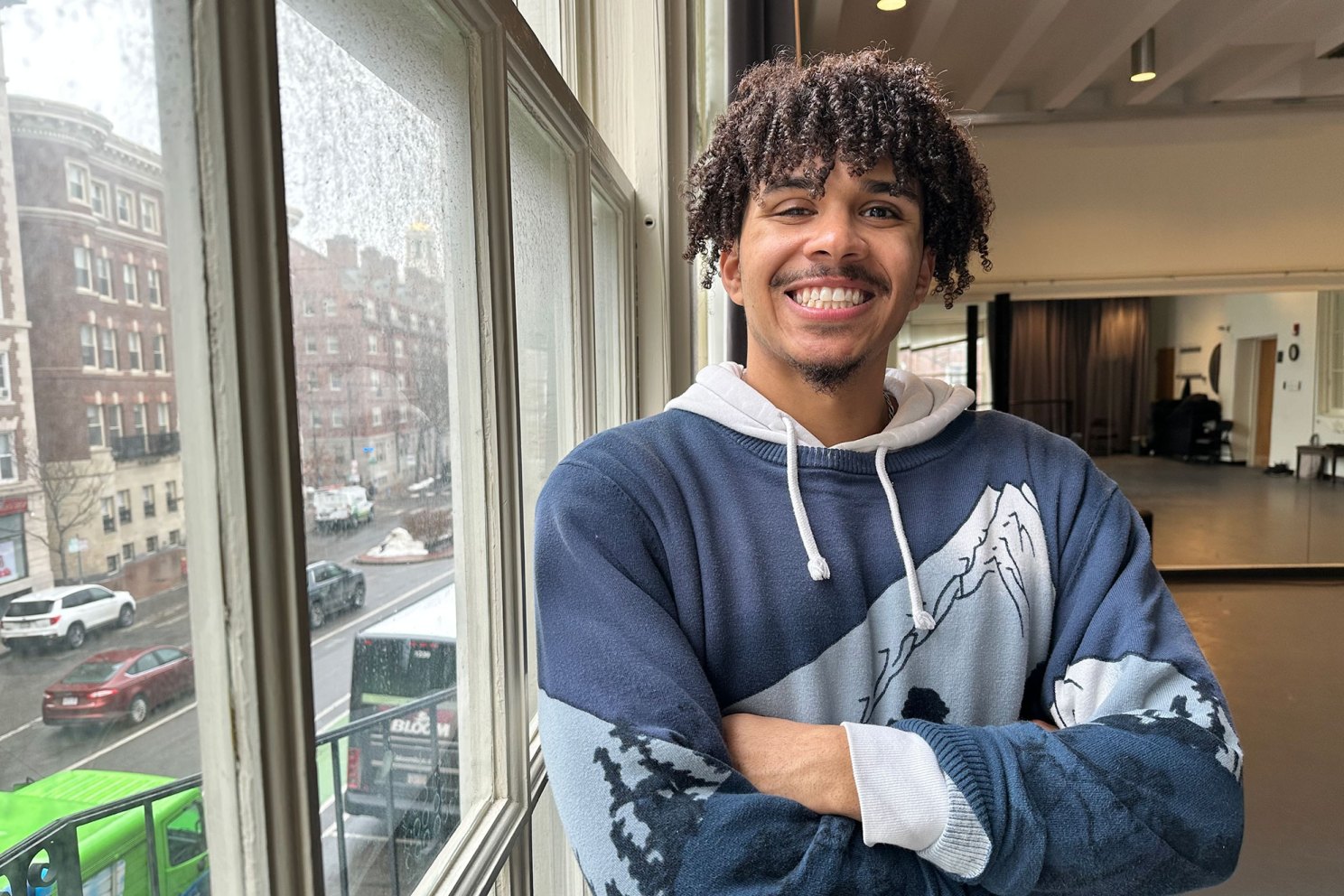
Quadree “Dree” Palimore.
Lauren Fabiszak/Harvard College
Arts & Culture
Retelling Frederick Douglass’ story, with a soundtrack
Senior composes musical about abolitionist’s early life
Quadree “Dree” Palimore paced the floor in a campus studio recently as Yerim Colin prepared to sing. The students were workshopping a number from Palimore’s original musical — an ambitious retelling of the life of Frederick Douglass.
“It’s been 30 days of your freedom, 30 days of you having your own identity,” Palimore prompted Colin. “What’s on your face, how are you going to express that to an audience? Think about that during the opening segment.”
The idea for the musical came to Palimore, now a senior, as a first-year, when a writing course on slave chronicles had him read the abolitionist’s memoir, “Narrative of the Life of Frederick Douglass.” He was inspired, in part, by Douglass’ relationship to music.
“In his ‘Narrative,’ he writes a lot about the role music had played for him as a slave, how he remembered hearing slave songs,” Palimore explained. “He wrote a lot about what he believed the power of music to be. That was compelling to me. There is power in a story. I think the use of song and music can elevate these emotions and experiences that this young man was facing.”
The first song came to him one day during sophomore year, while jamming with friends in Eliot House. His friends set down their guitars and left to take a break, but Palimore stayed, chasing notes on the keyboard.
“I had never written my own song. But I knew when I played that melody for the first time, that it felt different,” he recalled. “Out of the blue, I started playing the first melody ever for the musical.”
Now in his final College semester, Palimore is finishing the writing process for his musical, titled “Bailey: An American Narrative” after the abolitionist’s birth name. The show spans the seven-year period from October 1838 (about a month after 20-year-old Frederick Bailey escaped slavery in Maryland) to 1845, the year he published his memoir.
“The moments right before changing his name to Frederick Douglass feel important to me, because those were the days when he was making the big moves to do the things that he really wanted to do,” Palimore said. “I constantly think about how he reconciled being free with having that history attached to his name. How did he cry about it? How did he overcome it? How did he try to run from it?”
Palimore conducted extensive historical research, dug in the archives, and consulted Harvard experts, including Evelyn Brooks Higginbotham, Victor S. Thomas Professor of History and of African and African American Studies; Henry Louis Gates Jr., Alphonse Fletcher Jr. University Professor; and John Stauffer, Sumner R. and Marshall S. Kates Professor of English and of African and African American Studies.
But much of his writing process has also been imaginative. Palimore is fascinated by the idea of Douglass at his own age, and while writing his sections of dialogue tries to envision what the young abolitionist would have thought, journaled, and prayed about.
The music in the show is a mix of genres: rap and spoken word, some jazz, gospel, and orchestral. Palimore was also inspired by 19th-century music and has arranged what he’s calling a “2025 version” of the 1840s anti-slavery song “Come Join the Abolitionists.”
A vocalist and member of Harvard Glee Club, Palimore had only beginner piano chops and no composing experience when he began the musical, but he dove into learning. He declared a secondary in Theater, Dance & Media, signing up for courses such as “The Making of a Musical: The Creative Process” with Professor of the Practice of Theatre Diane Paulus and head of dramaturgy Ryan McKittrick, and “Beginning Acting” with head of directing Marcus Stern. He transferred from Mather House to Eliot, to be closer to the friends with whom he freestyled.
“Just being at Harvard, there are a million opportunities, so I tried to take as many as I could. Academic opportunities, of course, but also having access to piano rooms in the music building.”
Quadree “Dree” Palimore

Yerim Colin ’27 with Palimore at the piano.
Lauren Fabiszak/Harvard College
In the summer of 2024, Palimore did a directing internship at the A.R.T. for “Romeo and Juliet.” He attended an Office for the Arts vocal workshop with “Hamilton” actor A.D. Weaver and presented material from “Bailey” at the OFA’s Creative Careers Conference.
“Just being at Harvard, there are a million opportunities, so I tried to take as many as I could,” Palimore said. “Academic opportunities, of course, but also having access to piano rooms in the music building.”
Stew Stewart, professor of the practice of musical theater writing, has served as a mentor to Palimore during this project.
“Dree is a bracingly unique student whose fierce intelligence and visionary ambition fuels a passion for learning and creating that gave me the feeling of collaborating with an equal, more so than merely a professor passing on wisdom and knowledge,” Stewart said. “The more a student brings to the table the more we have to work with, and Dree’s got enough stuff for a few tables.”
Realizing he needed time to focus solely on writing the musical, Palimore took a gap year after junior year. He lived at his family home in Urbandale, Iowa, and worked at Target, melodies running through his head as he operated the elevated lift in the stockroom.
“I would take my 15-minute breaks and put my AirPods in and listen to the songs that I was composing, and I would take notes in my Pages app on my phone,” Palimore recalled. “I would be excited to go home to work on it.”
Palimore is planning a first table read of the show for April. He dreams about his work being performed on bigger stages in the future.
“Nothing else had ever brought me such fulfillment, staying up until 3 a.m. composing a work and then dreaming about it that same night, and then waking up at 7 a.m. and immediately pick up my laptop to implement those cello parts,” Palimore said. “I had never felt a certain way about anything before. The opportunities and experiences at Harvard revealed to me that art is what I want to do for the rest of my life.”