Featured series

Arts & Culture
Moved by what’s missing in Homer’s ‘Harrow’
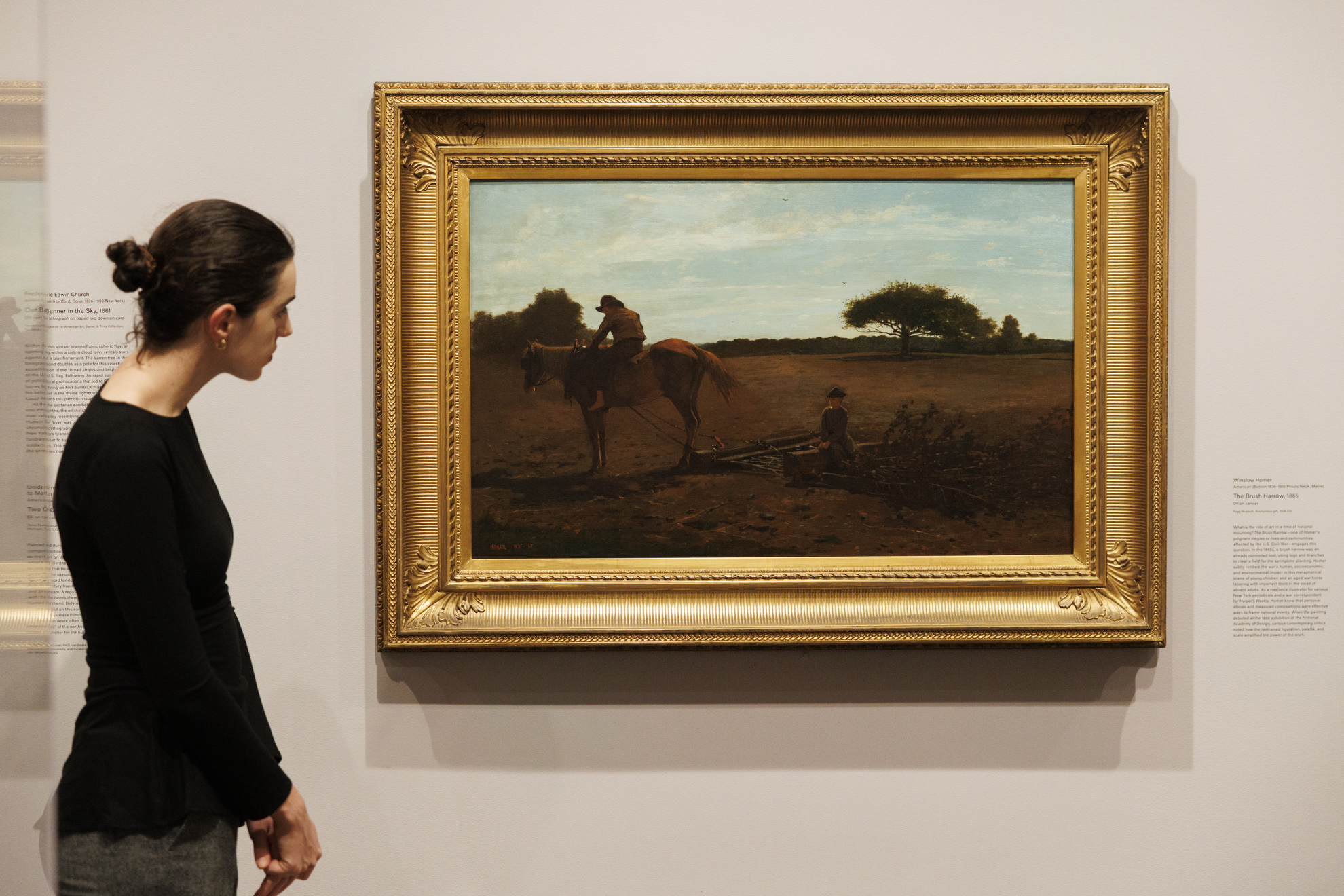
Winslow Homer’s “The Brush Harrow” was the focus of the first in a series of talks marking the 250th anniversary of the signing of the Declaration of Independence.
Photos by Niles Singer/Harvard Staff Photographer
Curator launches series steeped in U.S. history
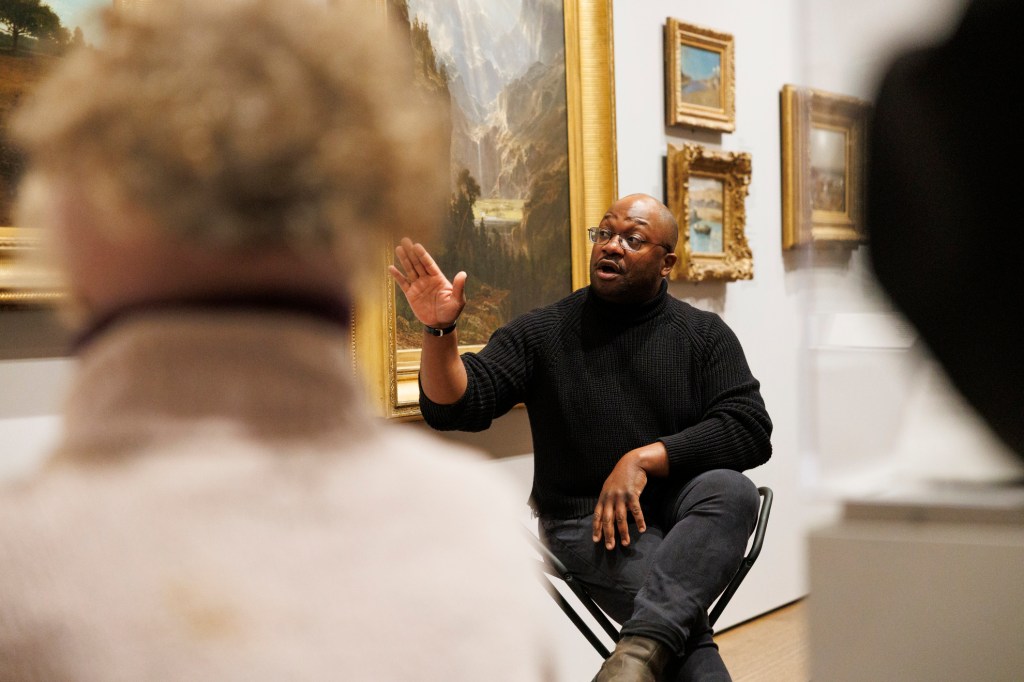
At first sight, Winslow Homer’s “The Brush Harrow,” which depicts two young boys, a horse, and a harrow against an arid landscape, evokes a feeling of somber isolation — but it’s hard to pinpoint why. During a talk by curator Horace D. Ballard at the Harvard Art Museums on Jan. 29, visitors learned that Homer painted the scene in 1865, as the Civil War was ending, making the emotional underpinnings of the work clearer.
“One in five young men between the ages of 16 and 40 disappeared, went missing, or died during the Civil War,” said Ballard, the Theodore E. Stebbins, Jr., Curator of American Art, delivering the first talk in a special series marking the 250th anniversary of the signing of the Declaration of Independence. “So, the poignancy of this work is that children are doing the work that parents, siblings, uncles, and aunts used to do.”
A leading American painter of the 19th century, Homer is best known for his seascapes and marine subjects. But as a young man, he worked as a Civil War correspondent for the illustrated journal “Harper’s Weekly,” sketching scenes of the battlefields and camp life during the four-year conflict.
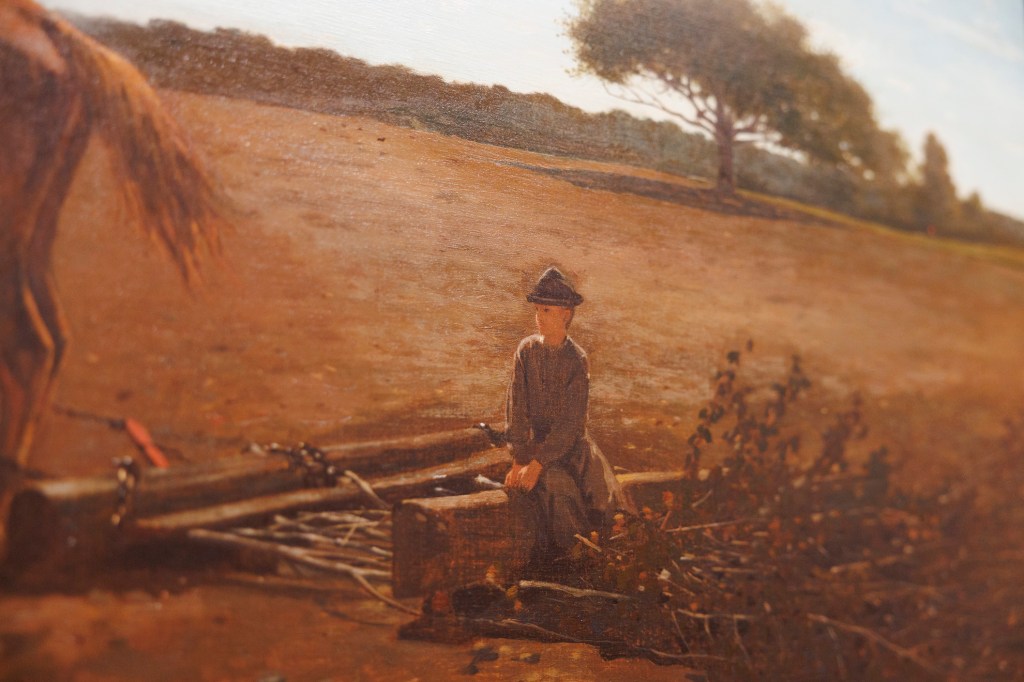
Like other Homer works from the period — including “The Veteran in a New Field” (1865), and “Prisoners from the Front” (1866) — “The Brush Harrow” is a reminder of the costs of war. Ballard picked up on this theme, noting the depiction of children “doing the work that no one should ask children to do,” and a horse that “came back from the war without his rider.” A 2019 analysis by museum conservators of the painting uncovered the letters “US” on the horse’s side. Horses ridden by Union soldiers were branded with those initials.
Ballard added that when he chose the painting to launch the series, he was struck by Homer’s interest in young people caught up in events that they cannot fully comprehend.
“This work is both an elegy and a love letter, in many ways, to children and young people, to what’s been lost, but also, in some way, to a renewed understanding that life does continue,” he said. He also noted that the painting depicts “the bravery and resilience of young people under hard and harsh conditions.”
“That is on my mind of late,” Ballard said, “as we think about the moment we’re living in, and as we also think about this year, when we’re celebrating our 250th anniversary, and we realize that often those who are not in the headlines of history bear the effects of it.”
Sophie Bennett, a Cambridge resident who attended the gallery talk, said that Ballard’s remarks left her with a new appreciation of Homer’s painting. “It’s a beautiful thing when museums do the kind of talks that help visitors learn about the paintings in their galleries,” she said. “I appreciated Ballard’s way of taking us on the journey of what you initially observe, and then how that relates to the historical context of the piece.”
Other gallery talks in the American Works of Art at the 250th series — in which Ballard will lead discussions related to other thematic artworks on display — will be held on Feb. 17 at 2 p.m., March 25 at 12:30 p.m., April 18 at noon, June 11 at 12:30 p.m., and July 1 at 12:30 p.m.