Featured series


Nation & World
Crush your goals the Ohtani way

Photo by Gregory Shamus/Getty Images
Baseball superstar’s method for acing ambitions can help anyone, says Business School professor
When a professional baseball player gets that coveted call-up to the major league, it’s a life-changing entree into the big time known as “The Show.” So it’s fitting that fans have dubbed Shohei Ohtani, the Los Angeles Dodgers superstar pitcher and hitter who has dominated baseball over the last eight seasons, “Sho Time.” With two World Series championships (2024 and 2025) and four MVP awards — he’s the first to win the award twice in both the National and American league — Ohtani is widely seen as one of the best to ever play the game.
Talent and hard work have been integral to Ohtani’s success, but a new Harvard Business School case study suggests a simple goal-setting technique that the ballplayer began following while in high school in Japan can help anyone, not just athletes, turn ambition into reality.
The case study’s author, Frances X. Frei, UPS Foundation Professor of Service Management at the Business School, explains in this conversation edited for clarity and length.
Ohtani followed a training program called the Harada Method that guided him from a promising high school player to MVP. Tell me about this method.
Takashi Harada, the person who created it, turned around underperforming high school teams at a pretty massive scale using this method and made them startlingly overperforming. So, this didn’t just work for Shohei, loads of people did it and got outsized success. That’s when I started to think it might also be for the rest of us. But then, honestly, it was in my teaching it to students and watching them get captivated by it and do it and start telling me stories of how it has helped them. They notice a before and after in how they’re spending their time and their intentionality on things.
How does it work?
You come up with a multiyear ambition; so really dare to dream. And then, the first step of the chart is, “What are the set of things that if I concentrated on this year, I’d make meaningful progress on my multiyear ambition?” You have one thing in the center: my multiyear ambition. For him, it was “be the No. 1 draft pick” four years later. And then, what are the eight things that if I did this year, I would make progress on my ambition? He had “physical conditioning” and “mental strength” and then four pitching things — “control,” “sharpness,” “speed,” and “trickery.” He had “character” and “karma” for No. 7 and No. 8.
To me, one of the most compelling parts of the method was the inclusion of karma. If karma wasn’t included, I don’t know that it would have captivated my attention.
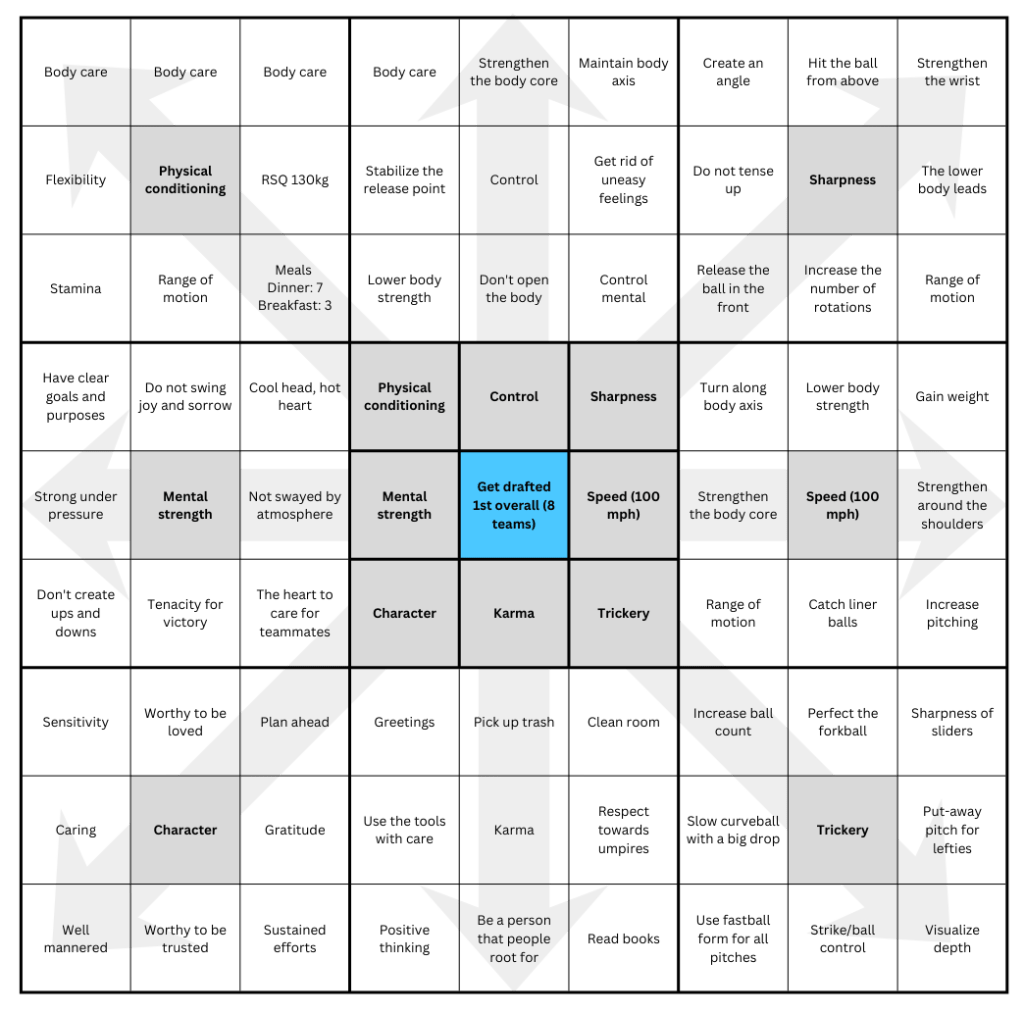
Then the method asks you to do that one thing surrounded by eight, do it again, one more time. So, each of the eight yearly goals — physical conditioning, mental strength, character, karma, etc. — bring those out and surround them by the eight things I have to do on a daily basis to achieve that.
What’s amazing about the Harada Method is it breaks down your multiyear ambition. Students have found this so captivating because you either are thinking at the broad, multiyear ambition or you’re thinking at the micro — what do I have to do every day? This bridges them in a way that really provides forward momentum.
What did you find so intriguing about Ohtani’s process?
One is how he filled out the grids. There’s the No. 1 ambition, and then there are eight things surrounding it. Four of them having to do with pitching all the way down to the detailed behavior, the body, the mental. “Cool head, hot heart” was one of them. I have since learned it is common Japanese vernacular. I didn’t know it at the time, but that one really struck me. But it was “character” and “karma” that just weakened my knees. And indeed, I encourage everyone who uses this method to include character and karma regardless of if you want to be a pitcher or not. I’ve taught it now to 800 students — 100 percent used “character” and “karma” on theirs because they felt it.
“Pick up the trash” — that one really spoke to me; “clean room” because that’s private. Nobody else is going to see that. “Respect towards umpires.” He is known as the most respectful player. He does a greeting to the umpires at every single at bat. The one that I really wish I had learned a lot earlier was “be a person that people root for.” That one really hit me between the eyes because when I was that age, and for a lot longer, I thought “be a person who was right.” [laughs]
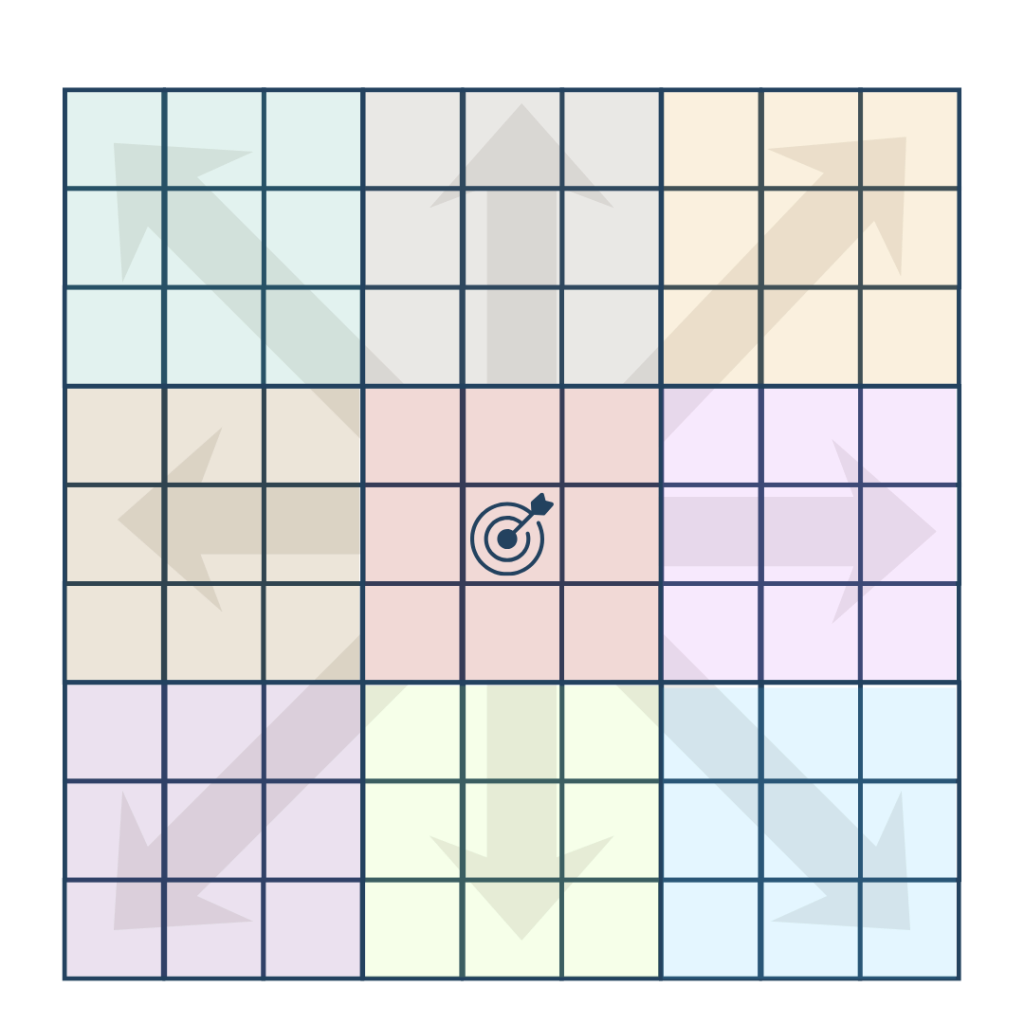
How to use the Harada Method
1
Set your
main goal

2
Write your main goal in the
center of a 9×9 grid

3
Add eight support
goals around it

4
Surround each support goal by eight behaviors you can practice
If he only had the four pitching things, I don’t think he would be as successful. I think it takes all of us, every ounce of us, to give ourselves the best position to achieve greatness. I don’t want to call it an insurance policy, but it’s not a bad word for it.
You’ve tried the Harada Method. What did you learn from that exercise?
Yes, my wife and I did it. We’re pretty ambitious people, and it helped us to clarify and articulate to each other, so we knew how to be helpful to one another: What am I going to do today that’s going to help make progress? It separates the signal from the noise of progress and really channels it. The articulation of it really helps you know what to do and stimulates progress.
My mission in the world is to add a zero for me and others. I’m very ambitious. I’m recovering from cancer and I have a new lease on life. And I’m a woman of a certain age. Jane Fonda taught me you’ve got three acts and I’m in my third act.
“Add a zero” is, instead of selling 100 books, how are you going to sell 1,000 books? Instead of having 1,000 customers, how are you going to get 10,000 customers? My philosophy now is how do we add a zero, and I’m trying to teach that to everyone. I’m trying to unleash ambition in people. I’ve never had such a great technique.
My wife, Anne Morriss, and I are writing our fourth book, which we want to retitle “Add A Zero.” That’s how much this has captivated us. We have our podcast called “Fixable.” I now do weekly office hours that are open to anyone where I teach a lot of these things. I call it Office Hours Live — we usually get about 1,000 people a week to come from all over the world. I taught this method on the goal-setting one.
So even those who aren’t aspiring athletes can benefit from Ohtani’s approach?
I’ve done it with hundreds and hundreds of people who are not athletes who either have ambition or I’m trying to encourage to have more ambition. Because what we know is that if you have a stretch goal, you achieve more than if you don’t.
The individual aspect of this, to me, is the compelling unit of analysis. This is a personal thing, and I think it’s for all ages. Lots of people are reading the case with their family and then decide who in the family wants to do the Harada Method. And then they start talking about the grids and then they talk about how their relationship shifts, how it just opens up pathways in doing it.