Featured series


Arts & Culture
‘A whole new experience of Kubrick’
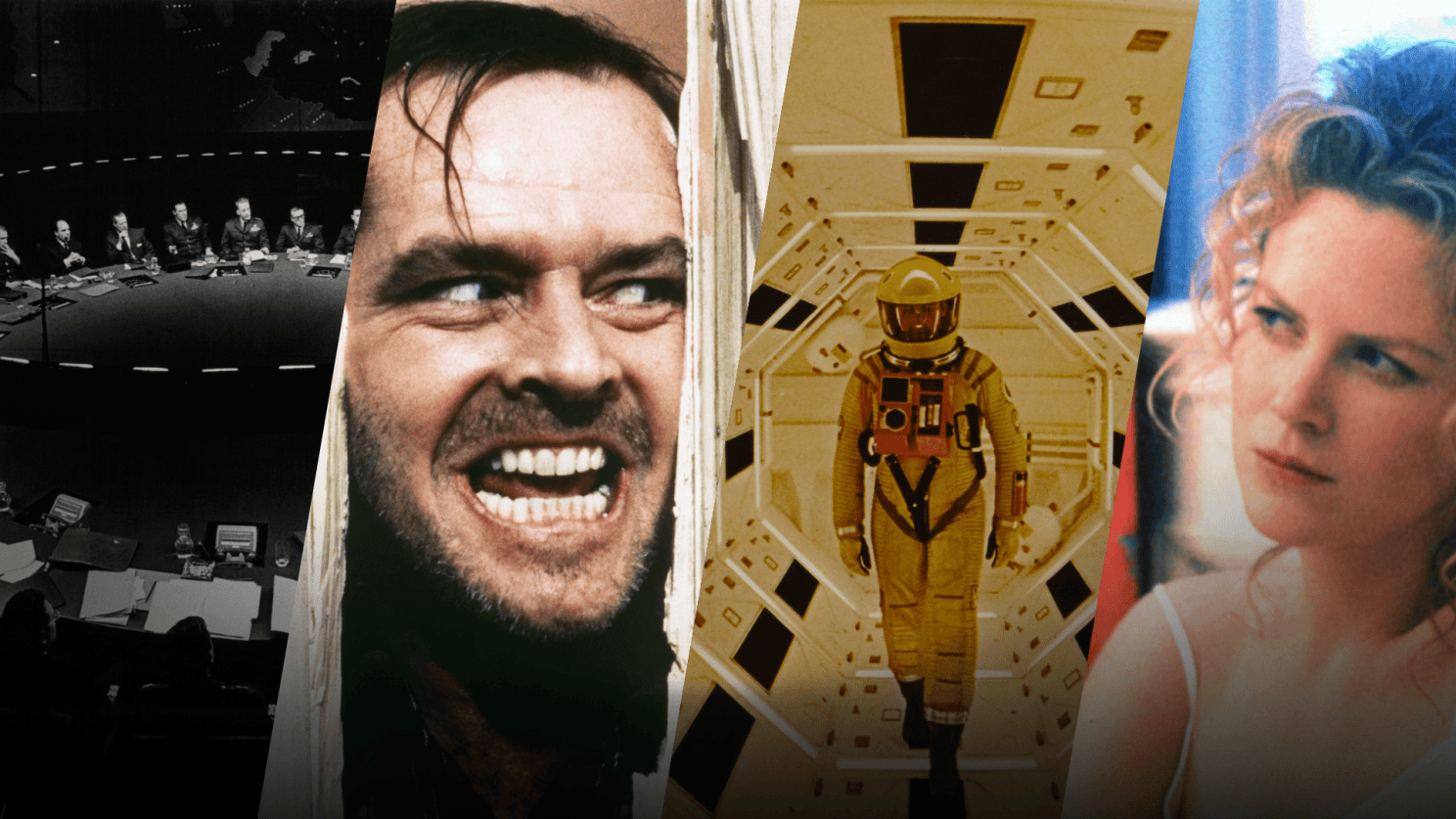
Scenes from “Dr. Strangelove” (from left), “The Shining,” “2001: A Space Odyssey,” “Eyes Wide Shut.”
Photo illustration by Liz Zonarich/Harvard Staff
As HFA screens full works, professor dissects why films like ‘The Shining’ and ‘2001’ still provoke audiences today
As scrupulous as he was influential, Stanley Kubrick is considered one of the greatest filmmakers of the 20th century — and he’s one whose legacy seems to only grow.
Through April 27, the Harvard Film Archive will present all 13 of Kubrick’s feature films, as well as his early documentaries, and two more films to which he contributed (including “A.I. Artificial Intelligence,” completed by Steven Spielberg after Kubrick’s death), all on 35 mm film. The screenings will run alongside the course “Cinema of Stanley Kubrick,” taught by Justin Weir, Curt Hugo Reisinger Professor of Slavic Languages and Literatures and Professor of Comparative Literature. In an interview edited for clarity and length, Weir discussed recurring themes in Kubrick’s works and why many of his films, decades later, remain relevant.
What inspired you to teach a course on Kubrick?
I’m thrilled with any chance to collaborate with the Harvard Film Archive and to make use of Harvard’s collection. I’ve taught several of Kubrick’s films in different courses over the years, but never all of them together and never on the big screen. It is a unique opportunity. The HFA is one of Harvard’s treasures. I’m really grateful to them for making this happen.
Why do Kubrick’s films continue to resonate?
Although his films sometimes received mixed reviews when they first appeared, Kubrick has been very influential, and one can see echoes of his work in other filmmakers. A film like “2001: A Space Odyssey” is nearly 60 years old (it’s from 1968), but it doesn’t feel very dated when you watch it. Works like “2001” and “Dr. Strangelove” regularly appear on lists of top or favorite films, and others, like “A Clockwork Orange” or “The Shining,” have just become part of the pop culture vocabulary, appearing in various parodies and memes. These are movies that people still watch.
What themes of his work do you find especially relevant?
Kubrick’s examination of war, nuclear war, and violence in general is as relevant as it ever was. He was fascinated by technology. For many of us, the HAL computer from “2001” is still the first example we think of when we imagine artificial intelligence running amok. Personally, I’ve always been interested in authors and directors who seem to go out of their way to influence how we receive or interpret a work of art. Kubrick was famous for his framing and control of visual space, and he liked to provoke viewers, too. Why is it that we sometimes derive aesthetic enjoyment from being pushed around and provoked?

Kubrick’s films “have just become part of the pop culture vocabulary, appearing in various parodies and memes,” said Justin Weir. “These are movies that people still watch.”
Veasey Conway/Harvard Staff Photographer
Why did you choose to screen the movies at the HFA? What do you hope people get from this viewing experience?
Like everyone else, I stream music and watch an endless variety of movies on my laptop and TV. But it is becoming more and more clear that appreciation for analog experiences has been growing. We see it with students in our courses who want to read longer novels, learn to make art, or find other ways to unplug their education. Viewing prints of all of Kubrick’s films on a big screen is a terrific opportunity for the Harvard community — but it was never supposed to be such a rare occurrence. They were all made for wide distribution. Half of his films were made before I was born, but I’m old enough to remember seeing a few of them when they were released in theaters. And I hope that getting to view the complete works chronologically will give students a whole new experience of Kubrick and a new way to imagine approaching any director.
How does Kubrick’s approach evolve over time?
That’s a huge question. I guess I’d say that I’ll be answering it over an entire semester’s course with students. Kubrick had enduring interests — the Arthur Schnitzler story that’s the source for “Eyes Wide Shut,” for example, was one that he had wanted to film for a very long time. But he also adapted to the times and questions of the day. You can see his filmmaking change with available technology. It’s hard to imagine “The Shining” without the Steadicam shots of Danny riding his Big Wheel around the hotel, or “Barry Lyndon” without the extremely fast lenses that permitted such low-light photography.
How does Kubrick’s unfinished project “A.I. Artificial Intelligence” fit into modern conversations about AI?
Kubrick’s work on “A.I Artificial Intelligence” should be compared to the eventual film, which was directed by Steven Spielberg. I suppose Spielberg brings a sort of empathy to that film, something which Kubrick might not have been able to achieve. It’s a great film, much better I think than the initial reviews suggested. It really brings into focus how emotional attachments to AI devices might be formed and the crucial ethical questions that immediately emerge.
What is your favorite Kubrick film?
“Dr. Strangelove” is my favorite. It is a very funny movie about a disturbing topic. I should give the full title. It’s “Dr. Strangelove or: How I Learned to Stop Worrying and Love the Bomb.”
Is there a certain film you’re most looking forward to screening?
They will all be great, but I’m most excited to see “2001” and “Barry Lyndon” on the big screen.
Tickets: $10 regular admission; $8 non-Harvard students, Harvard staff, and senior citizens; Harvard students free. Tickets go on sale 30 minutes prior to show time at the box office and are also available in advance on the HFA website.