Featured series

Science & Tech
How did that cancer cell become drug-resistant?
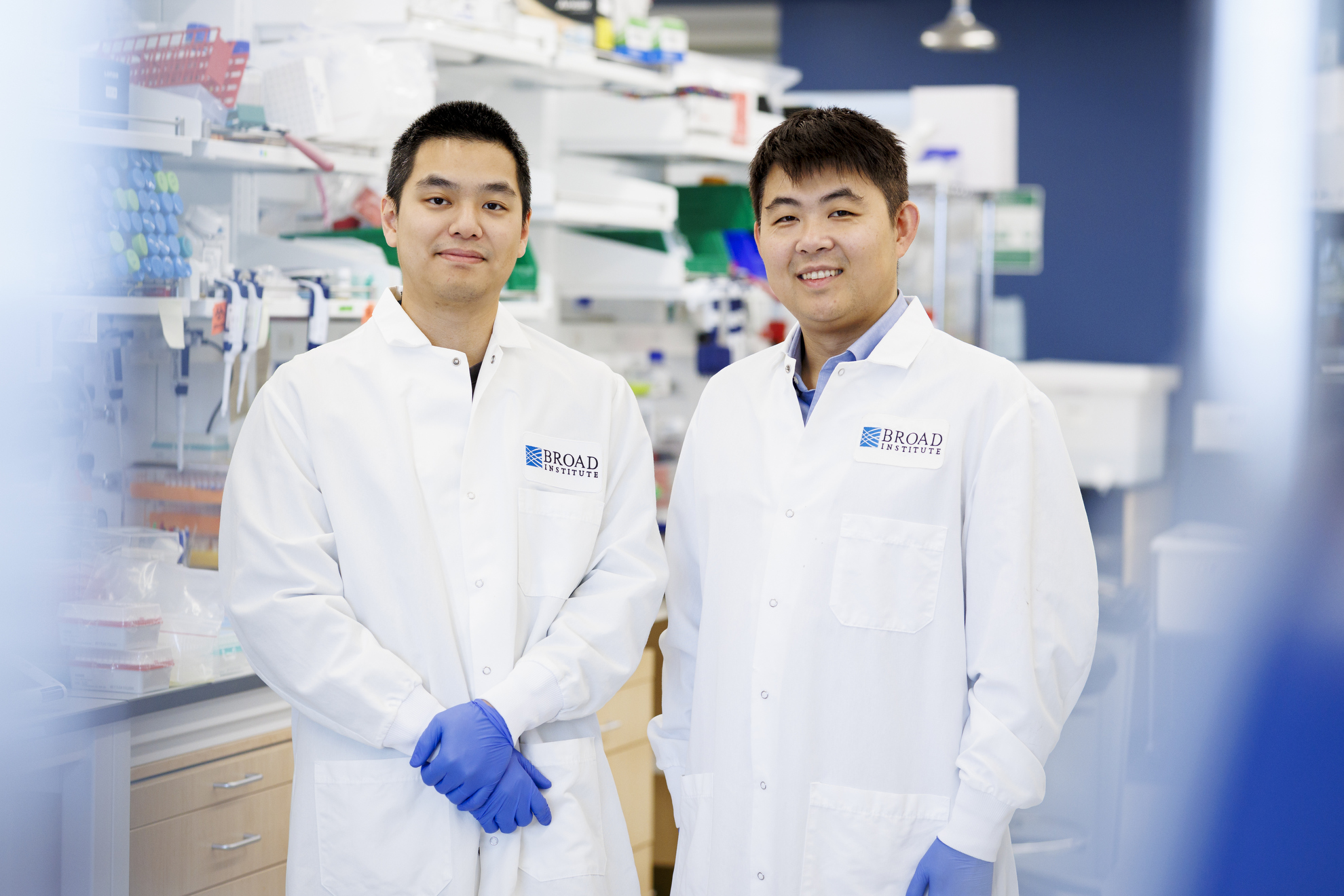
Kevin Yu-Kai Chao (left) and Fei Chen.
Niles Singer/Harvard Staff Photographer
Researchers find way to create microscopic archives of gene activity to gain insights into how, why changes happen
Harvard scientists have invented a way to create a tiny “time capsule” in cells, one that preserves an archival record of gene expression that can be retrieved long after it normally disappears.
“It’s like a time machine for the cell,” said Fei Chen, associate professor of stem cell and regenerative biology and a core member of the Broad Institute of MIT and Harvard, who led the new study. “You can look at a cell now to see how its past influences the present — for example, what genes were turned on in the past to cause a cancer cell to become resistant to drugs.”
Dubbed “TimeVault,” the new technique was published Jan. 15 in Science. It aims to surmount a longstanding limitation in cell research and offer a new tool for studying topics such as cell differentiation, response to stress, adaptation, or drug resistance.
Biologists have long sought methods to study the life history of cells and the molecular changes that unfold during processes such as development and disease.
But most existing techniques cannot measure these processes over time. For example, RNA sequencing provides only a one-moment snapshot of gene expression and destroys the cell.
Numerous other technologies offer different glimpses of cellular activity, but none compile an ongoing record.
To overcome this hurdle, the Chen Lab sought to build a way to record gene activity, store the information within living cells, and later recover it to see how past events influenced the fate of the cell.
The researchers first experimented with bacteria proteins called encapsulins, but they did not perform well. Then they read an article about mysterious structures known as vaults.
Vaults — so named because early researchers likened them to vaulted cathedral ceilings — are enigmatic structures naturally occurring inside cells. Although smaller than the membrane-enclosed organelles such as the nucleus or mitochondria, vaults are the largest particles made by human cells and among the most abundant, with about 10,000 in most cells and up to 100,000 in some immune cells.
First discovered 40 years ago, their function remains unknown. Vaguely resembling footballs or hand grenades, vaults are mostly hollow — meaning they could be engineered to store other molecules. Better yet, they do not trigger an immune response because they already exist within cells.
“The first time we tried it, it just worked so much better than encapsulins — approximately 10 times better,” said Chen. “So we immediately shifted our approach to using vaults.”
First, the method assembles a “transcriptome,” or an inventory of all the messenger RNA (mRNA) produced by the cell at that moment. (Most cells contain complete copies of the genome, but only certain genes are expressed at any given time and thus produce the mRNA instructions to build proteins.)
The system uses poly(A) binding proteins, which naturally bind to mRNA and are widely employed to produce transcripts of gene activity. With bioengineering, researchers attached these proteins to others that naturally form vaults. When the vault takes shape and closes up, the transcript information becomes enclosed within.
“It’s like a magnet for RNA,” explained Kevin Yu-Kai Chao, a Ph.D. student in chemical physics in the Kenneth C. Griffin Graduate School of Arts and Sciences and lead author of the paper. “Then the vault will capture the magnet.”
“It’s like a magnet for RNA. Then the vault will capture the magnet.”
Kevin Yu-Kai Chao
The vaults act like protective containers and shield the RNA from normal degradation by enzymes.
In experiments, the researchers found that the TimeVaults extended RNA preservation more than sevenfold — from a half-life of about 17 hours in the cell cytoplasm to 132 hours inside the vaults.
This information is even inherited by daughter cells. When cells divide, the vaults are divided between the offspring cells.
Next, researchers used chemical techniques to dissolve the vaults and assemble transcriptome snapshots of past activity, which can be compared with other snapshots taken later.
“It’s a link between past and future,” said Chao. “Previously there was no link.”
The researchers tested the method by subjecting cells to heat shock and mimicking hypoxia (low oxygen), two stressors with well-established effects on gene expression. In both cases, the TimeVaults preserved evidence of the classic cellular responses long after it had vanished from the main body of the cell.
In another experiment, the team used the method to examine why some cancer cells became resistant to therapeutic drugs.
Thus far, the researchers have only used the method to record a single time point, but they hope it can be adapted to record multiple time points — and perhaps someday take scientists closer to a cellular version of a “black box” flight recorder.
“It’s the first way to actually look at the history of a cell and connect it to the future.”
Fei Chen
“It’s the first way to actually look at the history of a cell and connect it to the future,” said Chen. “We believe there probably will be a lot of cool applications from a research and potentially therapeutic standpoint. We’re actually very excited to share this with the scientific community.”
One colleague, a pioneering biologist known as “The Vault Guy,” is already excited. Leonard Rome, a Distinguished Professor at the David Geffen School of Medicine at UCLA whose team first discovered vaults in 1986, applauded the new method for its innovative engineering of the still-mysterious structures. “Frankly, I’m delighted that Dr. Chen has been able to exploit the properties of the vault particle in this way and by doing so deliver an entirely new method for probing a cell’s history,” he said.