Featured series
Nation & World
How to help lift slumping American math scores
Getty Images
Scholars see solutions in classroom creativity, higher teacher pay — and attendance
Scholars are frustrated. After decades of effort to bring more challenge and joy to math class, American students have made little net progress.
In 2022, the nation’s students ranked 34th in the preeminent international test of mathematics.
While the U.S. historically has never approached the top scores set by East Asian and Northern European students, the latest results have the country seven points below the average set by other affluent countries, and they represent the nation’s lowest score in the history of the test.
If math scores have begun recovering, it is only unevenly — varying not only by gender or family income, but from state to state and classroom to classroom.
And there are so many variables at play in the hoped-for recovery that most Harvard scholars and alumni are loath to propose a simple fix. But they have some ideas — and concerns.
For years, American students looked to be on the right track, making steady progress. The advances began to stall out around 2011, then quickly melt away in the last five years even after $190 billion in pandemic relief was distributed to schools in 2020 and 2021.
“It can feel like you’re beating your head against the wall,” said Heather Hill, the Hazen-Nicoli Professor in Teacher Learning and Practice at the Harvard Graduate School of Education. “It would have amazed my 25-year-old self, to see that we’ve made so little progress.”
It’s not just a matter of a line sloping downward. A protracted math deficit could have significant real-world effects.
One recent study estimated that the current math skill gaps could cost the average student nearly $20,000 in lifetime earnings. And exposure to some advanced math has been linked to all manner of positive effects, from improved media literacy to a higher likelihood of earning degrees (especially in STEM fields), and better chances of admission to a selective college or university.
Lessons learned
If researchers on campus can devise and test meaningful strategies to improve math instruction, their discoveries face a long, uncertain road into the hundreds of thousands of American classrooms.
First of all, Hill notes, “the federal government doesn’t make policy, and states really often can’t, either — all they can do is lay down standards and test. So it’s really up to districts and teachers to figure out how to get better.”
And even when scholarship does influence policy, the results can be unpredictable.
In about a half century of “math wars,” U.S. schools slowly turned from “procedural” math pedagogy — think of repeated times tables, reducing fractions, plotting lines — to a “conceptual” alternative that hoped to impart the deep meaning behind those operations.
Most scholars today came to regret that move as based on a false binary.
“I don’t really distinguish between ‘procedural’ and ‘conceptual’ as a rule — I think it’s a mistake,” said Noah Heller, a lecturer at HGSE. If conceptual understanding is vital, Heller said, “any cognitive science will tell you that when you’re trying to get something into working memory, repeated practice is really important.”
As a member of the School’s teaching and teacher leadership program, Heller helps prepare math teachers for the classroom, where academic disagreements can feel remote or confusing.
“When it becomes ideological, it’s a real disservice to kids and families,” Heller said. “It may keep some of us academics employed, but it’s not affecting the reality on the ground.”
Hill agreed.
She acknowledged that whenever curricula change, too many teachers experience it as an unwelcome jolt. “Often, I think it’s experienced as just another top-down directive … another topic du jour, a new science of math, whatever.”
And as those new curricula try to incorporate the many aspects of mathematical aptitude, the result is not always pretty, she added. “The more modern curriculum materials are harder to use,” said Hill, who sits on the board of Illustrative Math, a major math curriculum provider.
“Say we need to find an equivalent fraction for ¾, given that the denominator is 12. It’s not enough to say, ‘Multiply the top by three — yay!’ You have to explain what is going on.”
“Math is cumulative: If you don’t understand fractions when they’re introduced in third and fourth grade, you’re going to have a lot of trouble when you get to algebra.”
Heather Hill
That doesn’t mean scholars have nothing to offer, argued Jon Star, Hill’s husband and her colleague at HGSE.
Star has spent much of his scholarly career arguing for a binary-busting approach to middle- and high-school math teaching, which he calls “procedural flexibility.”
“The way algebra was typically taught was, ‘There’s a sequence of steps that you should use to solve this equation, and those are the steps you should always follow,’” Star said.
Instead of reaching for a real-world example, “procedural flexibility” aims to stay in the beautiful, rational world of math, Star said. “It is saying: Actually, there are almost always lots of ways to solve an equation. And it’s asking students to be flexible, to be fluent — to see algebra as a tool you can use.”
That can often mean looking at more than one perfectly correct solution to a problem as a class and giving students an element of freedom in their own work.
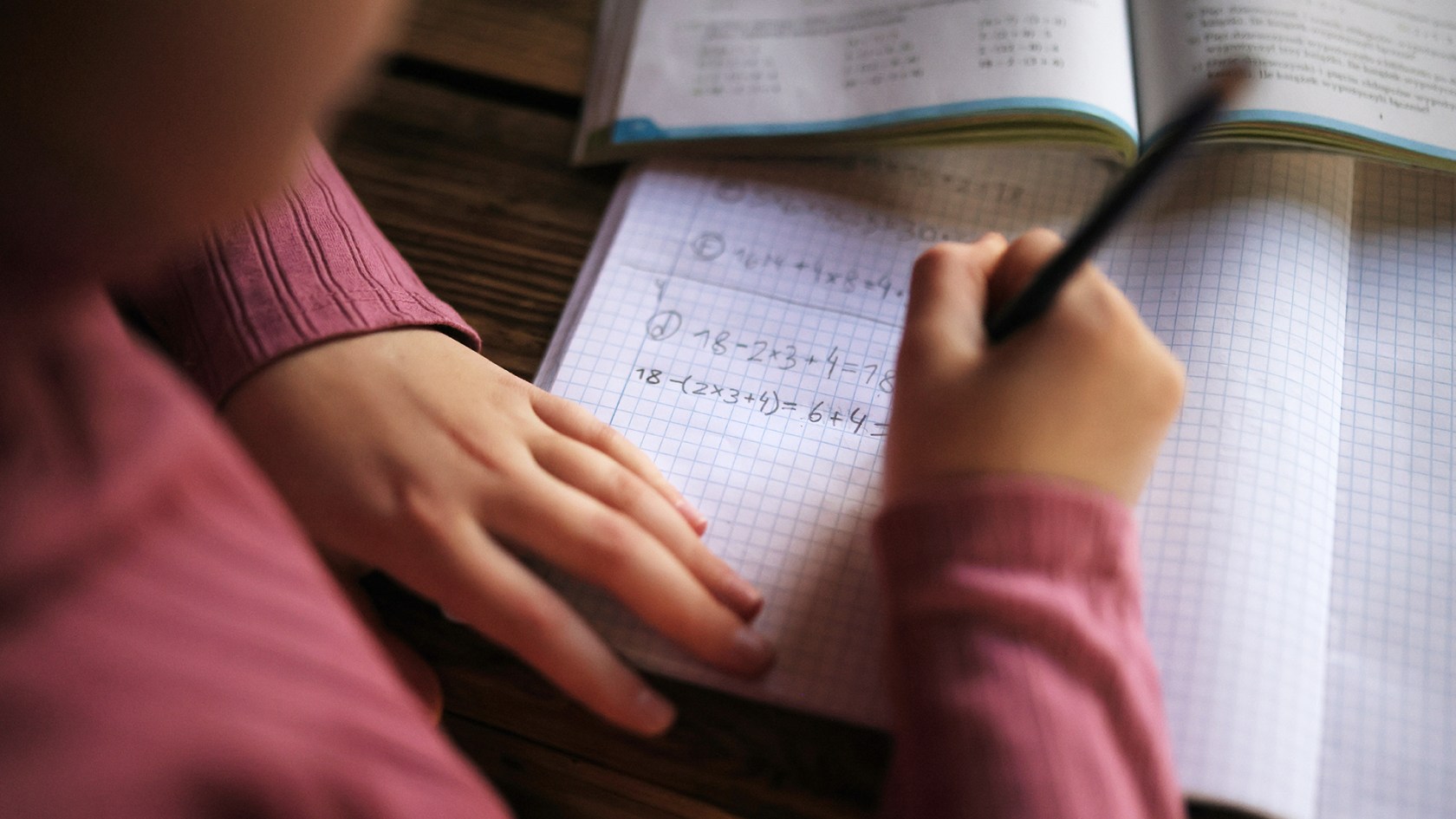
He offered an example equation: 3(x + 4) = 15. The typical procedure would have students “multiply out” the 3 — perfectly correct, but students could save a step if they simply divided both sides by 3. (x = 1, by the way.)
“Choice itself is motivational,” Star said. “And there’s a social component, too: I’m going to have a conversation with you about how you did it, how your buddy did it, which way is better.”
Star has published many papers arguing that change of framing helps students form a deeper understanding and enjoyment of math, all while still adding, multiplying, plotting, and reducing to the lowest common denominator.
Another virtue, though, is its simplicity, he said. “To teach multiple procedures, to engage students in conversations in which ones are better and why — to have that kind of depth of conversation … it feels a bit more attainable” to classroom educators.
On the frontlines
Star knows that world well. He came to academia only after five years as a middle-school math teacher. And a quarter century later, he has completed a round trip.
The Carl H. Pforzheimer Jr. Professor of Teaching and Learning also resumed work as a teacher of eighth-grade math at an independent school in Watertown, Massachusetts.
Star said the double duty is “mutually informative,” with classroom experiences feeding into his research and vice versa.
But he acknowledged that “there are all sorts of challenges, structural and otherwise, that make doing the job hard, that make it feel like I actually don’t have that much time to share my love of math.”
Most of the researchers interviewed for this piece stressed that it’s never been more difficult to be a teacher in this country. They have to handle unusual learning gaps and emotional challenges that arose with COVID-19, and work within the multiplying constraints of curricular and bureaucratic work.
If many teachers bristle at being forced to adopt new approaches suddenly and without input, the best ones learn to treat curriculum as something like “the director’s notes for a play,” Heller said: something to improvise over and adjust on the fly.
It is a rare skill set. But Heller and others stressed that teacher pay has not kept up with the rate of inflation, especially since the pandemic, which is a particular problem when it comes to attracting new math teachers.
“Guess who has the best job opportunities?” Hill said. “It’s people who’ve done well in math, done well in STEM subjects. So math and science are particular shortage areas, and districts are probably hiring people they wouldn’t otherwise hire.”
Jeannette Garcia Coppersmith, currently seeking her doctorate from HGSE, is also a former classroom teacher. While she studies difficult subjects like how implicit bias affects Black and Latino students in math class, her recommendation for one change is simple.
“We need to raise the status of the profession,” she said. “We really are entrusting teachers with one of the most important things: raising our children to promote a free and just and democratic society. That’s no small feat.”
Back to class
But she and others acknowledged one other big risk to the nation’s math recovery.
Long after absence rates first surged post-pandemic, too many students are still missing the lessons that could help get them back on track.
“First of all, math is cumulative: If you don’t understand fractions when they’re introduced in third and fourth grade, you’re going to have a lot of trouble when you get to algebra,” Hill said.
And there are relatively few chances to fill the knowledge gaps. When it comes to literacy, Hill said, “Kids could be making up ground through talking with their parents at the dinner table about a book or reading a book on their own that they got from the library … They don’t really learn math outside of school.”
For Thomas Kane, faculty director of HGSE’s Center for Education Policy Research, the first thing to tackle is high rates of chronic absenteeism.
“It’s cost-effective, because we’re already paying for the teachers, the buses, and the underutilized buildings,” Kane said. “And it not only increases instructional time, it also boosts learning per class period, because teachers are not having to constantly reteach the same material.”
Kane and colleagues at Harvard and other universities have gone district-by-district to find that — perhaps unsurprisingly — stubbornly high rates of absenteeism correlate to slower academic recoveries, an effect that can be also seen in the data from individual states.
Efforts are underway, in Massachusetts and elsewhere, to nudge students back into schools, but it is slow and uncertain work.
Star is still optimistic. He and Hill both stressed that, given current salaries, most math teachers are in the field because they truly want to be.
If they now face a heavy burden of responsibility for a national turnaround, Star hopes they will embrace the challenge, as he did again in his mid-career, of giving young people a warm welcome into the “beautiful, abstract world” of math.
“It’s fascinating, what goes on in kids’ heads,” he said. “If you ask good questions, and you’re a good listener, you’re going to be interested in what you hear.”