Featured series


Health
How COVID-era trick may transform drug, chemical discovery
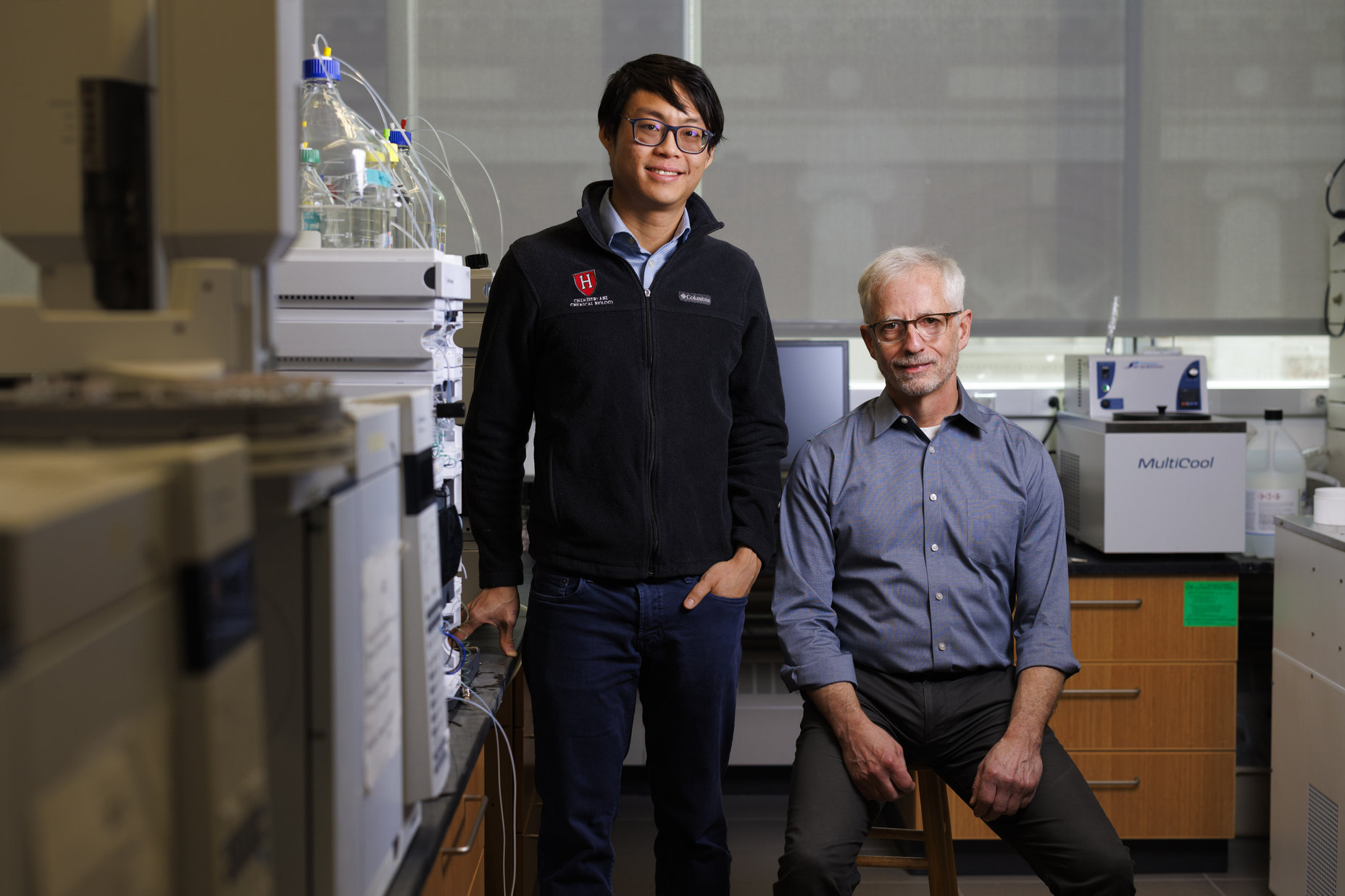
Marcus Sak (left) and Eric Jacobsen.
Veasey Conway/Harvard Staff Photographer
Harvard chemists, inspired by group-testing strategy, develop faster way to identify useful catalyst combinations
Laboratories turned to a smart workaround when COVID‑19 testing kits became scarce in 2020.
They mixed samples from several patients and ran a single test. If the test came back negative, everyone in it was cleared at once. If it was positive, follow-up tests would zero in on who was infected. That strategy, known as group testing, saved valuable time, money, and resources.
Now, a team of Harvard chemists in collaboration with Merck scientists has adapted the same basic idea to speed up production of drugs and other valuable chemicals.
In a new Nature paper, a team led by Eric Jacobsen, Sheldon Emery Professor of Chemistry in the Department of Chemistry and Chemical Biology, described an experimental and computational framework that uses pooled tests to hunt for cooperative interactions between catalysts, substances that can speed reactions and reduce the energy needed for reactants to transform into products.
This approach dramatically cuts down the number of reactions chemists need to run while still revealing which combinations perform well together.
“This idea of bringing two different catalysts together and seeing if the combination might do something especially powerful — either in a reactivity context or a selectivity context — has been interesting to me and many other chemists for a long time,” Jacobsen said. “We’ve now found an efficient approach to uncovering unanticipated manifestations of cooperativity.”
“We’ve now found an efficient approach to uncovering unanticipated manifestations of cooperativity.”
Eric Jacobsen
Chemists have long known that two catalysts can sometimes cooperate to give higher yields or cleaner products, or to enable milder conditions than any single component can manage alone.
However, even testing a small set of potential candidates, the math quickly becomes brutal: A panel of 50 potential catalysts, for example, contains more than 1,200 unique pairs, not to mention three‑way or four‑way combinations.
To overcome that limitation, the researchers took inspiration from group testing.
In public health, the goal is to identify as many infected individuals as possible using as few tests as possible. In this new research, the tests are looking for catalyst pairs that make a reaction unusually efficient or selective.
“We landed on this idea that comes from COVID testing.”
Marcus Sak
“We landed on this idea that comes from COVID testing,” said Marcus Sak, lead author on this study and a graduate student at the Kenneth C. Griffin Graduate School of Arts and Sciences. “Can we use simple math and statistics to create an algorithm for discovery that needs to know very little — or even nothing — about the chemical features of the system?”
Instead of testing each pair individually, the team designed pooled experiments: Each reaction contained multiple catalyst candidates in a specific pattern. A custom algorithm then examined how each pool performed and used that information to infer which specific pairings must have been responsible for any boost — or drop — in performance.
“It’s not just a matter of pooling and testing. There’s a lot of statistical analysis,” Jacobsen said. “We were able to develop code to predict the best pooling strategies for evaluating different combinations of catalysts.”
“We were able to develop code to predict the best pooling strategies for evaluating different combinations of catalysts.”
Eric Jacobsen
There was a key challenge, though: Unlike COVID tests, where a sample is either positive or negative, real chemical systems are messy and complex. Some catalysts help, others hinder, and many can do both, depending on what else is in the flask.
“Catalysts can cooperate with each other, but they can also inhibit each other,” Jacobsen said. “You could just ask, ‘If cooperativity is so important, why don’t you just throw every catalyst in one flask and see if that soup does better than the individuals?’ The problem is, if you add all the catalysts you know in a soup, you’re guaranteed to get mud. They cancel each other out.”
To make sure their pooling–deconvolution strategy was accurate, the researchers first tested it on simulated data. The algorithm consistently identified the true cooperative pairs while ignoring misleading signals.
Encouraged, the team employed a real-world challenge identified by co-author Richard Liu, assistant professor of chemistry and chemical biology: a palladium‑catalyzed decarbonylative cross‑coupling reaction. These reactions are essential tools for building complex molecules, including potential drug candidates.
The algorithm identified several ligand pairs that outperformed individual ligands on their own.
Reducing catalyst loading and energy use are key goals for sustainable chemistry, especially when precious metals are involved. But the authors emphasized that the value of their framework goes well beyond any single transformation.
“I think it’s a very complementary approach to what you might consider the more rational design approach of using our mechanistic understanding to impose the effects we’re looking for,” Jacobsen said.
Looking ahead, the researchers hope to push beyond pairs to ternary and higher‑order cooperativity, where three or more catalysts or ligands act together.
“Coming up with powerful strategies for looking for interesting chemistry, in this case cooperativity, through high‑throughput experimentation and really strategic analysis can open up an enormous amount,” Jacobsen said. “We’re going to learn a lot of chemistry in the coming years.”
This research was partially funded with grants from the National Institutes of Health and the National Science Foundation.