Scholars detail how disciplines offer value in cultivating mind, character but also enable fresh perspectives on societal, practical problems
Eileen O’Grady
Harvard Staff Writer
5 min read
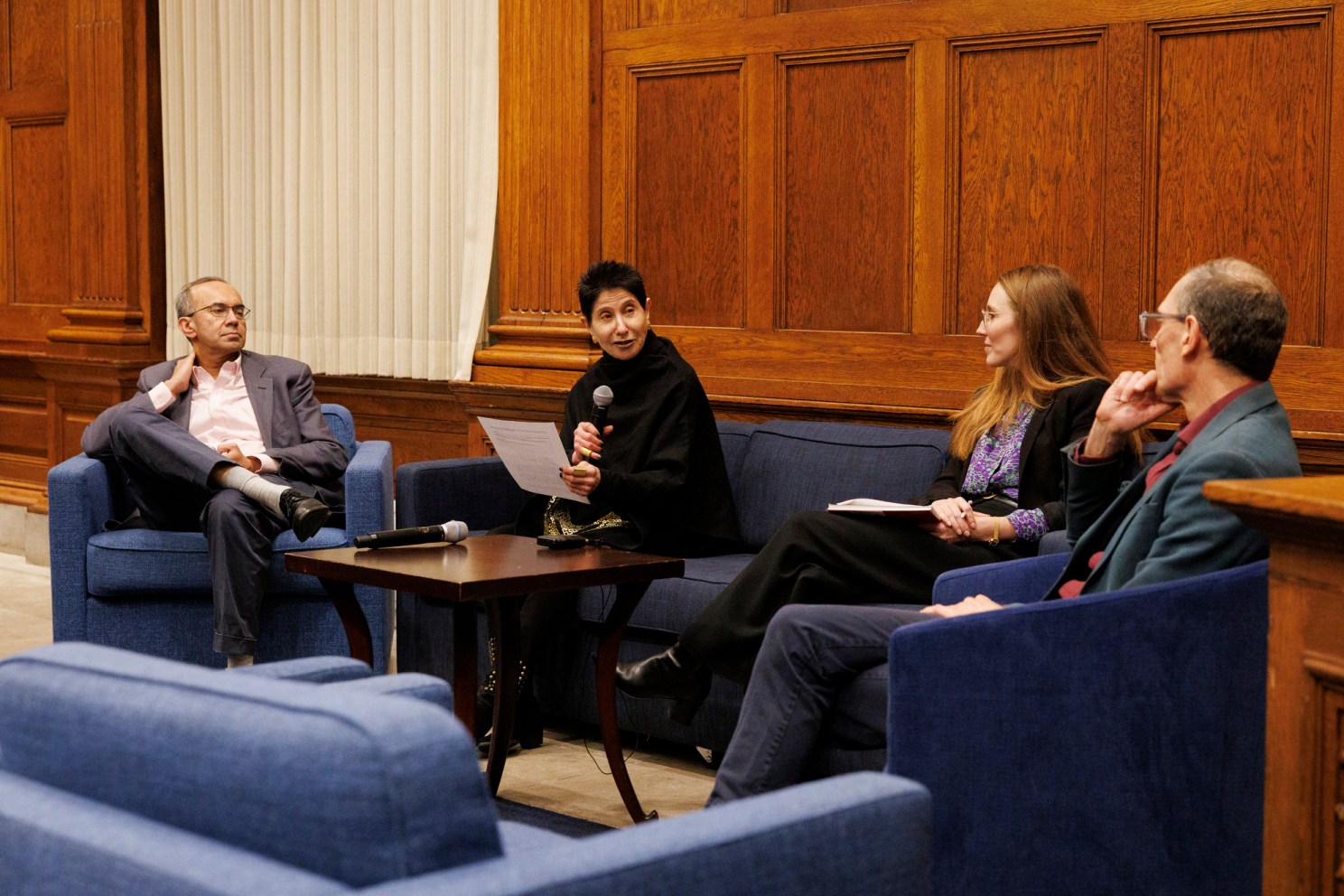
Tarun Khanna (from left), Doris Sommer, Moira Weigel, and Martin Puchner.
Niles Singer/Harvard Staff Photographer
When Moira Weigel was living in Silicon Valley in the mid-2010s, she noticed a surprising trend: Tech entrepreneurs were actively engaged with the humanities.
“I think there’s a temptation as a humanist to be a bit snarky about this kind of thing,” said Weigel, assistant professor of comparative literature, during a late November discussion titled “Who Needs the Humanities?” hosted by the Department of English. “But I want to take it seriously as reflecting a sincere desire for cultivation, maybe some version of bildung, or self-formation, and also a desire for resources to deal with risk and uncertainty — the hard things that are true, perhaps, even for the gentle tech billionaire.”
“Humanities departments in universities have experienced a steep decline, but that’s not the case with humanities outside the universities, where literary festivals and book clubs and podcasts and other activities have enjoyed huge public interest and demand,” said Martin Puchner, Byron and Anita Wien Professor of Drama and of English and comparative literature, who organized the event. “The attempt here is to really to learn from an outside perspective what people outside the humanities want from the humanities, or how they use the humanities, and to talk to colleagues in the humanities who are trying to build bridges.”
“Have you noticed that the decline in the humanities runs parallel to the decline in democracy?”
Doris Sommer
Sommer said humanists have a responsibility to shape young people into world citizens who can participate effectively in democracy. She cited philosopher Wilhelm von Humboldt, founder of the Humboldt University of Berlin, who said the disciplines cultivate the mind and character and create world citizens, and also Kant, who made the case for studying aesthetics as a way to strengthen people’s capacity for judgment.
Plus, engaging in “mental gymnastics,” Sommer argued, helps keep people’s minds in shape.
“Have you noticed that the decline in the humanities runs parallel to the decline in democracy?” Sommer said. “If we’re not teaching disinterested thinking, judgment, preconceptual consultations, do we have any chance to be democratic citizens? No. So that’s really an urgent task.”
Weigel argued that the humanities offers us important practices — reading, writing, conversing — that people can find of great value outside of academia. She cited the success of a literary magazine she launched with some friends for a Silicon Valley audience back in 2016.
“This little magazine project reflects close reading, writing, engaging people in close description of their lives,” Weigel said. “There’s a love of wonder or knowledge that is not exclusive to the humanities, but it’s part of the humanities. There’s a commitment to non-monetizable or non-instrumental thinking, and a belief in the fundamental worth and interest of all human beings in our modes of expression.”
Bringing an economics perspective to the discussion, Khanna disagreed with Weigel, arguing the humanities can be instrumental, or practical, in inspiring real-world applications.
“I think of applied humanities as being extremely instrumental. I use them to solve problems on a daily basis.”
Tarun Khanna, HBS
He cited two government initiatives he has worked on, including a post-apartheid reconciliation effort in South Africa that brought together former ANC guerrilla fighters and Afrikaners in a classroom setting for discussion and debate, and a separate initiative to bring creative play into the Indian school curriculum through makerspace labs.
“I think of applied humanities as being extremely instrumental,” Khanna said. “I use them to solve problems on a daily basis. For me, the market mechanism is simply another instrument that society has, using markets to coordinate activity across people.”
Sommer, who developed the Pre-Texts pedagogical method that uses art to engage students with texts, argued that studying the humanities offers intellectual training unique to the fields that can help people examine complex problems from perhaps different perspectives to get to practical actions, like creating political change.
“You’re exercising a muscle that you can engage to make an intervention,” Sommer said.
An audience member asked how the humanities should be responding to an era when much of society — including higher education — is driven by market logic, forcing students to balance the need for a stable job with a desire for a higher meaning and purpose.
Khanna said market logic was never intended to be the only way forward.
“To me, market price mechanism is a tool that that society and humanities made available to us for use, and we should use it judiciously and smartly,” Khanna said.
Weigel said it’s a difficult question that’s important to tackle. While markets perform important functions, she said, it’s important that some things remain outside of it.

 Featured series