Featured series


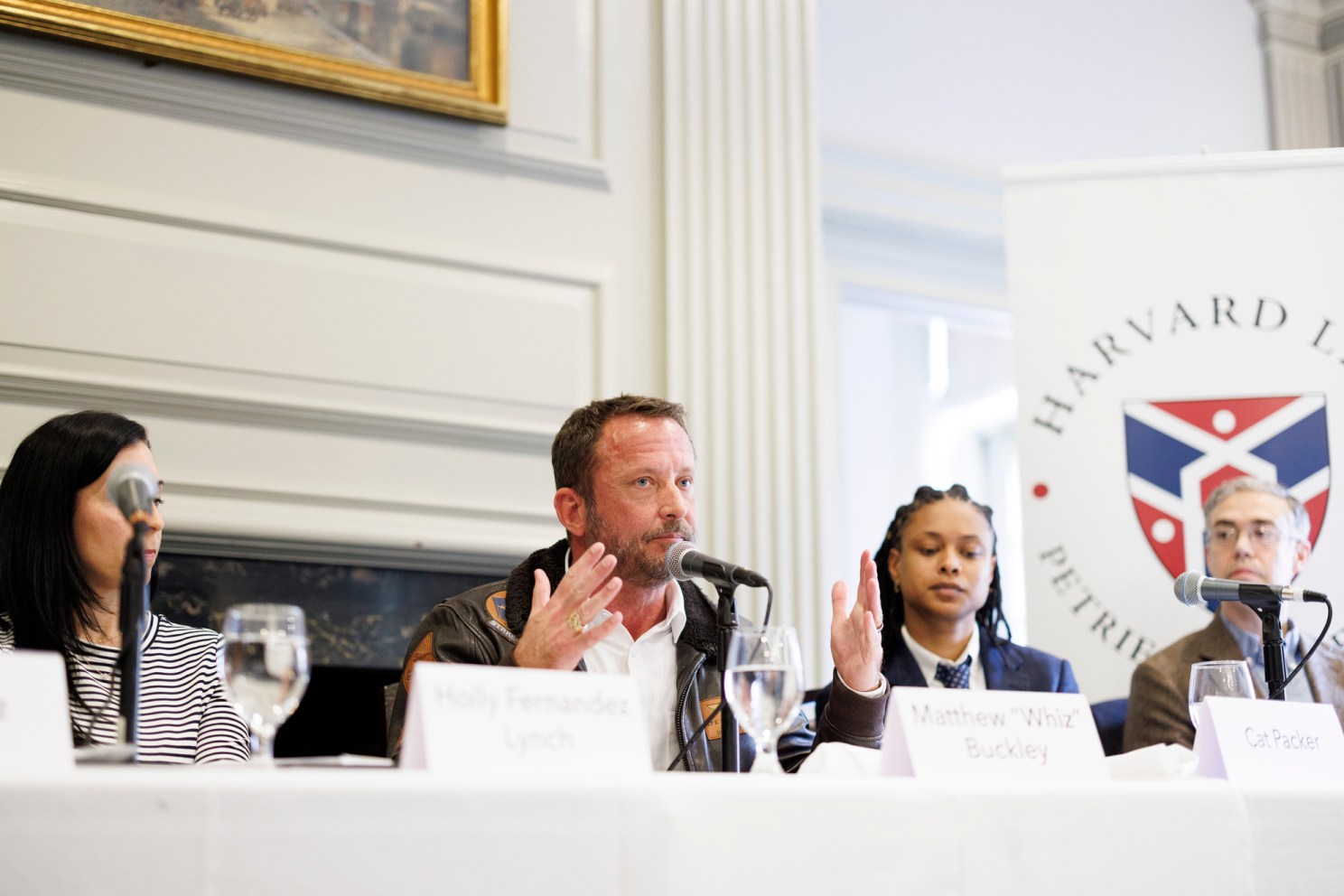
Holly Fernandez Lynch (from left), Matthew Buckley, Cat Packer, and David Yaden.
Veasey Conway/Harvard Staff Photographer
Debate over psychedelic legalization tends to focus on two extreme views: the need to speed therapeutic access to meet urgent problems such as veteran suicide, and calls to thoroughly research substances first to ensure they meet safety standards.
Even as I. Glenn Cohen, faculty director of the Law School’s Petrie-Flom Center for Health Law Policy, Biotechnology, and Bioethics introduced the event’s title — “Toward Psychedelics Access: Go Faster or Slower?” — he acknowledged it was an oversimplification.
“The public discourse sometimes seems to be drawn over these extreme questions,” said Cohen, James A. Attwood and Leslie Williams Professor of Law. “And although there are places where these are mutually exclusive ‘or’s,’ we’re going to try to bring the ‘and’ into the equation, too.”
The talk, hosted by the Petrie-Flom Center and moderated by former Slate Magazine editor David Plotz, brought together experts from a range of backgrounds to discuss the future of psychedelic use in the U.S.
David A. Yaden, the Roland Griffiths Professor of Psychedelic Research at Johns Hopkins University School of Medicine, began the conversation by discussing how even the definition of psychedelic is debated. Some use the term broadly to talk about drugs from ketamine and MDMA to psilocybin and cannabis. Though Yaden’s research tends to focus on “classic psychedelics” like psilocybin, he stressed that it’s hard to generalize the clinical effects of psychedelic drugs. While many people are excited about their healing potential, he expressed caution and said there are “real risks” to using these substances.
The lack of knowledge stems largely from a lack of research funding, he said. “What I would love to see is the NIH funding medical researchers to do large, rigorous, well-powered studies with active controls, which are expensive but would provide us with information that would be absolutely priceless,” he said.
“What I would love to see is the NIH funding medical researchers to do large, rigorous, well-powered studies with active controls, which are expensive but would provide us with information that would be absolutely priceless.”
David A. Yaden
Matthew Buckley, a former Navy TOPGUN pilot and the president of the No Fallen Heroes Foundation, emphasized the tremendous healing potential of psychedelic drugs. He said that the version of himself from five years ago would be astonished to hear him speaking this way today, “but that guy died on a mattress on the floor in Mexico” during a psychedelic healing retreat.
On this retreat, he said, with a group of disaffected former Navy SEALs and retired athletes, ingesting substances such as ibogaine and 5-MeO-DMT helped him resolve deep trauma, depression, and alcoholism that had alienated him from his family and led to the deaths of many of his fellow servicemen. His foundation funds similar therapies for members of the military and other first responders.
“I got home from that retreat and I said, ‘This is going to end veteran suicide,’” Buckley said. Through his foundation and the Sacred Warrior Fellowship, a Florida-based church Buckley founded that incorporates psychedelic use, he offers struggling people drugs that he believes have a powerful healing potential.
Holly Fernandez Lynch, associate professor of medical ethics and law at UPenn’s Perelman School of Medicine and Carey Law School, discussed the tension in the psychedelic community about the proper pathway for drug approval. “I come at this with what I think is a pretty straightforward principle, although it’s controversial, which is, if you’re making medical claims, then you should have to prove those medical claims,” she said. “We should hold psychedelic medicine and psychedelic drugs to the same standard as other medicines.”
“We should hold psychedelic medicine and psychedelic drugs to the same standard as other medicines.”
Holly Fernandez Lynch
She acknowledged that this is difficult. “I’ve sat next to ALS patients or family members, and they look at me and they say, ‘You’re evil. Why don’t you want my family member to have access to this medicine?’” She says it’s more complex than that. She wants people to have access to the most effective drugs, but she wants them to understand how the drugs can be used, what their effects might be, and how they can be used safely.
“As scientists,” said Yaden, “we’re not for or against psychedelics. We want to report the facts and produce knowledge of risks and benefits profiles.” Although psychedelic studies can be quite expensive, in part because it’s difficult to maintain a control group of people who believe they’ve taken the experimental drug, he says this difficulty is not unique to psychedelic drugs. “All psychotherapy research, for example, has this issue — and many other substances as well,” he said. “We just don’t talk about those as much.”
Buckley argued that this slow, methodological approach does not meet the urgent problem of veteran suicide. “There’s got to be a happy medium,” he said. “I think in the West, we have this massive ego, like, ‘We just discovered these compounds. Let’s study them for 20 years.’ Are you kidding me?”
“I think in the West, we have this massive ego, like, ‘We just discovered these compounds. Let’s study them for 20 years.’ Are you kidding me?”
Matthew Buckley
While Lynch said she understood the desperation people feel as they try to access certain potentially transformative drugs, she noted that there’s a downside: “There are lots of snake-oil salesmen out there who would be willing and ready to take advantage of people who are desperate.”
In certain cases, quick commercialization of a previously illegal substance can have unintended consequences. An audience member told an anecdote about a dispensary that offered a discount to patrons who spent a great deal of money on cannabis.
“I might be eating these words,” said Cat Packer, director of drug markets and legal regulation at the Drug Policy Alliance, “but I think that there has to be some level of oversight and regulation.”
Though she supports decriminalization efforts for psychedelics and other drugs, she said that with cannabis specifically, commercialization sometimes went “too far, too fast,” while other areas continue to overregulate the substance.
“I think it requires a delicate balancing act,” she said.