 Featured series


Nation & World
Think the viral meme of that legislator is funny?
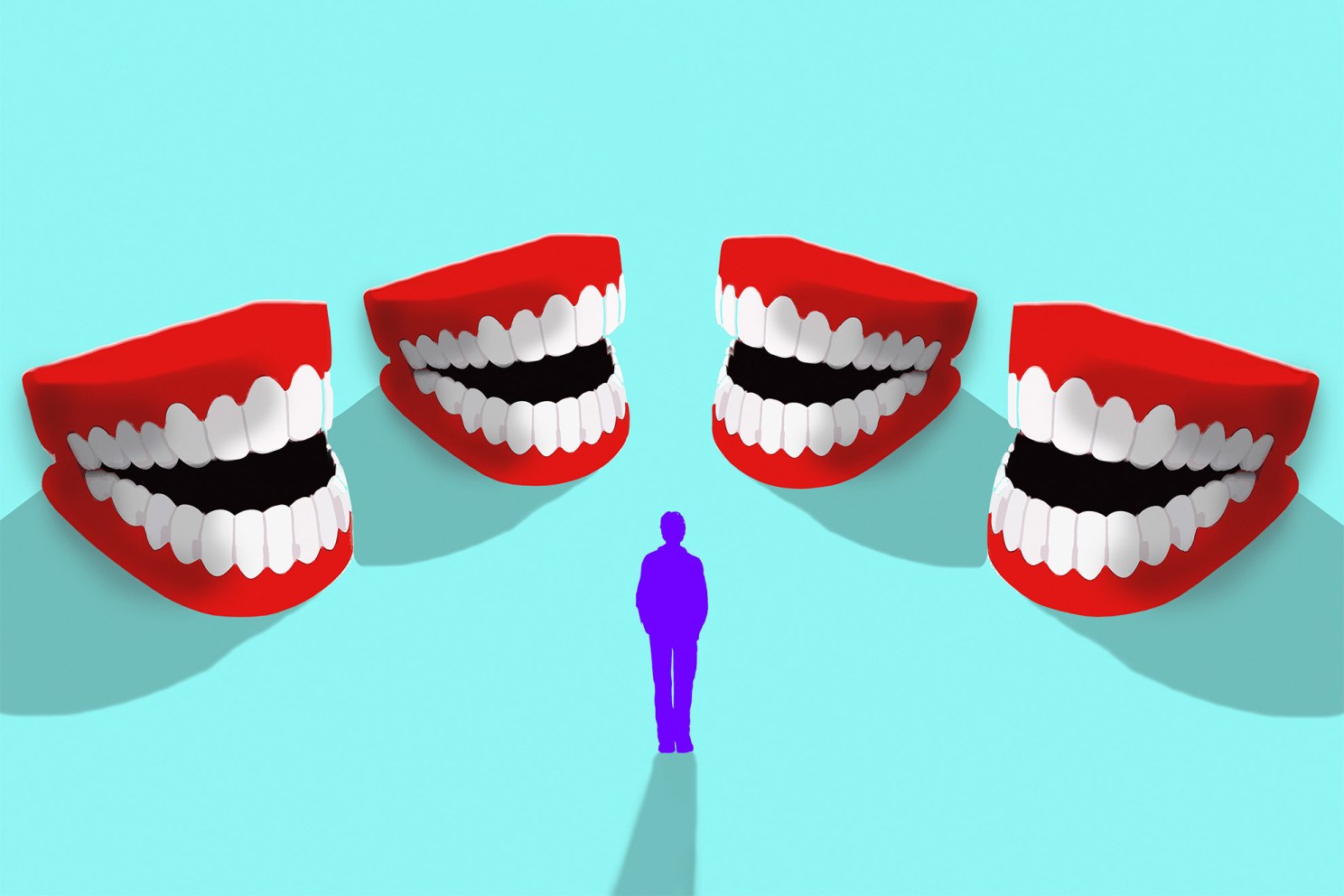
Illustration by Gary Waters/Ikon Images
Political philosopher says rampant schadenfreude among electorate poses risk to democracy
Schadenfreude seems to permeate American politics these days as viral clips and memes of politicians making real or AI-generated gaffes and off-color remarks are gleefully shared by ideological foes.
The German word, which means taking delight in another’s misfortune, describes a response that was once taboo to express openly. Now it’s been embraced by partisans as a powerful weapon to reinforce political support and group identity.
In this edited conversation, Susanna Siegel, the Edgar Pierce Professor of Philosophy, who has written about this dark side of American politics, explains how reveling in someone else’s setbacks — or accusing others of doing so — is poisonous to democracy.
How do scholars look at schadenfreude and its use in politics?
Schadenfreude is the celebration of someone else’s pain or other negative condition. Schopenhauer compared it to cruelty. Like many emotions, it can play out in politics. We saw this happen with the slogan “own the libs.” Owning the libs is celebrating the pain, offense, or fury of a political opponent.
Schadenfreude can operate as a kind of psychic dynamite.
We see this most clearly when we look at attributions of it. Would you sign up for a cooperative venture with someone who celebrates your pain? Probably not. Would you be a more likely to be indifferent to their pain, or even to feel glad about it, if they were celebrating yours? Quite possibly.
In these ways, accusations of schadenfreude, if they stick, get in the way of building civic communion.
Some believe there’s a big difference between reveling in the misfortunes of a stranger or a generic group, like New York Yankees fans, and celebrating a co-worker’s failure or police shutting down the neighbors’ noisy party. Is one type of schadenfreude less “bad” than another?
I don’t see a sliding scale of badness; I see a difference in kind. There’s an important difference between the interpersonal context and the public or political context.
Consider a classic trope in slapstick comedy — the klutz. If while engaged in deep conversation with a friend I accidentally walk into a pole, my friend may laugh, amused by the collision. Yet their reaction isn’t cruel. Why not? Because amusement is not the only way my friend relates to me. They’re also disposed to care whether I am injured, would help me if I needed help, and so on.
By contrast, if someone posted a picture of the collision on social media with the caption “Can you believe what this incompetent woman did?” it’d be much different because there is no surrounding relationship.
Discussions on social media can easily go south because they lack surrounding cues (tone of voice, gesture, the world of embodied signals) that can modulate what people hear in the words they read.
This difference between embodied and decontextualized messages has important upshots for politics.
When memes, tropes, or talking points convey via social media that political opponents are celebrating your pain, these messages are crafted to seem complete without any surrounding context. They can give the impression that you don’t have to know anything else to orient yourself to the accused. And that’s part of what gives them power to propagate.
It’s what [philosopher and psychologist] John Dewey called “sensationalism.” Sensational messages make an impact in isolation from broader context. Sensationalism underlies virality.
Sports team rivalry is a red herring in this context. Teams are there to compete. Games of all kinds are a circumscribed context in which aggression, competition, the energizing quality of attack and defense have an outlet.
How do we break out of this downward spiral schadenfreude seems to cause — accusing others, sometimes falsely, of doing it to justify our hostility toward political opponents?
Since attributions of schadenfreude are a way to create enemies, schadenfreude is a key form of political communication for politics that rely on vilification, politics that replace diplomacy and institutionalized norms with arbitrary impositions of will, and politics that operate through patronage, kickbacks, and other interpersonal forms of power.
When schadenfreude infuses politics of this kind, the important point of intervention isn’t on the psychological feeling. It’s on the vilification narratives that make the psychic dynamite explode.