Featured series
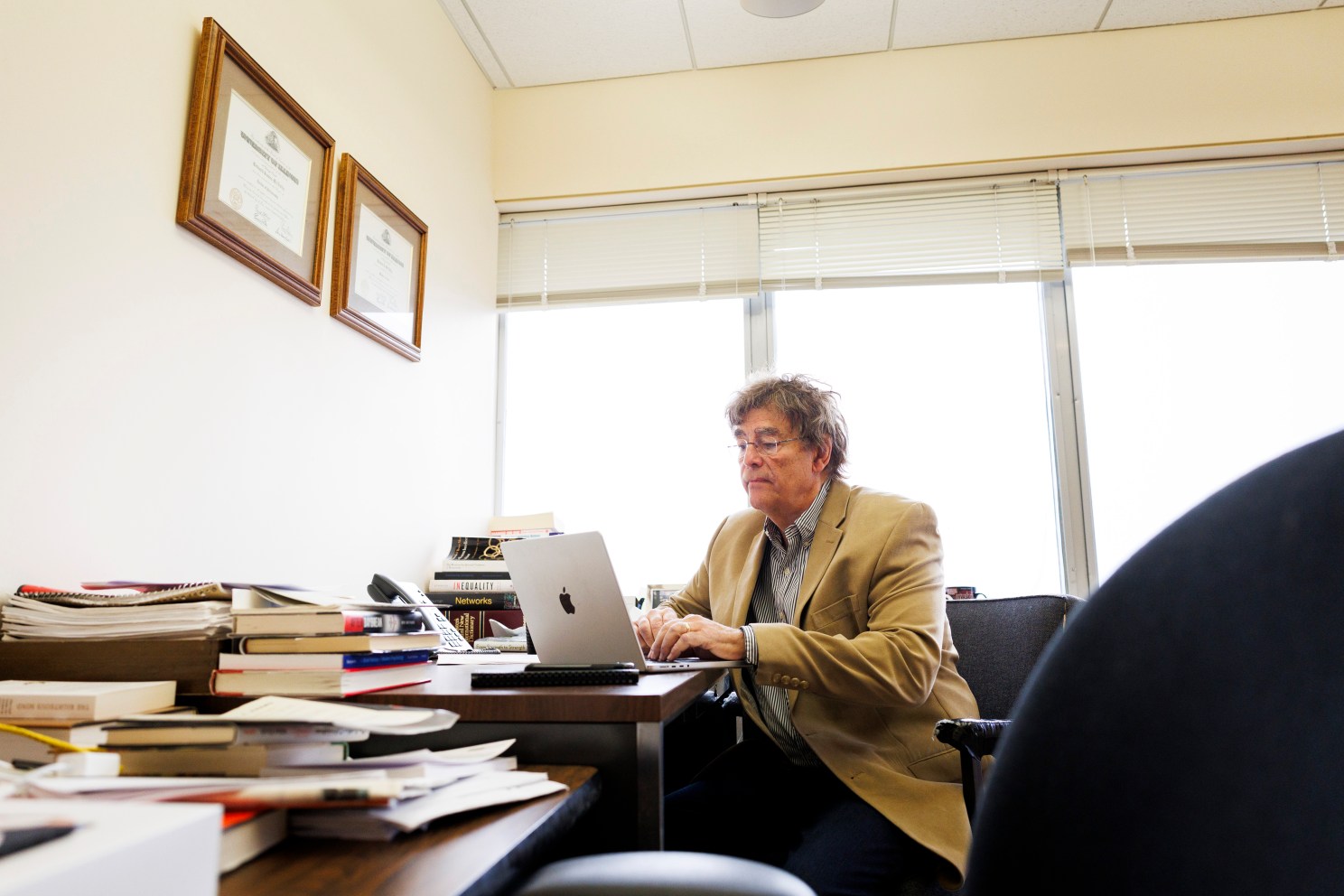
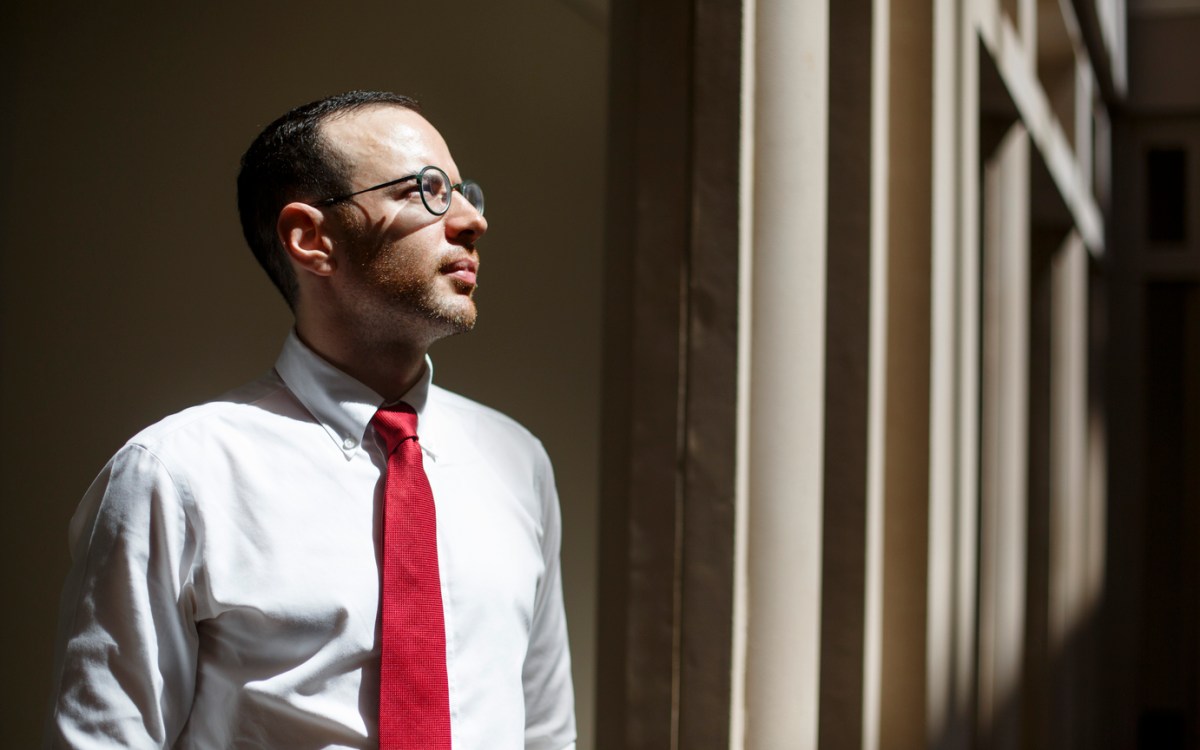
Professor of Psychology Richard J. McNally.
Stephanie Mitchell/Harvard Staff Photographer
Science & Tech
Science needs contrarians, and contrarians need support
Institute of Quantitative Social Science initiative tailored to researchers exploring provocative ideas
Picture a scientist with a provocative hypothesis — something that defies conventional wisdom or verges on the outlandish.
Supporting the pursuit of that big, bold claim is the goal of the Institute for Quantitative Social Science’s new Extraordinary Claims, Extraordinary Evidence (ECEE) program. Designed for social scientists who want to explore highly controversial topics, the program helps tenure-track faculty generate the rigorous evidence necessary to assess their ideas.
“Science depends upon contrarians,” said Gary King, Albert J. Weatherhead III University Professor and IQSS director. “We need researchers trying to propose claims that most others think are wacky or wrong or offensive or ridiculous, because sometimes rigorous evidence will convince us all that they’re right.”
The ECEE initiative — named for a quote by Carl Sagan, the late Harvard faculty member and science communicator — specifically helps scientists secure the funding and data resources necessary to gather what King called the “extraordinary amount of evidence” required to prove or disprove their hypotheses.
“Harvard faculty have no shortage of bold ideas,” said Steven Worthington, director of data science for IQSS. “An extraordinary claim is an idea unusual enough that, if true, it could shift the focus of a field.” Citing concerns that such ideas might otherwise “remain unexplored for political, social, or financial reasons,” Worthington said that the initiative ensures that “they’re actually tested.”
ECEE falls within the IQSS’s mandate “to provide the infrastructure to do big science in the social sciences,” according to King.
The program takes many forms. “The primary support has to do with quantitative methods,” Worthington said. That includes practical help with everything from data collection, analysis, and visualization to assistance with statistics. In addition, ECEE can assist with physical resources, including shared workspace.
The program is open to all faculty, from the most senior to those just starting out. “The service lowers the barrier to entry for difficult questions and dangerous hypotheses,” Worthington said.
Made possible by a generous gift from Alexander and Diviya Magaro ’94, ECEE is currently aiding eight research projects — and is considering others.
“What we’re looking for is something that meets our criteria for what is extraordinary,” Worthington said. “If it does, then we ask: Can we actually gather evidence and apply the necessary methods to test this?”
Some claims, he points out, cannot be examined using empirical evidence. “It has to be something where we can gather data and do our due diligence to test that claim,” Worthington said. “Then we assess whether we have the quantitative expertise needed to help in that domain.”
Confidentiality is critical, said King, who noted that IQSS won’t share which faculty are receiving support via ECEE. “We have found that total confidentiality, combined with the extraordinary research support we’re offering, helps faculty to take risks on highly contrarian projects,” he said. “They can go public if they wish, but the program does not require that they even acknowledge our help.”
One group that has decided to go public is led by Professor of Psychology Richard J. McNally. Their study, “Sending Signals: Trigger Warnings and Safe Space Notifications,” published earlier this year in the Journal of Experimental Psychology, looks at two common methods for mitigating harms when students view potentially traumatic materials.
McNally and his co-authors found that trigger warnings had “no overall impact on students’ perceptions.” Meanwhile, defining classrooms as “safe spaces” increased feelings of safety and willingness to discuss controversial subjects. But the practice also boosted students’ perceptions of their professors as “left-wing authoritarians.” The paper recently received an editor’s choice honor from the American Psychological Association, which publishes the journal.
“That was an interesting project because it’s a lightning-rod topic at the moment,” Worthington said. “What the authors were able to do was to turn a highly politicized topic into an evidence-based analysis.”
With support from ECEE, the researchers asked, “How can we examine this but in a way that is transparent and methodologically rigorous?”
“Our role was to help ensure that the evidence was strong enough that even skeptics would take it seriously,” Worthington said.
The study involved a careful experimental design and detailed interviews with more than 800 students. Thanks to ECEE, “we could have this big design that had the statistical power to detect any differences, should they be lurking in this massive data,” explained McNally.
Without the support, he added, “we could have never pulled it off at this scale.”