Featured series
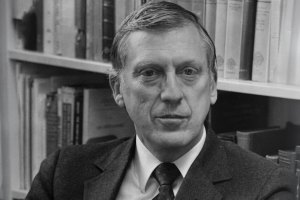

Roy Parviz Mottahedeh.
Harvard file photo
At a meeting of the Faculty of Arts and Sciences on Dec. 2, 2025, the following tribute to the life and service of the late Roy Parviz Mottahedeh was spread upon the permanent records of the Faculty.
Roy Parviz Mottahedeh, Gurney Professor of History, Emeritus, passed away on July 30, 2024, after a distinguished career of teaching and service at Harvard University. He was a towering figure as a historian, medievalist, and student of Islamic societies.
While Mottahedeh spent only the first 14 years of his life in New York, where he was born in 1940, he always considered himself “essentially a New Yorker” and Central Park “still the best place for a walk.” His family background in the Bahá’í faith and his early education in Quaker schools made him particularly sensitive to different approaches to religion in multicultural societies. Regular weekend visits to the Metropolitan Museum of Art with his parents, renowned collectors of “Oriental” porcelain, enabled him to spend much time in the Near East rooms there.
Mottahedeh received his first college degree from Harvard, where he wrote his honors thesis on a medieval Iranian intellectual under the guidance of his revered teacher Sir Hamilton Gibb, before graduating magna cum laude in 1960. Granted a Harvard fellowship to travel for a year, he chose to spend much of it in Persian-speaking Afghanistan, since he could not obtain a visa for Iran. He then studied Arabic and Persian for his second degree at the University of Cambridge, England, before returning to Harvard as a graduate student.
Reflecting on his career decades later, Mottahedeh wrote: “For anyone like me of Iranian background, the problem of sectarianism and the occasional rejection of pluralism seems a central issue in the history of the Islamic Middle East. Consequently, in my research I was attracted to the history of the 10th and 11th centuries partly because it was a period of greater toleration in religious matters in the Middle East.”
Always a man of his own times, Mottahedeh added: “I still dearly hope for growing acceptance in the Middle East of the variety of belief and advocacy that has been so important to the societies in which it exists.”
Mottahedeh knew well that scholarship is not a matter of belief and advocacy, of pieties and “good” politics. Whatever one’s sources of concern and inspiration, they had to be cultivated with deep study and critical thinking. Deep study entailed an approach toward languages that was expected to go far beyond functional acquisition and proficiency since there is no substitute for reading the primary source texts through in their original language, be they medieval or modern sources, with their distinct registers.
Mottahedeh was widely renowned for his remarkable range across Arabic and Persian history and texts. Endowed with a gifted touch in interpreting texts in their historical context, he was a virtuoso in using them to illuminate that very context. Those of us who had the good fortune of co-teaching with him — he was always generous toward his younger colleagues in that regard — learned a good deal from his rigorous yet gentle pedagogy.
Starting his teaching career in 1970 at Princeton, Mottahedeh quickly developed a reputation as a mentor whose love of teaching and dedication to his students were exemplary. During his 16 years there, Mottahedeh achieved the highest levels of recognition in the academic world. His first book, “Loyalty and Leadership in an Early Islamic Society,” led to his Guggenheim Fellowship and his inclusion in the first cohort of MacArthur Fellows in 1981. A masterpiece of the historian’s craft, the book examined medieval Islamic social structures through the categories of thought that prevailed in the medieval Muslim societies, rather than imposing categories like ethnicity, nation, or class as we now understand them.
Mottahedeh returned to Harvard at a turbulent moment for the Center for Middle Eastern Studies (CMES), which had been shaken by the use of undisclosed funds from the CIA for a CMES-sponsored conference. As the new director of CMES, Mottahedeh re-oriented its vision. The new CMES was to be rooted in the rigorous disciplines of the social and human sciences and centered around history, rather than area studies of the type that proliferated during the Cold War era. It was this vision that restored universal respectability to Middle East studies at Harvard and soon attracted the best and the brightest of young minds for graduate work. At Harvard, Mottahedeh also turned out to be an exceptionally successful institution builder, in collaboration with like-minded colleagues. His legacy includes his initiatives in or contribution toward the creation of numerous positions: Ottoman and modern Middle Eastern history; the Alwaleed Islamic Studies Program; and the Shawwaf visiting professorship for supplemental teaching in Islamic and Arabic studies. He also attracted new funds and teachers to build the Arabic and Turkish language programs and raised support for advanced study of Persian sources.
Much of this achievement was due to Mottahedeh’s unequalled standing as an intellectual. For almost every article of his on the medieval Islamic world, the word “seminal” rings true and has been used repeatedly. Mottahedeh also intervened in contemporary debates at times, such as in his landmark critique of Samuel Huntington’s “clash of civilizations” thesis.
Among Mottahedeh’s books, “The Mantle of the Prophet” is widely recognized as a masterly, ground-breaking contribution to the broader republic of letters and public culture ever since it was published in 1985. Written in Mottahedeh’s trademark prose of inimitable simplicity that subtly masked his prodigious learning, the Mantle wove strands from two millennia of Iranian history into a thoroughly enlightening look at contemporary Iran — precisely what the public needed after the Islamic revolution there.
All who counted themselves among Mottahedeh’s colleagues, students, and friends knew that he was in a league of his own, yet this was not the most remarkable thing; it was rather how Mottahedeh carried that standing with inexhaustible reserves of generosity, as well as with intellectual and personal elegance. It is one thing to be brilliant, yet another to be brilliant with grace and graciousness, which is how he will be remembered.
Mottahedeh is survived by his wife, Patricia Erhart Mottahedeh, two sons, and two grandchildren.
Respectfully submitted,
William Graham Jr.
William Granara
Charles Maier
Intisar Rabb
Cemal Kafadar, Chair
Portions of this Minute were previously published: Richard W. Bulliet, “Roy P. Mottahedeh (1940–2024),” Journal of Persianate Studies 17, No. 1-2 (2024): 195–200, https://doi.org/10.1163/18747167-bja10050 [accessed Nov. 18, 2025].