Featured series
Nation & World
Hope for imminent Russia-Ukraine peace is out of touch with reality, expert says
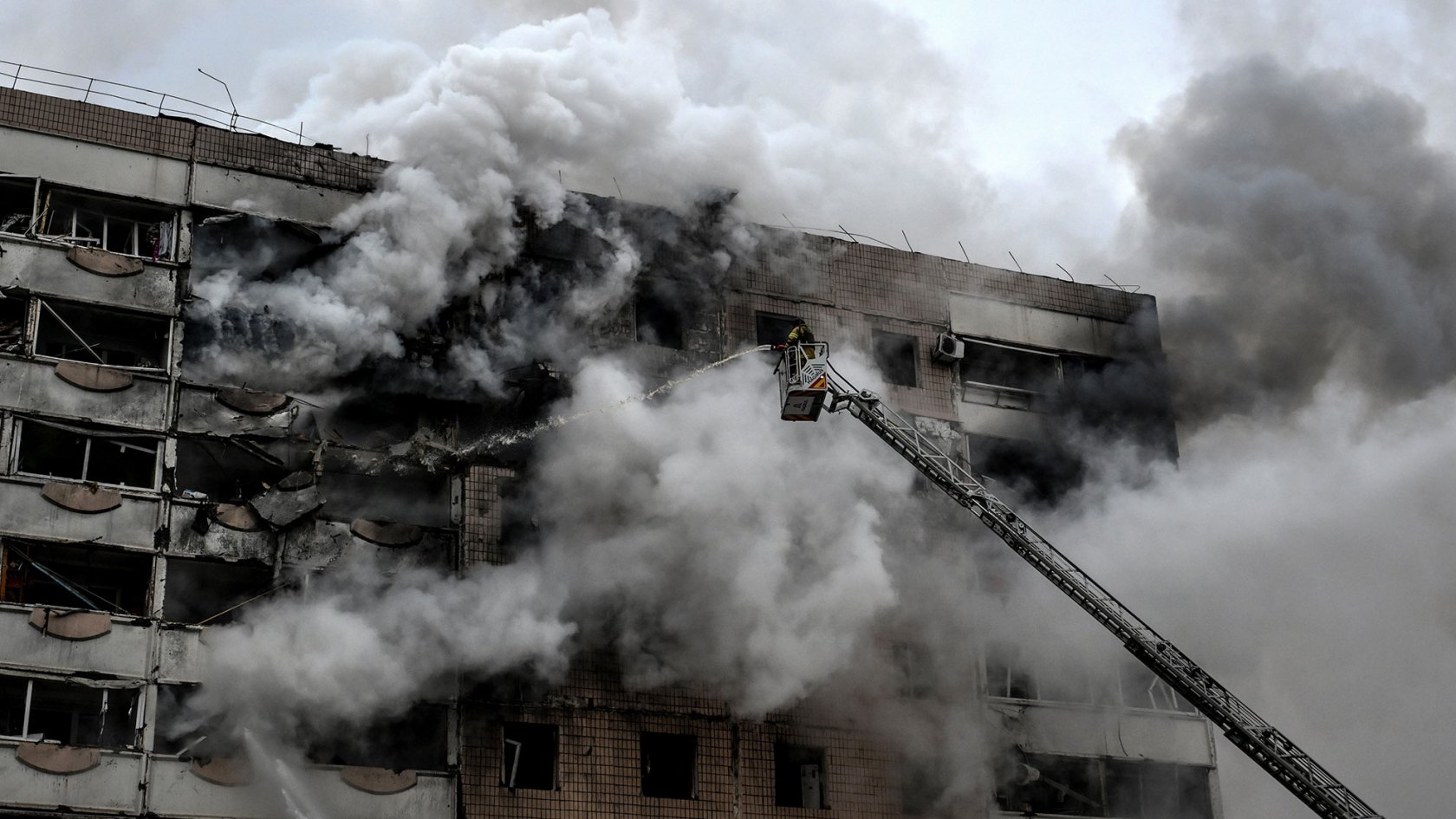
A fire in an apartment block hit by a Russian guided aerial bomb in Zaporizhzhia, Ukraine.
Dmytro Smolienko/Ukrinform/NurPhoto via AP
‘Fundamental conflict is as big today as the day the war started’
In the eyes of some, an end to the Russia-Ukraine war may be closer than ever. Officials from the U.S., Ukraine, and the European Union met this week in Berlin and came away from the talks sounding optimistic about a reaching a deal, in part because Ukraine has reportedly backed off its long-held ambition to join NATO, a concession Russia has long sought. In exchange, Ukraine would receive what’s described as a “NATO-like” security guarantee, though specifics remain vague and Russia, absent from the talks, has not signaled its approval.
Ivo Daalder does not expect a breakthrough any time soon.
In this edited interview, Daalder, who served as the U.S. ambassador to NATO from 2009 to 2013 and is now a senior fellow at the Belfer Center at Harvard Kennedy School, outlines key tensions between Russia and Ukraine and explains why he’s skeptical that these latest negotiations, however productive, will culminate in a ceasefire in the coming weeks.
The president of the European Commission praised the talks as cooperative, saying that the parties had made “real and concrete progress.” Do you see signs of real progress on a deal?
I see signs of closer alignment between Ukraine and Europe on the one hand and the United States on the other hand. But I don’t see that as progress toward ending the war, because the fundamental problem isn’t an alignment between Ukraine, Europe, and the United States; it’s an alignment between Ukraine and Russia. And that alignment is as far away today as it has been in any time in the last four years. So yes, there’s progress on one side, which is important, but there’s no progress getting to an end of the war.
Russia and Ukraine have fundamentally opposite goals. Russia wants to subjugate Ukraine — control its future from Moscow. It wants to deny its sovereignty and independence, as well as take chunks of its territory. And Ukraine wants to be a sovereign country that has control over all its territory. That’s what this war is about. The war is not about whether the United States and Europe and Ukraine can agree. The war is about who decides the future of sovereignty of Ukraine — is it Ukraine or Russia? And that fundamental conflict is as big today as the day the war started.
What do you make of President Zelensky’s willingness to set aside Ukraine’s hope to join NATO, at least for now, in exchange for a security guarantee?
I think it’s a good-faith effort, but he also realizes two things: that making concessions to the United States isn’t about getting to a peace deal, it’s about demonstrating to the United States that Ukraine is not at fault. That’s No. 1. No. 2, saying that Ukraine is not going to be joining NATO anytime soon, is just reality because the United States is opposed. The decision on whether Ukraine joins NATO is not Moscow’s — but it’s not Kyiv’s either. It is the decision of NATO’s 32 member states, one of whom happens to be the United States.
Control of the Donbas region remains a sticking point. Do you see any scenario in which Ukraine or Russia might compromise on this point?
Not at present. Sometime in the future, when one or both sides have decided that a negotiated peace that includes some territorial concessions is preferable to continuation of the war, you might get there. But today, you’re nowhere near that.
What’s the best potential outcome for Ukraine? What’s realistic?
The best outcome is a ceasefire along the current line that is monitored by international capabilities, whether that’s the U.S. or others, with a commitment from the United States and Europe to back Ukraine’s sovereignty up to and through the ceasefire line, and that commitment made conditional on Ukraine not trying to change the status quo through the use of force. So that’s the best they can hope.
How likely is that?
Ukraine is prepared to do that today, so it really depends on Russia. The question is, at what point does the cost of continuing the conflict to Russia outweigh the benefit of stopping? Today, they believe they’re winning and are economically still capable of producing the equipment and paying for the manpower to continue the fight. It’s only when you run out of people or the cost of getting people to the front is too high and/or imports to equip their forces become too high. The likelihood of that happening sometime in 2026 or early 2027 is high if the United States continues to put pressure on the oil sector, which has had a significant impact on Russian revenue streams. The goal for Ukraine and the Europeans is to convince President Trump that this entire problem is made and continued by Russia, and that the only way to get the solution he wants is to pressure Russia. That’s the goal. It’s not to get to a peace agreement because they don’t believe there’s a peace agreement today. Down the line, yes, but not now.