First, male gets heated up, then female, and then, you know
Study shows infrared radiation from plants serves as invitation to pollinating insects
Kermit Pattison
Harvard Staff Writer
7 min read
Brace yourself for a hot story about plant sex.
Harvard researchers have discovered that cycads — an ancient lineage of seed plants — heat their reproductive organs to attract beetle pollinators, which in turn evolved specialized infrared sensors. First male cycads warm their pollen cones to entice beetles, and then the female plants heat up, drawing the insects over and thereby transferring the genetic material to fertilize the seeds.
The new study, published Thursday in a cover story in Science, shows that infrared radiation is a pollination signal, one far older than the vivid colors that later became dominant among flowering plants.
“This is basically adding a new dimension of information that plants and animals are using to communicate that we didn’t know much about before.”
Wendy Valencia-Montoya
“This is basically adding a new dimension of information that plants and animals are using to communicate that we didn’t know much about before,” said lead author Wendy Valencia-Montoya, Ph.D. ’25, a junior fellow in the Harvard Society of Fellows. “We knew of scent, and we knew of color, but we didn’t know that infrared could act as a pollination signal.”
In fact, heat may be one of the most ancient modes of communication between animals and plants, even predating the dinosaurs.
“Long before petals and perfume,” said Valencia-Montoya, “plants and beetles found each other by feeling the warmth.”
The findings shed new light on the ancient alliance between plants and pollinators and culminates a scientific quest that stretched more than a dozen years since Valencia-Montoya began studying cycads as an undergraduate in Colombia.
It has long been known that many plant species warm their pollination cones or flowers by cranking up their metabolism.
“But everyone assumed that the heat was mostly just to help volatilizing scents,” said Valencia-Montoya, who found it puzzling that plants would invest so much energy in heat production.
After coming to Harvard for her Ph.D., she planned to continue research on cycads in South America but was forced to adjust her plans during the pandemic. Instead, she conducted most of her research at Montgomery Botanical Center in Florida.
Her work was supervised by Professor Nicholas Bellono of Molecular and Cellular Biology and Naomi Pierce, Hessel Professor of Biology in the Department of Organismic and Evolutionary Biology and the Museum of Comparative Zoology (both co-authors on the new paper).
As the oldest known seed plants pollinated by animals, cycads are sometimes called “living fossils” and have long aroused fascination among biologists. The plants have stout trunks and crowns of featherlike leaves and resemble palms and ferns but are not closely related to either.
Cycads appeared around 275 million years ago and reached their peak diversity around 150 million years ago during the Jurassic period. They were largely displaced by the rise of flowering plants, which became the dominant group in the last 70 million years.
Today about 300 cycad species remain, most of them listed as endangered.
Cycads are so-called dioecious plants because they have male and female individuals distinguished by their reproductive cones. Male cones produce pollen, and female cones bear ovules that, if fertilized, develop into seeds.
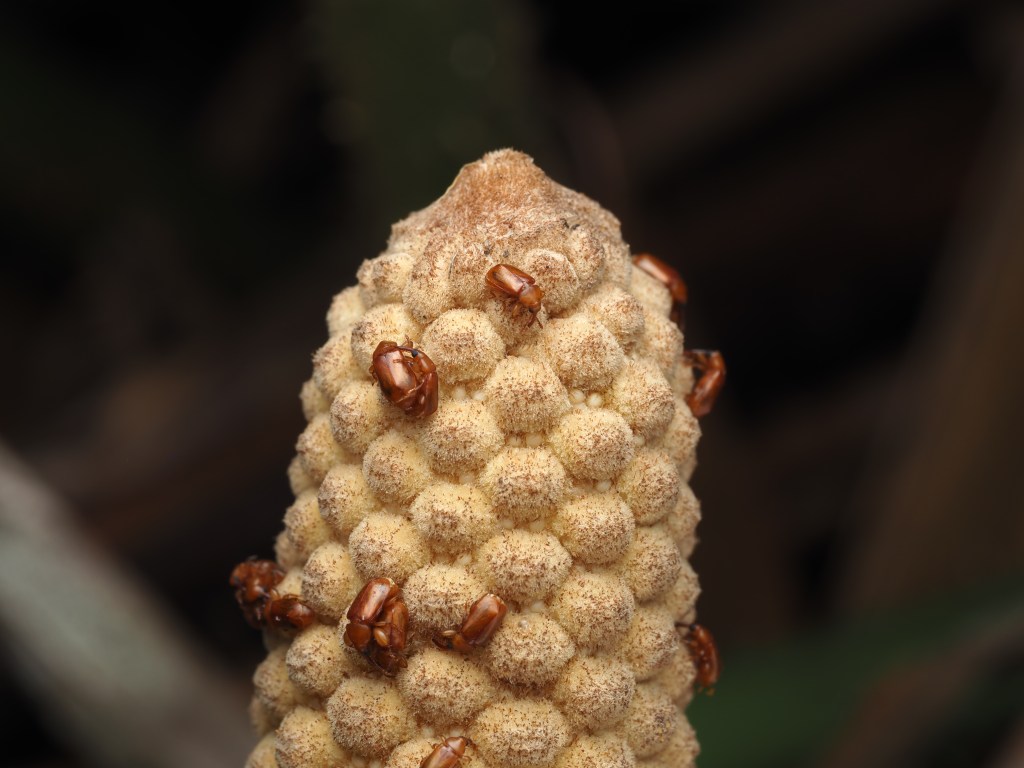
Beetles of the species Rhopalotria furfuracea on a male cone of the cycad Zamia furfuracea.
Photo by Michael Calonje
In the new study, Valencia-Montoya and her colleagues focused on Zamia furfuracea, a 4-foot-tall cycad native to Mexico commonly called “cardboard palm.” Like every cycad, it has an exclusive symbiotic relationship with its own pollinating beetle species — Rhopalotria furfuracea, a small, long-snouted brown weevil.
In a push-pull pollination relationship, cycads use a combination of signals including heat, odor, and humidity to attract beetles to feed on pollen in the male cones. At a certain point, these signals become so overwhelming the beetles are driven away from the male plants and toward the female ovulate cones.
“It’s sort of like a guy who puts on cologne to go out on a date. A little bit can be a nice thing, but too much becomes repulsive.
Naomi E. Pierce
“It’s sort of like a guy who puts on cologne to go out on a date,” explained Pierce. “A little bit can be a nice thing, but too much becomes repulsive.” By migrating between plants, the beetles transmit male pollen and fertilize the seeds in the female plants.
But how did heat factor in this ancient relationship?
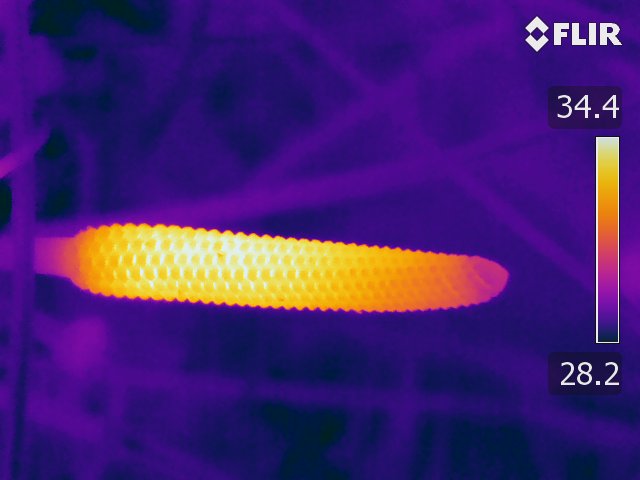
Valencia-Montoya and her colleagues took thermal images and found that cycad heat production focused on the cones. The parts bearing the reproductive organs, the sporophylls, contained high concentrations of energy-producing mitochondria. Zamia furfuracea could heat its cones 46 degrees Fahrenheit above the ambient air temperature, but other cycads could get even hotter.
The researchers examined 17 cycad species and discovered that all followed a circadian pattern at the end of the day, with male cones heating and then cooling, and female cones warming three hours later.
Next Valencia-Montoya and her colleagues tracked movements of the beetle pollinators by marking them with ultraviolet fluorescent dyes and watching at night as they moved between plants in an open field.
The beetles were attracted to the warmest parts of the cones — first the males, then the females.
“This was one of the early compelling pieces of evidence that this is probably related to pollination,” said Bellono. “Male and female plants were actually heating in a circadian-controlled manner — and we could see it locks with the beetle movement.”
“Male and female plants were actually heating in a circadian-controlled manner — and we could see it locks with the beetle movement.”
Nicholas Bellono
Next the researchers investigated the pollinators: How did beetles sense the heat?
In insects, the main sensory organs are the sensilla, the hairlike structures on the antenna. Using techniques such as electron microscopy, electrophysiology, and transcripts of genes expressed in the cells, the researchers discovered that beetle antenna tips have specialized thermosensitive organs packed with heat-sensing neurons.
One key molecular sensor was the protein TRPA1, which is also employed by snakes and mosquitoes to sense warm-blooded prey.
These organs were calibrated to the specific heating temperature of the cycad. Researchers examined another beetle species and discovered it too had sensation range fine-tuned to the specific heating temperature of its own cycad host.
The researchers believe that heat generation evolved near the origins of the cycads some 275 million years ago and might be among the oldest known pollination signals.
Thermal image of a male cone of the cycad Zamia furfuracea during pollen release.
Photo by Wendy Valencia-Montoya
Until now, push-pull pollination was believed to be mainly driven by scent. The new study suggests that this relationship probably also was hot from the start.
Heat-producing plants tend to be from ancient lineages (cycads account for about half of them). But producing heat is metabolically expensive so it likely became involved in an evolutionary trade-off with other pollination signals.
In the grand scheme of plant evolution, the importance of heat waned and color rose. Eventually, the drab-colored cycads were outcompeted by the explosive radiation of colorful flowering plants — and their pollinators, such as bees and butterflies, evolved keener visual senses.
The fact that the infrared signal had remained unrecognized for so long probably reflects our own sensory bias.
“All the sensory cues that have been recognized very fast are the ones that we can perceive ourselves,” said Valencia-Montoya. “But the ones that are hidden are just as important.”
This research was funded in part by the National Institutes of Health.

 Featured series