Featured series


Tag: Steve Bradt
-
Health
Speeding up biomolecular evolution
Scientists at Harvard University have harnessed the prowess of fast-replicating bacterial viruses, also known as phages, to accelerate the evolution of biomolecules in the laboratory.

-
Health
Designing gene
Taking advantage of the simple color pattern of deer mice, Harvard researchers showed that small changes in the activity of a single pigmentation gene in embryos generate big differences in adult color pattern.

-
Science & Tech
Light touch
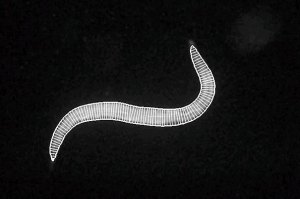
Physicists and bioengineers have developed an optical instrument allowing them to control the behavior of a worm just by shining a tightly focused beam of light at individual neurons inside the organism.
-
Health
The face looks familiar
People’s ability to recognize and remember faces peaks at ages 30 to 34, about a decade later than most other mental abilities, a new study says.

-
Health
Female chimps treat sticks as dolls
Researchers at Harvard University and Bates College say female chimpanzees appear to treat sticks as dolls, carrying them around until they have offspring of their own. Young males engage in such behavior much less frequently.

-
Science & Tech
‘One-drop rule’ persists
Harvard psychologists have found that the centuries-old “one-drop rule” assigning minority status to mixed-race individuals appears to live on in our modern-day perception and categorization of people like Barack Obama, Tiger Woods, and Halle Berry.

-
Health
Wandering mind not a happy mind
People spend 46.9 percent of their waking hours thinking about something other than what they’re doing, and this mind wandering typically makes them unhappy, according to research by Harvard psychologists Matthew A. Killingsworth and Daniel T. Gilbert.

-
Health
Obesity rate will reach at least 42%
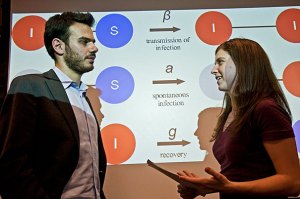
Researchers at Harvard University say America’s obesity epidemic won’t plateau until at least 42 percent of adults are obese, an estimate derived by applying mathematical modeling to 40 years of Framingham Heart Study data.
-
Science & Tech
Race plays minor role in Facebook friendships
Race may not be as important as previously thought in determining who befriends whom, suggests a study of Facebook habits by sociologists from Harvard and UCLA.

-
Health
I’ll get mine, Jack
A new paper suggests that the mutually beneficial relationships that species create are maintained mostly because of simple self-interest.