
 Featured series
Tag: George Whitesides
-
Nation & World
A bit of chemistry, a bit of rock ’n’ roll
Nobel laureate Carolyn Bertozzi ’88 demonstrated talent for science, creativity even as a Harvard undergrad.

-
Nation & World
Future sound of a Beatles playlist: drip, drip, drip
In a new paper, Harvard chemists describe a data-storage method that uses mixtures of seven fluorescent dyes to save files.
-
Nation & World
Faster testing for illicit drugs
The landscape of the illegal drug trade changes constantly, particularly amid the current opioid crisis. Law-enforcement officers regularly find or confiscate pills, powders, and other substances and need to know…
-
Nation & World
Soft robots for all
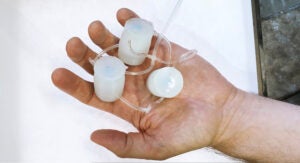
The first soft ring oscillator gets plushy robots to roll, undulate, sort, meter liquids, and swallow.
-
Nation & World
A soft touch
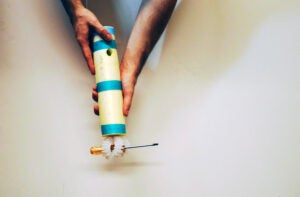
A new rubber computer combines the feel of a human hand with the thought process of a traditional computer, replacing the last hard components in soft robots. Now, soft robotics can travel where metals and electronics cannot — high-radiation disaster areas, outer space, and deep underwater — and turn invisible to the naked eye or…
-
Nation & World
Replacing hard parts in soft robots
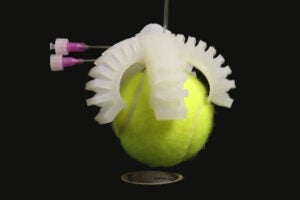
Harvard scientists have created a soft valve that could replace “hard” valves and lead to the creation of entirely soft robots. The valve’s structure can also be used to produce unique, oscillatory behavior.
-
Nation & World
Onward and upward, robots
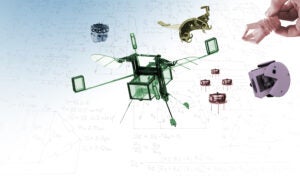
The first article in a series on cutting-edge research at Harvard explores advances in robotics.
-
Nation & World
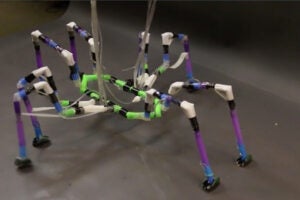
From drinking straws to robots
Inspired by arthropod insects and spiders, scientists George Whitesides and Alex Nemiroski have created a type of semi-soft robot capable of walking, using drinking straws, and inflatable tubing. The team was even able to create a robotic water strider capable of pushing itself along the water’s surface.
-
Nation & World
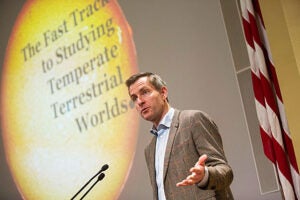
Understanding life, here, there, and everywhere
Harvard’s Origins of Life Initiative has grown along with the rise in interest in how life first arose on Earth and whether it exists on other planets.
-
Nation & World
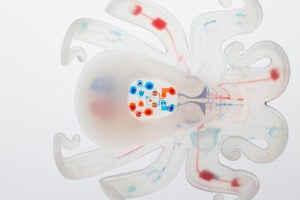
The first autonomous, entirely soft robot
Developed by a team of Harvard researchers, the first autonomous, entirely soft robot is powered by a chemical reaction controlled by microfluidics. The 3-D-printed “octobot” has no electronics.
-
Nation & World
Advancing ingenuity
Between academic discovery and product development lurks a lull in research funding that inventors call the “chasm of death,” where a prototype or a proof of concept can feel just…
-
Nation & World
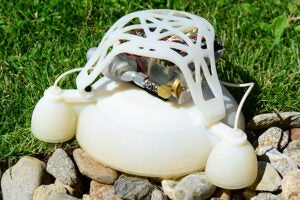
And now, the hopping robot
Harvard-designed robot transitions from soft to hard, reducing the stress where the rigid electronic components join the body.
-
Nation & World
When flames attack
Harvard researchers were able to predict when test flames in the lab were likely to switch from slow- to fast-moving fires, which could open the way to making similar predictions for forest fires.

-
Nation & World
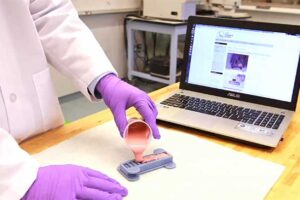
Build your own bot
A new resource provides both experienced and aspiring researchers with the intellectual raw materials needed to design, build, and operate robots made from soft, flexible materials.
-
Nation & World
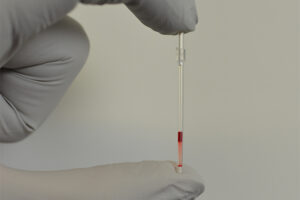
From chance meeting, a chance to save lives
Harvard scientists have developed a new test for sickle cell disease that provides results in just 12 minutes and costs as little as 50 cents — far faster and cheaper than other tests.
-
Nation & World
Cheap and compact medical testing
Harvard researchers have devised an inexpensive medical detector that costs a fraction of the price of existing devices, and can be used in poor settings around the world.

-
Nation & World
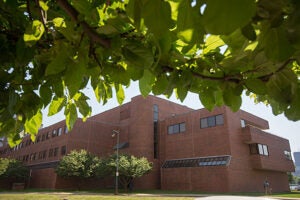
Energy research wins grant
Harvard chemist Cynthia Friend has been awarded a major center grant from the U.S. Department of Energy’s Basic Energy Sciences’ Energy Frontier Research Centers program, which is designed “to accelerate the scientific breakthroughs needed to build the 21st-century energy economy.”
-
Nation & World
Robots with lift
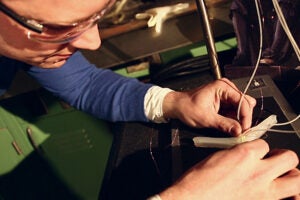
Using small explosions produced by a mix of methane and oxygen, researchers at Harvard have designed a soft robot that can leap as much as a foot in the air. That ability to jump could one day prove critical in allowing the robots to avoid obstacles during search and rescue operations.
-
Nation & World
Sophisticated worms
In a new study of worm locomotion, researchers show that a single type of motor neuron drives an entire sensorimotor loop.

-
Nation & World
Soft Robots, in color
Having already broken new ground in robotics with the development, last year, of a class of “soft”, silicone-based robots based on creatures like squid and octopi, Harvard scientists are now working to create systems that would allow the robots to camouflage themselves, or stand out in their environment.
-
Nation & World
Smart suit improves physical endurance
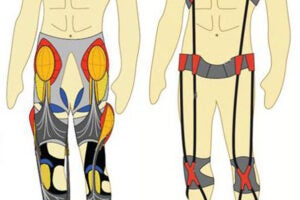
Harvard’s Wyss Institute for Biologically Inspired Engineering announced that it has received a $2.6 million contract from the Defense Advanced Research Projects Agency (DARPA) to develop a smart suit that helps improve physical endurance for soldiers in the field.
-
Nation & World
Changing the world, in under 9 minutes
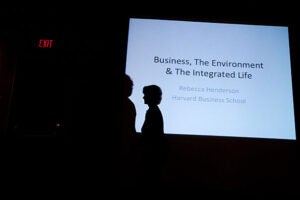
The inaugural event “One Harvard: Lectures that Last” featured short talks by a dozen speakers representing Harvard’s graduate and professional Schools. The session was designed to reveal the crosscurrents of innovation that can flow from discipline to discipline, and to expose students to fresh ideas.
-
Nation & World
Incubator of Innovation – Innovation at Harvard
Medicine, business, politics….You never know where the spark of innovation may originate at Harvard.
-
Nation & World
Soft-bots
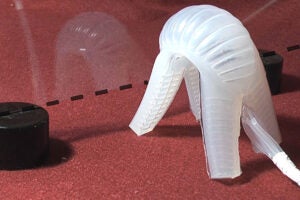
Harvard Professor George Whitesides and his research team have developed an array of “soft” robots based on natural forms, including squids and starfish, that may one day be used to aid disaster recovery efforts by squeezing into the rubble left by an earthquake to locate survivors, or as a way to free up a surgeon’s…
-
Nation & World
Innovate, create
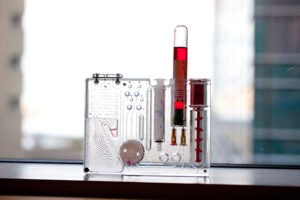
From oddities like breathable chocolate to history-making devices with profound societal effects, like the heart pacemaker, Harvard’s combination of questing minds, restless spirits, and intellectual seekers fosters creativity and innovation that’s finding an outlet in new inventions and companies.
-
Nation & World
It’s the ‘lab-on-a-chip’ model
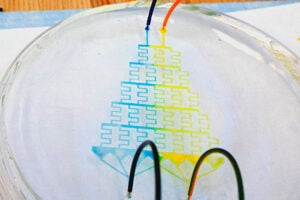
With little more than a conventional photocopier and transparency film, anyone can build a functional microfluidic chip.
-
Nation & World
Living, breathing human lung-on-a-chip
Researchers at Harvard’s Wyss Institute for Biologically Inspired Engineering have created a device that mimics a living, breathing human lung on a microchip. The device, about the size of a rubber eraser, acts much like a lung in a human body and is made using human lung and blood vessel cells.
-
Nation & World
Gates on giving, getting, sharing
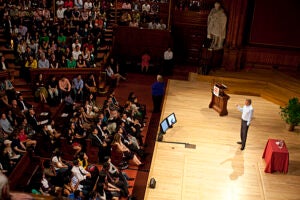
In a visit to Harvard, Microsoft’s Gates says that top minds need to focus on critical social problems — to find solutions.
-
Nation & World
Bringing new meaning to the term scientific paper
An insight from the labs of Harvard chemist George M. Whitesides and cell biologist Donald Ingber is likely to make a fundamental shift in how biologists grow and study cells…
-
Nation & World
Taking a stride toward synthetic life
Harvard scientists have cleared a key hurdle in the creation of synthetic life, assembling a cell’s critical protein-making machinery in an advance with both practical, industrial applications and that advances…