Featured series

Tag: Genome
-
Nation & World
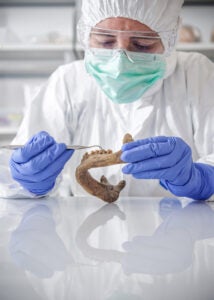
Bringing Stone Age genomic material back to life
Scientific breakthroughs will enable exploration of Earth’s biochemical past, with hopes of discovering new therapeutic molecules.
-
Nation & World
DNA shows poorly understood empire was multiethnic with strong female leadership
Biomolecular archaeology reveals a fuller picture of the Xiongnu people, the world’s first nomadic empire.

-
Nation & World
Tracing history of early seafarers through genes
New genetic research shows untold migration to remote Pacific islands was generally matrilocal.

-
Nation & World
Geneticists’ new research on ancient Britain contains insights on language, ancestry, kinship, milk
Two new studies highlight technological advances in large-scale genomics and open windows into the lives of ancient people.
-
Nation & World
A Rosetta Stone of biology
Harvard researcher develops program to read any genome sequence and decipher its genetic code.

-
Nation & World
Innovative tool offers hope for children with rapid-aging disease
Several hundred children worldwide live with progeria, a deadly premature aging disease.
-
Nation & World
A promise to a friend
Wei Hsi “Ariel” Yeh dedicated her research in chemistry to solving some of the vast genetic mysteries behind hearing loss.

-
Nation & World
A crisper CRISPR
Fewer off-target edits and greater targeting scope bring gene editing technology closer to treating human diseases.

-
Nation & World
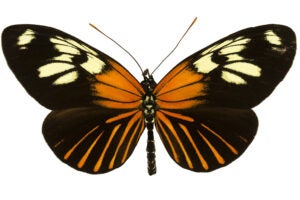
A clue to biodiversity?
An analysis of 20 butterfly genomes found evidence that many butterfly species — including distantly related species — show a surprisingly high amount of gene flow between them, Harvard researchers found.
-
Nation & World
Early birds may be happier than night owls
A new study finds that being genetically programmed to rise early may lead to greater well-being and a lower risk of schizophrenia and depression.

-
Nation & World
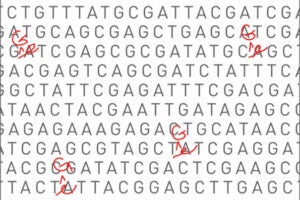
A step forward in DNA base editing
Scientists at Harvard University and the Broad Institute have developed a new class of DNA base editor that can repair the type of mutations that account for half of human disease-associated point mutations. These single-letter mutations are associated with disorders ranging from genetic blindness to sickle-cell anemia to metabolic disorders to cystic fibrosis.
-
Nation & World
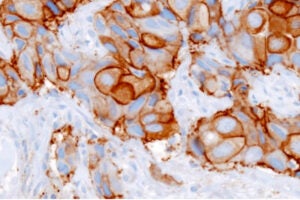
First draft of a genome-wide cancer ‘dependency map’
Researchers have identified more than 760 genes upon which cancer cells of multiple types are strongly dependent for their growth and survival.
-
Nation & World
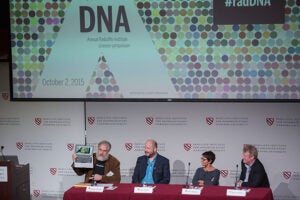
History as mosh pit
Today’s discoveries in DNA technology are as exciting as another era’s moon missions, opening avenues of scientific inquiry and invigorating even longstanding fields, speakers at a Radcliffe science symposium on DNA said.
-
Nation & World
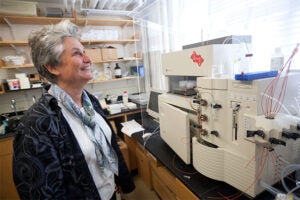
Expanding the brain
New findings reveal how genomic imprinting can dramatically expand biological diversity, and could have important implications for understanding the brain.
-
Nation & World
Improved accuracy in genome editing
A team of scientists has engineered a form of the genome-editing protein Cas9 that can be controlled by a small molecule and offers improved DNA specificity.

-
Nation & World
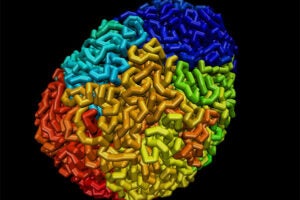
Creating ‘genomic origami’
Researchers have assembled the first high-resolution, 3-D maps of entire folded genomes and found a structural basis for gene regulation, a kind of “genomic origami” that allows the same genome to produce different types of cells.
-
Nation & World
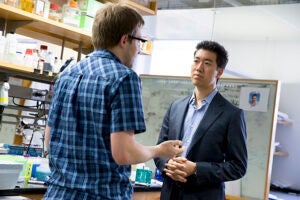
Toward genetic editing
Led by David Liu, professor of chemistry and chemical biology, a team of Harvard researchers developed a system that uses commercially available molecules called cationic lipids to deliver genome-editing proteins into cells.
-
Nation & World
New evidence on Neanderthal mixing
New research illuminates the mixing with Neanderthals in early human prehistory, narrowing the window of time when they crossbred to between 50,000 and 60,000 years ago.
-
Nation & World
Diabetes’ genetic variety
Harvard researchers working at the Broad Institute of MIT and Harvard have uncovered nine rare genetic mutations that dramatically increase the risk of developing type 2 diabetes. The discovery of the mutations highlights the dizzying genetic diversity of a disease rapidly spreading around the world.
-
Nation & World
New test for Down syndrome
Experts in child health gathered at Harvard Medical School on Tuesday for a symposium on how genome biology is changing children’s health.

-
Nation & World
A foundation for future research
Harvard researchers recently developed the most detailed “specificity profile” for Cas9 — a “machine” made of protein and RNA that can be programmed to target specific DNA sequences and to precisely cut, paste, and turn on or turn off genes. Future researchers will use the data when developing genetic tools and therapies.

-
Nation & World
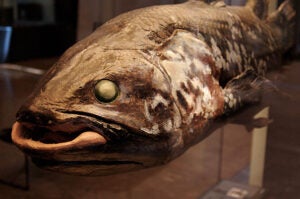
Coelacanth genome surfaces
An international team of researchers has decoded the genome of a creature whose evolutionary history is both enigmatic and illuminating: the African coelacanth
-
Nation & World
One cell is all you need
Scientists at Harvard have pioneered a breakthrough technique that can reproduce an individual’s entire genome from a single cell. The development could revolutionize everything from cancer treatment, by allowing doctors to obtain a genetic fingerprint of a person’s cancer early in treatment, to prenatal testing.
-
Nation & World
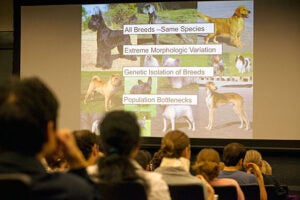
So doggone complicated
Geneticist Elaine Ostrander runs a comparative-genomics lab that examines dog DNA to understand better the traits that might aid understanding of human diseases.
-
Nation & World
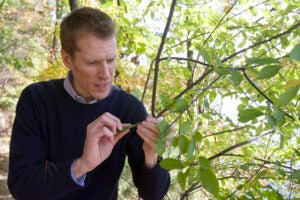
‘Stealing’ life’s building blocks
Researchers have found that a parasitic flower takes large portions of its genetic code from its host, and that some genes borrowed by the flowers may even be functional. The surprising finding suggests that the process may convey some evolutionary advantage to the flowers.
-
Nation & World
A boost to international learning
Eight faculty led programs designed to give students international experience have received grants from the President’s Innovation Fund for International Experiences.
-
Nation & World
Vivid details
A landmark effort to sequence the genome of the butterfly Heliconius melpomene has revealed that it shares genes that control color patterns with two species that closely mimic its appearance — Heliconius timareta and Heliconius elevatus — suggesting that all three exchange genes as a result of occasional hybridization.

-
Nation & World
The whys of religion vs. evolution
University of Chicago evolutionary biologist Jerry Coyne says that dysfunction within American society promotes high levels of religious belief that in turn blocks general acceptance of evolutionary theories.

-
Nation & World
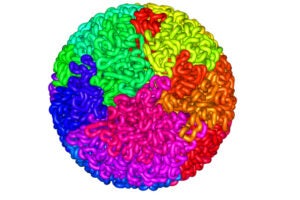
A new view of DNA
A new imaging technique, developed by Erez Lieberman-Aiden, a Junior Fellow of the Society of Fellows, is giving scientists their first three-dimensional view of the human genome, one that is already shedding new light on a number of what Liberman-Aiden calls the “central mysteries of biology.”
-
Nation & World
A data bank to battle cancer
Researchers at Brigham and Women’s Hospital and the Dana-Farber Cancer Institute are collaborating on a massive, long-term effort to collect and analyze tumor tissue from 10,000 cancer patients annually. The researchers hope the data will enable them to understand better how tumors behave, while providing opportunities to test new therapies.