107 stories tagged ‘Anthropology’
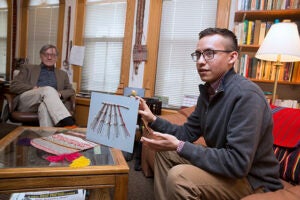
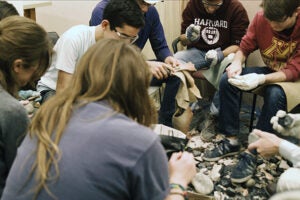
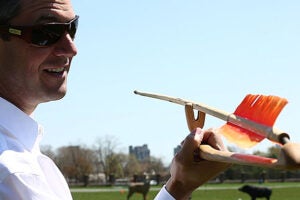
Students in Matthew Liebmann’s “Encountering the Conquistadors” class recently got a feel for prehistoric life, trying their hands at an ancient weapon called the atlatl.
Zongze Hu, who received his doctorate in anthropology from Harvard in 2009, has wasted little time fostering the discipline in his native China, establishing new graduate and undergraduate programs at Shandong University.
Mystery of Native Americans’ arrival
Research led by scientists at Harvard and University College London has shown that Native Americans arrived in three waves of migration, not one, as is commonly held and that at least one group returned home to Asia.
Images from long ago or far away
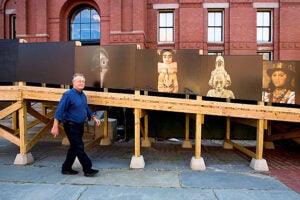
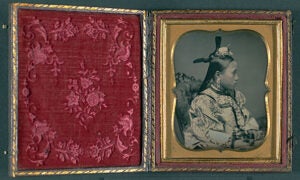
A new exhibition at the Peabody Museum of Archaeology and Ethnology traces the development of photography and its use in anthropology from the beginnings of both fields in the 1800s to the present.
Illuminating an unseen history
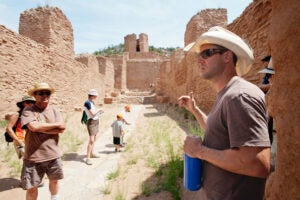
In his new book, “Revolt: An Archaeological History of Pueblo Resistance and Revitalization in 17th Century New Mexico,” Assistant Professor of Anthropology Matthew Liebmann offers a first-of-its-kind look at how the Pueblo people lived during their brief independence from Spain.
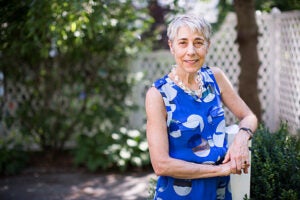
Susan Greenhalgh, a new professor in Harvard’s anthropology department, studies China’s controversial one-child policy, finding lessons for American health policymakers, too.
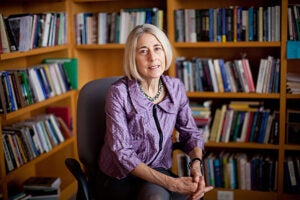
A research team at the Radcliffe Institute for Advanced Study is debunking myths surrounding the brutal practice of foot binding young women in China, tying it to handwork and weaving rather than marriage prospects.
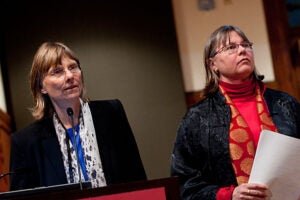
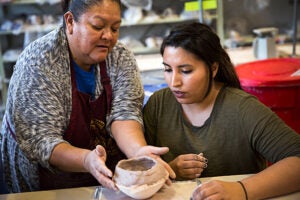
President Drew Faust paid a visit Nov. 17 to the popular undergraduate course anthropology 1010: "The Fundamentals of Archaeological Methods and Reasoning." Faust’s attendance was inspired by a special meeting of the course at the Harvard Ceramics Studio, where students learned how pottery is made, and got to try their hands at making their own pieces.
HDS professor receives funding from Battelle Memorial Institute
Laura Salah Nasrallah, professor of New Testament and early Christianity at Harvard Divinity School (HDS), has received funding from the Battelle Memorial Institute to organize a symposium. Scholars of diverse disciplinary training will meet for a symposium during the 2012-13 academic year to discuss the topic “How Bodies Matter: Religion, Archaeology, and Physical Anthropology in [...]
Harvard Foundation honors Kleinman, students
The Harvard Foundation honored Arthur Kleinman, Esther and Sidney Rabb Professor of Anthropology in the Faculty of Arts and Sciences and professor of medical anthropology and psychiatry at Harvard Medical School, on May 3 with its 2011 Distinguished Faculty Award at the annual Harvard Foundation Student/Faculty Awards Dinner in Quincy House.
Seemingly overnight, people in the Mideast and North Africa have risen in anger to demand more freedom. Is this the beginning of democracy in the Arab world, or a new era of political chaos? Harvard analysts offer insights on what is likely to come next.
The Moche of Ancient Peru: Media and Messages
Jeffrey Quilter, a senior lecturer on anthropology and deputy director for curatorial affairs and curator at Harvard’s Peabody Museum, introduces the Moche civilization and explores current thinking about Moche politics, history, society, and religion.
A lifelong love of African art
The Peabody Museum’s Monni Adams, 90, continues to research and publish in her field, now focusing on African masks.
University of Macedonia honors Herzfeld
Michael Herzfeld, professor of anthropology and curator of European ethnology in the Peabody Museum at Harvard University, will receive an honorary doctorate from the University of Macedonia on Nov. 24.
Female chimps treat sticks as dolls
Researchers at Harvard University and Bates College say female chimpanzees appear to treat sticks as dolls, carrying them around until they have offspring of their own. Young males engage in such behavior much less frequently.
The art and technology of care giving — undervalued now — “cuts to the quick” of our humanity. Caring — for others, for ourselves, even for things and places — is at the core of our humanity. But how to cope with its demands in a medical setting was the subject of a two-panel conference, sponsored by the Mahindra Humanities Center at Harvard.
New Harvard lecture series, “Visible Language,” explores the origins of the written word across diverse ages and cultures, its origins marked by a “diverse oneness.”
FSC-Harvard fellows Paravel & Sniadecki win Locarno film awards
The Film Study Center is pleased to announce that FSC-Harvard fellows Verena Paravel and J.P. Sniadecki have been awarded the Pardo for Best First Feature and the Special CINÉ CINÉMA Jury Prize for their “vilm” (video-film) Foreign Parts at the 63rd annual Locarno Film Festival. Raised in North and West Africa and the South of [...]
Competing for a mate can shorten lifespan
“Love stinks!” the J. Geils band told the world in 1980, and while you can certainly argue whether or not this tender and ineffable spirit of affection has a downside, working hard to find it does. It may even shorten your life. A new study by Harvard researchers shows that ratios between males and females [...]
Marcus Briggs-Cloud believes native language is what connects communities. His time at the Divinity School has helped him strengthen that bridge.
Kedron Thomas awarded Newcombe Doctoral Dissertation Fellowship
The Woodrow Wilson Foundation recently announced Kedron Thomas, a Ph.D. candidate in anthropology in the Harvard Graduate School of Arts and Sciences, as one of 20 recipients of the Charlotte W. Newcombe Doctoral Dissertation Fellowship for the 2010-11 academic year.
Neanderthal genome tells a human story
A preliminary draft of the genome of the Neanderthal, our closest evolutionary relative, reveals in exquisite detail how this long-extinct member of the Homo genus relates to modern humans.
What are the”Hard Problems” in the social sciences?
Just over a century ago, one of the world’s leading mathematicians posed this question to a number of his colleagues: What are the most important unsolved questions in mathematics? The answers – which David Hilbert then ranked in what he believed to be their order of importance – produced a list of 23 mathematical problems [...]
In 1900, renowned mathematician David Hilbert laid down a challenge to future generations: 23 handpicked mathematical problems, all difficult, all important, and all unsolved. Since then, countless mathematicians around the world have struggled to solve the 23 “Hilbert Problems.” To date, 10 have been fully solved, 11 are partly solved or simply cannot be solved, and two remain at large [...]
Women in life sciences still lag in compensation, advancement
Women conducting research in the life sciences continue to receive lower levels of compensation than their male counterparts, even at the upper levels of academic and professional accomplishment, according to a study conducted by the Mongan Institute for Health Policy at Massachusetts General Hospital. In their report in the April issue of Academic Medicine, the [...]
Husband-and-wife filmmakers chronicle a dying way of life and humanity with their new film “Sweetgrass.”
FAS professor learns in roundabout fashion that her book about the sexual abuse of Peruvian women has become an inspiration for an award-winning film.
Daycare workers and kindergarten teachers tend to offer young humans a lot of coaching about the idea of sharing. But for our ape cousins the bonobos, sharing just comes naturally.
Harvard biology professor Richard Wrangham talks about the importance of cooking in human origins.
‘Herskovits at the Heart of Blackness’
PBS will air “Herskovits at the Heart of Blackness,” a documentary that examines the towering influence of controversial anthropologist Melville Herskovits, on Feb. 2 at 10:30 p.m. as part of the series “Independent Lens.” Actress Maggie Gyllenhaal will host the program.
Julie Peters, the inaugural Byron and Anita Wien Professor, focuses on artistic cultural history, as well as the literary works themselves.
Digging Veritas 2009 – The Find
While digging up the Old Yard, Harvard students may have turned a corner in rediscovering the 17th century Indian College.
Anthropologist Hymes dies at 82
Dell H. Hymes, 82, an influential linguistic anthropologist and folklorist who taught at Harvard from 1955 to 1960, died in Charlottesville, Va., on Nov. 13.
What, exactly, distinguishes humans from apes? It’s certainly more than just our genes, renowned anthropologist Sarah Blaffer Hrdy. Hrdy, who received her A.B. in 1969 and Ph.D. in 1975 for work in Harvard’s Department of Anthropology, returned to speak on “Mothers and Others: The Origin of Emotionally Modern Humans.”
Radcliffe Fellow and anthropologist Heather Paxson is studying small artisanal cheese operations as “ecologies of production” that are both commercial and moral.
Conley translates this French anthropologist's spellbinding narrative on his love affair with film and how our memories closely connect to the cinematic. Here's lookin' at you, kids.
Human Documents: Eight Photographers
Media maestro Robert Gardner presents this stunning array of photographs, or, "human documents," which explore geography, culture, and our shared humanity through a universal visual language.
Study: Women more likely than men to reject unattractive babies
Women are more likely than men to reject unattractive-looking babies, according to a study by researchers at Harvard-affiliated McLean Hospital, possibly reflecting an evolutionary-derived need for diverting limited resources towards the nurturing of healthy offspring. The findings also challenge the idea of unconditional maternal love. “Our study shows how beauty can affect parental attitudes,” said [...]
More than ever, the Harvard Art Museum is making it easier for scholars and students to use its permanent collection (more than 250,000 works) to shed light on a variety of disciplines.
Peabody Museum receives grant to preserve maps, plans, and drawings
The Peabody Museum of Archaeology and Ethnology has been awarded a $150,000 grant from the U.S. Institute of Museum and Library Services (IMLS).
Nick Rizzo ’09: Have compassion, will travel
Nick Rizzo ’09 has been certain since the second grade that crimson is his color. The young sports fan from Kingston, Mass., used to travel to Boston with his father to cheer for Harvard in the annual Beanpot hockey tournament. When it came time for college applications, there was no question: early action to Harvard.
Invention of cooking drove evolution of the human species, new book argues
“You are what you eat.” Can these pithy words explain the evolution of the human species? Yes, says Richard Wrangham of Harvard University, who argues in a new book that the invention of cooking — even more than agriculture, the eating of meat, or the advent of tools — is what led to the rise [...]
New department reflects the evolution of human evolution
Earlier this month, the Faculty of Arts and Sciences (FAS) made official what scientists worldwide have known for years: Harvard is a hotbed of research and teaching in the field of human evolutionary biology — the study of why we’re the way we are. “As the first university to create a graduate program in what [...]
Human colonization of Australia and the Americas examined
A recent symposium about the prehistory of Australia and the Americas brought together scholars from 10,000 miles apart. But that’s nothing compared to the journey early humans made to populate Australia and the Americas tens of thousands of years ago.
Climate change an ‘opportunity’ as well as a threat
Conservation pioneer Russell A. Mittermeier started this year’s Roger Tory Peterson Memorial Lecture (April 5) with a quiz. In front of several hundred listeners at Harvard’s Science Center he turned on a small recorder.
Fijian girls succumb to Western dysmorphia
In 1982, Harvard Medical School psychiatrist Anne E. Becker was still an undergraduate at Radcliffe when she traveled to Fiji for a summer of anthropology fieldwork. What struck her about this South Pacific island nation — and has in many research trips since — was “the absolute preoccupation with food and eating,” she said. “Family and social life really revolve around food. … It’s all about food, all the time.”
In the ether of radio waves, indigenous talk finds its place
Amid the pop music countdowns, the nightly news, and the laugh-show programs, radio waves across the world crackle softly with the voices of indigenous peoples. Their stories — too often unheard — tell of struggles for recognition, enfranchisement, territory, and cultural preservation. For these communities, radio does far more than entertain.
When the Arts Task Force appointed by Harvard President Drew Faust issued its recommendations last December, one of its main suggestions was to incorporate the museums into a more central role in the University and to find innovative ways for arts and non-arts faculty to collaborate.
Watching evolution in real time
In 1831, the young Charles Darwin set off on the H.M.S. Beagle, a Royal Navy sloop bound for detailed surveys of South America. He took with him the first volume of the massive trilogy “Principles of Geology” by Scottish geologist Charles Lyell. (He had the other volumes sent later.)
When gentrification occurs in City of the Seven Hills
History and modernity collide in Monti, a neighborhood in Rome, and the local way of life is falling victim to the impact. Michael Herzfeld, professor of anthropology in the Faculty of Arts and Sciences, explores the changing landscape of this ancient neighborhood in a new ethnography about this district within Italy’s capital city.
Fair, 64° F